PART 1
I balanced our household checkbook on the kitchen table on the first Sunday of every month for thirty-six years.
My husband, Warren, worked thirty years as an estimator for a commercial asphalt company, and I worked thirty-four years in the administrative office of the township school district. We had an ironclad system. Warren handed over his pay stubs, I logged the mortgage, the groceries, the heating fuel, and the property taxes, and every surplus dollar went into our mutual fund.
In thirty-six years, our joint ledger had never been off by more than forty cents.
Last Tuesday evening, a digit on our monthly bank statement did not add up.
I was sitting with my yellow pencil and my calculator, cross-referencing our utility payments against the credit union statement, when my eye caught an outgoing electronic debit I had never seen before.
It was an automatic scheduled transfer for exactly $800. It had cleared on the fifteenth of the month. The transaction line read: *ACH WDL TO ACCT #8841.*
I pulled the previous month’s statement from the accordion file under the desk. There it was again. The fifteenth of August: $800.
I went down to the basement, pulled the metal filing cabinet drawers open, and started pulling folders. I laid our tax returns and banking records across the ping-pong table under the bare fluorescent bulb.
The same transfer was there in July. It was there in January.
It was there four years ago, and six years ago. The debit had cleared on the fifteenth of every single month for eight solid years.
Eight years of eight hundred dollars leaving our joint account without a single handwritten check. That was ninety-six consecutive withdrawals. Seventy-six thousand eight hundred dollars had moved out of our household money while I sat at the table thinking we were watching every nickel.
I looked at the routing numbers. The receiving account was not with our local credit union. It was held at First Valley Bank, at their south branch seven miles away near the expressway.
On Wednesday morning, as soon as Warren left the house to go help his brother rebuild an engine block, I drove to the south branch of First Valley Bank.
I walked up to the counter, handed the teller my driver’s license and our joint statement, and asked for the current balance on account 8841.
The teller looked at her screen, tapped her keyboard, and stopped.
“Ma’am, I can’t give you this information,” she said, looking uncomfortable. “This is an individual account.
Sole ownership under Warren Miller. Your name is not on the signature card, and there is no authorized co-signer.”
“My joint household account has been feeding eight hundred dollars a month into that account for eight years,” I said. “I am his wife of thirty-six years.”
“I understand, Mrs. Miller,” she replied quietly. “Federal privacy regulations prohibit us from disclosing individual balances to third parties.”
I stood there in that lobby for two minutes. Then I walked over to the desk near the window, sat across from the assistant branch manager, a woman named Mrs. Gable, and laid my marriage certificate and our joint tax filings on the wood.
“Mrs. Gable,” I said, “my husband and I file joint taxes under these numbers. If marital funds have been diverted into an unlisted individual account, I need to know the current balance for our estate accounting.”
Mrs. Gable looked at my face, looked at the eight years of ACH transfer stubs, and clicked her mouse. She studied the screen for five long seconds.
Then she turned the monitor around so I could see.
After eight years of quiet eight-hundred-dollar deposits, the balance sitting in Warren’s secret account was exactly $412.
PART 2
I stared at that number on the glass screen.
$412.38.
Seventy-six thousand eight hundred dollars had been deposited into that account since 2018. If the money had simply sat there earning regular interest, there should have been over eighty thousand dollars in the ledger.
“Where did the money go?” I asked. My voice sounded thin, like dry paper tearing.
Mrs. Gable hesitated, but she scrolled down the statement summary.
“The funds do not accumulate here, Mrs. Miller,” she said, her voice dropping into a professional whisper. “Every month, between the seventeenth and the nineteenth, an automatic draft clears this account. It goes to a third-party payee.”
“Who is the payee?”
“It’s an automated disbursement to Meadowview Glen,” Mrs. Gable said.
Meadowview Glen was a private, residential memory care and long-term assisted living facility located forty miles north, just across the county line.
I didn’t say another word to Mrs. Gable. I thanked her, gathered my papers from her desk, and walked out to my car.
The drive home felt like moving through water. My mind was racing through every member of Warren’s family. His father had died in 1994. His mother had passed away in our spare bedroom twelve years ago, after three years of me bathing her, changing her sheets, and cooking pureed meals while Warren worked long days on county paving jobs. His brother, Dale, was living on his pension in town, perfectly healthy. Warren had no other siblings, no living aunts, and no cousins in the state.
I walked into our house. Warren’s muddy work boots were sitting on the mat by the back door; he had come home while I was gone. He was sitting at the kitchen table with a mug of black coffee, slicing an apple with his pocketknife.
“Where’ve you been all morning, Marion?” he asked, not looking up from the fruit. “I thought you were going to the dry cleaner.”
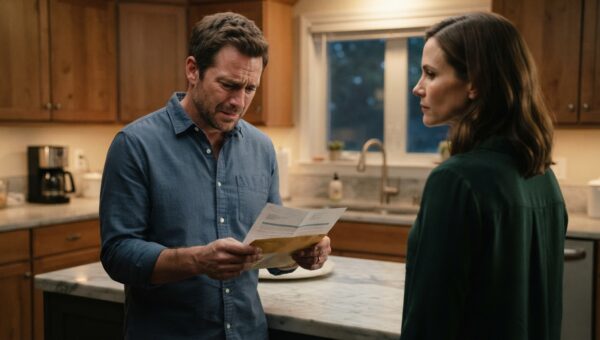
I took the First Valley Bank transaction printout and set it flat on the table, right next to his coffee mug.
Warren glanced at the paper. The small paring knife stopped in the middle of the apple slice.
“What is account 8841, Warren?” I asked.
He didn’t move. His hand stayed clamped around the knife handle. The ticking of our battery clock above the stove was the only sound in the room.
“Where did you get that?” he asked quietly.
“I got it from the branch manager on Route 9,” I told him. “Seventy-six thousand eight hundred dollars out of our checking account over eight years. Eight hundred dollars on the fifteenth of every month. And every penny of it transferred right out to Meadowview Glen. Who is at Meadowview Glen?”
Warren slowly laid the knife down on the paper napkin. He closed his eyes, his shoulders dropping two inches as if a roof had fallen on him.
“You shouldn’t have gone digging over there, Marion,” he said.
“Who is in that facility, Warren?” My voice wasn’t loud, but it was shaking. “We spent twelve years taking care of your mother in this house because you told me we couldn’t afford professional care. We canceled our thirty-fifth anniversary trip because you said the roof repairs on the garage took all our extra cash. Who have you been paying eight hundred dollars a month for?”
Warren looked down at his rough, scarred palms.
“It’s David,” he whispered.
The name hit my ears, but my brain couldn’t find a place for it.
“David who?” I asked.
Warren looked up, his eyes rimmed with red. “David Vance. My son.”
PART 3
The kitchen seemed to tilt.
Warren and I had never had children. When we were thirty, we spent four years visiting fertility clinics in Peoria, going through two rounds of treatments that drained ten thousand dollars and ended with a doctor telling us that I had severe uterine scarring. Warren had held me in the clinic parking lot while I sobbed into his coat, telling me that God gave us each other and that a marriage of two was a complete family.
For thirty-six years, I believed that our quiet house was the shape of our shared fate.
“Your son?” I whispered. The words tasted like ash.
“He was born two years before I met you, Marion,” Warren said, his voice cracking into a ragged rasp. “I was twenty-two. I was working road maintenance down in Jefferson County. I was with a girl named Carol for five months. When she got pregnant, she told me she didn’t want to get married and she didn’t want me in her life. Her family had money, and they made it clear I was nobody.”
“You had a child?”
“Carol signed papers handling everything herself,” he muttered, staring at the salt shaker. “She told me she would never ask me for a dime. And she didn’t. I moved up north, I took the job with the asphalt firm, and I met you. I told myself that part of my life was closed.”
“Then why did you start sending eight hundred dollars a month eight years ago?”
Warren pulled a handkerchief from his pocket and pressed it against his nose.
“Carol died of breast cancer in twenty-sixteen,” he said. “David was thirty-four years old. He has severe cerebral palsy, Marion. He can’t feed himself, he can’t walk without assistance, and he needs around-the-clock nursing care. Carol had spent her life taking care of him in an adapted bungalow down in Bloomington. When she died, her estate was gone. The medical bills from her illness ate up the house and the life insurance.”
I stood there by the refrigerator, holding on to the edge of the laminate counter.
“Carol’s sister called me eight years ago,” Warren continued, looking up at me with tears cutting through the wrinkles on his cheeks. “She found my name on an old hospital affidavit in Carol’s lockbox. The state was going to move David into a ward in East St. Louis. A state warehouse, Marion. It was sixty beds to a floor, understaffed, terrible. The sister told me if I could come up with eight hundred dollars a month to bridge the gap with his Medicaid waiver, Meadowview Glen had a private bed for him in their specialized adult pavilion.”
“And you never told me?” The question came out as a scream.
“How could I tell you?” Warren shouted back, slamming his hand against the table. “You spent five years crying over baby clothes in the attic! Every time you saw a stroller at the grocery store, you looked like your heart had been torn out! How was I supposed to look my wife in the eye and tell her I had a living, breathing son thirty miles away while she was barren?”
“Do not use that word in this house!” I yelled.
The anger in my chest was so sharp I could barely breathe.
“You didn’t hide him to protect my feelings, Warren,” I said, walking right up to his chair until I was looking down into his face. “You hid him because you were a coward. You let me spend thirty-six years balancing pennies, cutting coupons, and worrying about our heating bills while you stole eight hundred dollars a month out of our retirement to cover your secret past.”
“I had to save him from that state hospital!” he cried.
“Then you should have brought him into the light!” I told him. “You should have trusted your wife of thirty years to be a decent human being! Instead, you treated me like a fool who couldn’t be trusted with the truth.”
Warren buried his face in his hands, his broad back shaking with heavy, silent sobs.
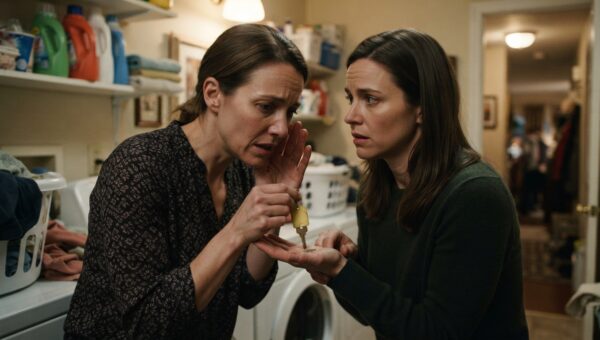
I picked up my car keys from the counter.
“Where are you going?” he begged, looking up through his fingers.
“I am driving to Meadowview Glen,” I said. “And you are sitting right there in that chair until I get back.”
ENDING
The drive north to Meadowview Glen took forty-five minutes.
The facility was a clean, one-story brick building set among willow trees and gravel paths. It was not a depressing warehouse. The halls were bright, the air smelled of floor wax and fresh laundry, and classical music was playing softly from the nurses’ station.
I asked for David Vance.
A nurse named Sister Thomas walked me down the west corridor to a sunny room at the end of the wing.
Sitting in an adapted high-backed wheelchair by the window was a man of forty-two. He had Warren’s dark, wavy hair, Warren’s heavy brow, and the same square chin I had looked at across our breakfast table for half my life. His hands were curled inward against his chest, and his legs were thin under a gray fleece blanket.
He looked toward the doorway when my shoes clicked on the tile.
He couldn’t speak in clear sentences, but when his eyes met mine, he let out a soft, humming sound and smiled, his face brightening with simple, innocent recognition.
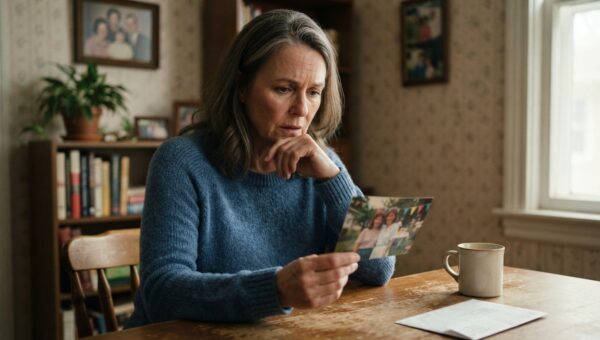
On the nightstand beside his bed was a framed photograph. It was a picture of Warren, taken five or six years ago at a rest stop on the tollway, holding David’s hand on a bench.
Warren had been coming here. He had been visiting his son on Saturday mornings while telling me he was picking up gravel at the quarry or checking on his brother’s lawn.
I walked into the room, pulled up the vinyl chair beside the window, and sat down.
I took David’s twisted right hand in mine. His skin was warm and paper-thin. He squeezed my fingers with surprising strength, making that same quiet humming sound in his throat.
I stayed in that room for two hours. I helped him sip a cup of cold apple juice, and I looked at the sketches his mother had framed on the walls before she passed away.
I felt no hatred for David. A child does not choose how he enters this world, and he does not choose the secrets grown men build around him. But looking at him, I felt the thirty-six years of my marriage crumble into something unrecognizable. The partnership I thought I had built was an illusion. I had been Warren’s housekeeper, his accountant, and his cover story, while his real emotional burden was kept safely out of my reach.
I drove home at dusk.
Warren was still sitting at the kitchen table. The coffee was cold. He hadn’t turned on the lights; he was sitting in the gray gloom with his hands folded in his lap.
I walked into the kitchen, set my purse on the counter, and turned on the overhead lamp.
“I saw him,” I said.
Warren looked up, his eyes bloodshot, his lips trembling. “Marion…”
“Listen to me,” I said, my voice dead level and steady. “The eight-hundred-dollar monthly transfer stops today.”
Warren flinched. “Marion, please. If the payment stops, they’ll discharge him. They’ll send him to the county annex.”
“You didn’t let me finish,” I told him.
I pulled out my chair, sat down across from him, and laid our checkbook between us.
“The eight hundred dollars is not coming out of our joint household budget anymore,” I said. “Tomorrow morning, you and I are going to an estate attorney in town. We are creating a formal, legal special-needs trust for David. We are funding it directly from your share of our retirement accounts, and you will sign the legal guardianship papers openly, under your real name.”
Warren stared at me, his mouth open.
“And as for you and me,” I continued, “we are dividing our assets fifty-fifty. I am moving into the town cottage my sister left me, and you can keep this house. I will not spend the rest of my life sleeping next to a man who lied to me for eight years while I balanced his checkbook.”
“Marion,” he pleaded, reaching across the table for my sleeve. “I made a terrible mistake. I love you. Please don’t leave me over this.”
I pulled my arm back, out of his reach.
“I’m not leaving you over David, Warren,” I said. “I’m leaving you because you never trusted me to love him too.”
We saw the attorney on Friday.
The trust was established, properly funded, and filed with the county probate court. The divorce was finalized six months later, quiet and clean, with no public arguments.
I moved my furniture into my sister’s small yellow house on Elm Street. It has two bedrooms, a small garden plot in the back, and a sunroom where I drink my tea every morning.
I still balance my checkbook on the first Sunday of every month. The ledger is simple now: my pension, my groceries, my water bill, and my modest savings.
Every other Wednesday afternoon, I get into my sedan and drive forty miles north to Meadowview Glen.
I bring David fresh lemon cookies from the bakery in town. I sit by the window, hold his hand, and read him chapters from the travel books he loves.
Warren visits on Saturdays, but I never ask about him, and the nurses know to keep our schedules separate.
David doesn’t know about the checking account, the eight-hundred-dollar transfers, or the thirty-six years of lies. He just knows that on Wednesdays, someone comes to sit in the sun with him, holding his hand with honest fingers.