Why do people keep old restaurant receipts tucked into the backs of their desk drawers long after the ink has faded to a dusty purple? I found three of them from last year just this morning while I was looking for a roll of stamps. They are just slips of cheap thermal paper with numbers printed on them, yet holding one of them makes the skin on my arms tighten up all over again.
Months ago, my son Mark and his wife Elena moved into a brick colonial just three miles down the road from my house. I helped them pick out the kitchen curtains and drove two hours to fetch their heavy oak dresser in the back of my pickup truck. I never minded helping because they were starting out, and Mark was my only boy.
Then came that Tuesday evening in late October when my phone lit up on the kitchen counter at 7:15 while I was washing a skillet. It was a text message from Elena. She said they were meeting at the downtown steakhouse and wanted me to join them. The text clearly stated that everyone was gathering at 8:00 for a late bite.
I didn’t think much of it at the time, even though I usually like to be in bed by ten. I changed out of my house slippers, put on my wool coat because the wind was coming off the river, and drove downtown in my sedan.
The streets were quiet and dark, the kind of stillness you only get on autumn weeknights when the college kids are all studying.
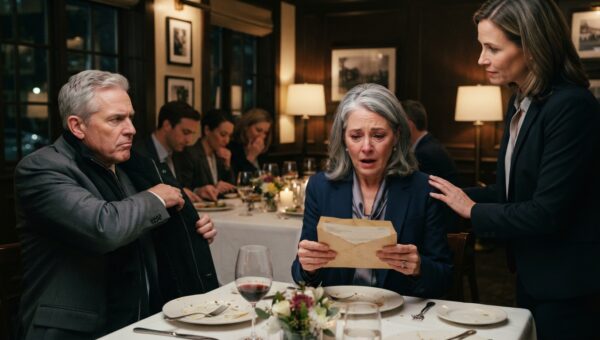
I walked through the heavy glass doors of the steakhouse at exactly eight o’clock, smelling the heavy tallow and melted butter right away. The hostess knew my name, or at least she looked at my face and pointed me toward the back corner booth where the lighting was dim and warm. I walked back there expecting to see them looking over menus or talking about their week.
Instead, the booth was mostly empty of food, and the table had two coffee cups and a plate with a few smears of chocolate cake left on it. Elena was dabbing her mouth with a cloth napkin while Mark looked down at his water glass like he was trying to count the bubbles. They were finishing dessert.
Elena looked up at me with that smooth, unbothered smile she always uses when she is about to make someone feel small.
You finally made it, she said. Her voice was light, almost cheerful, like I was twenty minutes late to a casual Sunday lunch.
I stood there by the end of the table with my purse strap over my shoulder and the cold air still clinging to my wool coat. I pulled my phone out of my pocket and tapped the screen to show her the text message that clearly said eight o’clock. She didn’t even look at it. She just laughed a little, a dry, dismissive sound, and said I must have read it wrong because everyone knew they reserved the table for earlier.
Mark didn’t say a word. He just stared at the salt shaker.
Right beside the empty white plate where I was supposed to sit, there was a black leather folder with a printed receipt sticking out of the top. I pulled it open just enough to see the total.
Six hundred and thirty dollars and twelve cents. There were two empty wine glasses, several expensive cut-cuts of beef, and multiple rounds of appetizers listed on the paper.
Nobody said anything for a second, and honestly that felt worse than shouting. Elena just signaled the passing waiter with a tiny wave of her hand and told him the last guest had arrived to settle up. I didn’t yell or make a scene because I was raised better than that, but my chest felt hollow. I reached into my bag, pulled out a twenty-dollar bill, and dropped it right on top of the leather folder to pay for the coffee I hadn’t even ordered.
I just stood there because my brain kind of stopped working for a second. I told them I had a headache and walked out into the cold air without looking back.
The next morning, the sun was cutting right across my kitchen table when the landline rang at 9:15. It was Leo, the manager of the steakhouse, whom I had spoken with briefly years ago when my husband was still alive. He told me I had accidentally left my cashmere scarf draped over the back of the corner booth the night before, which surprised me because I didn’t remember taking it off.
Then his voice dropped to a different register, the kind of tone people use when they are about to deliver bad news in a hospital waiting room. He asked me if I knew what time the reservation had actually been booked for the night before. I told him I thought it was eight, based on the text.
It was booked for six, Leo said. And your daughter-in-law specifically instructed the hostess to note on the digital ledger that you were the guest paying the final bill.
I sat down hard on my wooden kitchen chair. But that is not the strange part, Leo continued, his voice tight over the line. Someone at your table used a credit card with your name on it to pay for the first four hundred dollars of the tab before you even walked through the door.
I hung up the phone slowly, my fingers shaking just enough that the receiver clattered twice against the cradle before it settled. I didn’t call Mark or Elena right away. Instead, I opened my laptop on the kitchen table and logged into my online banking portal. I had never looked closely at the supplementary user accounts because Mark had assured me last winter that they only used the card for emergencies like car trouble or grocery runs when the baby was sick.
I scrolled back through thirty days of transactions with my glasses perched on the end of my nose. There were charges from local boutiques, charges from a high-end baby furniture store three towns over, and three separate dining charges at upscale restaurants where I had never set foot. The total was staggering, climbing well past four thousand dollars over the last two months alone.
Elena hadn’t just stuck me with a dinner bill as some kind of cruel joke. She had quietly cloned or linked my primary account information into her digital wallet during a visit to my house three weeks prior when I stepped out to answer the back door. The dinner setup was their final test run, a way to normalize charging massive family meals to my name right before they tried something even larger with my credit line.
I printed out every single page of those statements, the ink humming quietly as the machine spat out paper after paper. I called my bank’s fraud department and spent forty-five minutes on the phone locking every card, revoking every authorized user, and filing formal dispute claims for the unauthorized charges. When I was finished, I called Mark’s cell phone and told him to meet me at the small diner down by the hardware store in twenty minutes. No Elena. Just him.
He walked into the diner looking tired, his jacket half-zipped, expecting probably another lecture about family unity or church attendance. I didn’t say a word until he slid into the vinyl booth across from me and ordered a black coffee from the waitress. I slid the thick stack of printed bank statements and the itemized restaurant log right across the Formica table toward him.
What is this, Mark asked, his voice dropping as he looked at the top page with my bank’s logo on it.
Read page three, Mark, I said. Just read where it shows the card number used at the steakhouse at 6:15 last night before I even left my house.
He flipped the pages, his eyes scanning the columns of numbers, and I watched the color drain right out of his face. He didn’t look angry; he just looked small, the way he used to look when he broke a window with a baseball and tried to hide the shards behind the garage. He didn’t have any excuses left because the numbers didn’t care about his feelings.
She said it was just a temporary arrangement until our tax refund cleared, Mark whispered, staring down at the paper like it was burning his fingers. She said you wouldn’t even notice.
I noticed, I told him, my voice very quiet and steady in the noisy diner. And as of an hour ago, every single line of credit you and your wife were sharing has been permanently frozen and reported. You are on your own now, Mark. Both of you.
He tried to stammer something about family and helping out, but I held up my hand, and he stopped talking because he knew there was nowhere left to go. I stood up, left three dollars on the table for the coffee I didn’t drink, and walked out the door.
Later that afternoon, I drove back downtown to the steakhouse to pick up my scarf. Leo was waiting by the front podium with the folded cashmere garment neatly placed inside a clean paper shopping bag. He handed it to me with a quiet nod, his face expressionless and professional.
Thank you, Leo, I said, taking the bag from his hands.
Drive safe, Mrs. Hayes, he replied softly.
I walked out through the heavy glass doors into the bright afternoon sunlight, wrapping the soft wool scarf securely around my neck. The wind was still cold, but I didn’t feel it anymore. The restaurant, and the heavy, ugly weight of everything that happened inside it, stayed far behind me in the shadows as I walked toward my car.