The cardboard box didn’t rattle when I set it down on the oilcloth table. It was just a plain brown parcel with no return address, stamped with a messy postal cancellation from a city three time zones away where my daughter Maya had been living for nearly a year. I didn’t need to check the handwriting on the shipping label to know who sent it. The stiff, sharp slant of the capital letters belonged to Maya, even if she hadn’t written to me in months beyond a short text confirming she had arrived safely at her campus apartment.
I stood there in the quiet kitchen for a long minute, wiping my hands on my dish towel out of sheer habit, wondering why she would mail something back instead of just handing it to me during one of our awkward holiday visits. Our relationship had settled into a thin, brittle polite routine ever since she packed her sedan and drove west for college. We talked about the weather, we talked about her classes, and we carefully avoided every single subject that mattered.
The parcel sat beside the sugar bowl like a small, quiet accusation. I reached for my sewing scissors with the red plastic handles, the ones I kept in the junk drawer alongside the rubber bands and old coupons. I snipped the heavy brown packing tape, pulled back the cardboard flaps, and reached inside.
The first thing my fingers brushed against was worn, flattened plush.
I pulled it out and set it right in the center of the table. It was the little gray stuffed rabbit Maya had clutched in her small, hot fists the very first day I brought her home from the agency when she was four years old. Her fingers had rubbed the ears completely bald during her first two years with us, and I had mended those ears a dozen times with heavy blue thread back when she still let me tuck her in at night. But as I turned the rabbit over in my hands, something else caught my eye immediately.
The belly seam had been ripped open and resewn. And the thread wasn’t my old blue mending cotton. It was a stark, bright white polyester thread, pulled tight in neat, rigid little stitches that looked nothing like my grandmother’s cross-stitch or my own hurried midnight repairs.
A small scrap of stiff paper was wedged directly beneath the fresh stitches, sticking out like a white tongue.
I pulled the paper free. It was an old piece of hospital stationery, yellowed at the edges and folded twice. Written across it in faint, shaky blue ballpoint ink were eight words that made my chest seize up so hard I couldn’t draw a breath.
You should have opened this years ago.
Nobody said anything for a second, and honestly that felt worse than the silence of an empty house. I just stood there in the afternoon light because my brain kind of stopped working for a second. Maya hadn’t sent me her old toy just for a trip down memory lane. She had sent it because she wanted me to see whatever was hiding inside the stuffing.
My fingers were shaking so badly I dropped the small scissors twice before I finally managed to slide the sharp tip beneath the first white stitch.
Snip. Snip. The modern thread was stubborn, but it gave way. I pulled the seam wide open, widening the gap with my thumbs until the synthetic stuffing spilled out onto the table like cotton clouds. Buried deep in the center, wrapped securely in a second piece of crinkling hospital linen, was something heavy and cold.
I unwrapped the linen layer by layer.
It was a small, tarnished zinc locket, oval-shaped and scratched across the front like it had rattled around in the bottom of a drawer for decades. Attached to it was a folded birth registration card bearing a name I had never seen on any of the adoption paperwork the state agency had given us back in 2010. Elena Vance.
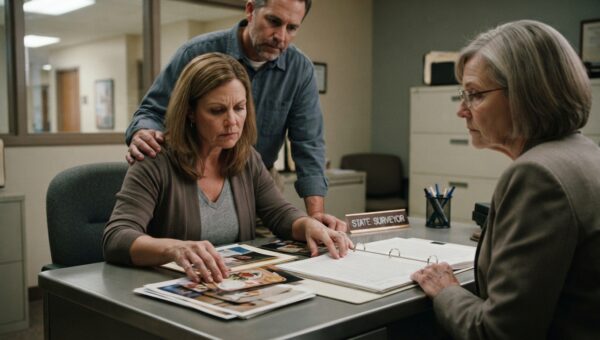
I didn’t even know why I remember this part so clearly, but the kitchen clock ticked twice while I stared at that name. The agency case worker, a brisk woman named Brenda who always smelled faintly of menthol cigarettes, had told us Maya’s mother was a transient girl who walked away voluntarily and never looked back. Brenda told us the file was clean, closed, and sealed tight to protect everyone involved.
I popped the zinc locket open with my thumbnail.
Inside was a tiny, faded photograph cut down to fit the oval frame. It showed a young woman with dark, heavy hair and wide, terrified eyes that looked so much like Maya’s when she was cornered that my stomach turned completely over. Tucked behind the photograph was a tiny slip of lined paper covered in hurried, cramped handwriting.
I had to squint to read it under the kitchen pendant light.
To whoever raises my little girl, please tell her I didn’t want to leave. They told me I had to sign the papers before they would let me see a doctor. I am leaving her this locket so she knows she has a face and a history. Don’t let them tell you I forgot her.
The paper slipped from my numb fingers and drifted down onto the oilcloth right beside the pile of gray stuffing.
I sat down hard at the kitchen chair because my knees just gave out. The quiet in the house felt heavy, pressing down on my shoulders like a wet woolen blanket. I stared at the zinc locket, at the frightened young face inside it, and then back at the cruel, sharp sentence I had thrown at Maya across this exact same table five years ago during the worst fight of our lives.
She had been thirteen, slamming a bedroom door so hard the framed pictures on the hallway wall rattled. We had been screaming about nothing, just the ordinary poison of a teenager testing every boundary she could find, until my temper snapped right in half.
Maybe your real mother would’ve understood you better.
I had bitten my tongue back the second the words left my mouth, but the damage was already done. Maya had gone completely still, her face turning pale and hard in a way that terrified me. She didn’t cry. She just looked at me like I was a stranger who had invited herself into her home. She stopped talking to me for days, and even after things settled down into a cautious truce, that sentence never fully left our relationship. It hung between us like an invisible glass wall through high school, through her awkward teen years, and right up until she packed her bags for college.
I covered my face with my hands. I was a terrible mother. I had spent thirteen years patting myself on the back for taking in a little girl the state had labeled unwanted, while some poor girl named Elena had been lied to and forced out of her child’s life by a corrupt agency that treated babies like paperwork.
And Maya had known.
That was the part that made my breath catch in my throat. Maya hadn’t just received this box today. She must have found this locket years ago, maybe tucked deep inside the rabbit’s stuffing when she was twelve or thirteen, right around the time our home started falling apart. She had kept the secret locked inside her own chest, watching me, testing me, waiting to see if I would ever look past my own pride and try to find the truth of where she came from.
And instead of digging deeper, I had thrown her adoption in her face like a weapon when I was mad.
I looked at the phone sitting on the counter. It was 4:14 in the afternoon. If I left right now, I could make it to the regional airport before the evening commuter rush.
I didn’t pack a bag. I didn’t even turn off the coffee maker. I just grabbed my car keys, scooped the zinc locket and the hospital note off the table, and slid them safely into my jacket pocket.
The drive to the airport was a blur of gray asphalt and taillights. I kept seeing Maya’s face in the passenger seat, not as she looked now at eighteen, but as a little four-year-old girl clutching that bald-eared rabbit on the front porch. I had told myself I gave her a good life. I gave her clothes, a bedroom, piano lessons, and college tuition. But I had kept her history locked away in a drawer because it was easier than admitting the world was complicated and unfair.
By midnight, my rental car was bumping across the gravel parking lot of Maya’s off-campus apartment complex in Ohio.
The building was a three-story brick walk-up with flickering yellow security lights over the side doors. A few windows glowed with the blue light of late-night television screens. I walked up the metal exterior stairs, my boots ringing out too loud in the cold night air, and stopped in front of apartment 2B.
My hand hovered over the doorbell for three full seconds before I tapped on the wood with my knuckles.
A deadbolt turned inside with a sharp click. The door swung open a few inches, held back by a silver chain guard. Maya’s face appeared in the gap, sleep-tucked and blinking against the hallway light, wearing an old gray college sweatshirt with the sleeves pushed up to her elbows.
She stared at me, and for a second, she looked so much like the photograph in the zinc locket that my heart just stopped.
“Mom?” she whispered, her voice cracking slightly. “What are you doing here?”
I didn’t try to smile. I didn’t try to make up an excuse about being in the neighborhood. I reached into my coat pocket, pulled out the small tarnished zinc locket, and held it out toward the gap in the door so the hallway light caught the metal.
“You should have yelled at me,” I said, my voice shaking so hard the words barely came out straight. “You should have thrown this at my head when I said that thing about your mother.”
Maya stared at the locket in my palm. The hallway was completely silent except for the low hum of a refrigerator inside her apartment. I saw her throat move as she swallowed hard. She didn’t reach for the chain right away.
“I found it when I was twelve,” Maya said quietly, her voice barely louder than a breath. “I was cleaning out my old toys in the closet and the seam had a loose thread. I felt something hard inside. I pulled it out and read the note.”
“Why didn’t you give it to me then?” I asked, tears finally spilling over my eyelashes and running down my cheeks.
“Because I was scared,” she said, and her voice broke on the edge of a sob. “I was scared that if you knew who she really was, or how much she wanted to keep me, you wouldn’t want me anymore. I thought maybe I was just a project you took on because you wanted to feel like a good person.”
“Oh, sweetheart, no,” I choked out, taking a half-step forward until my shoulder bumped against the edge of the doorframe. “That isn’t true. None of that is true.”
Maya’s fingers trembled as she reached down and unhooked the security chain. She pulled the door open the rest of the way, standing there in the doorway with her arms wrapped tight around her own waist, looking smaller than she had in years.
“I hated you for saying that,” she whispered, looking straight into my eyes. “When you said my real mother would have understood me better, I felt like everything we built together was just a lie.”
“It wasn’t a lie,” I said, stepping across the threshold and closing the distance between us until I could pull her into my arms. “I was angry, and I was selfish, and I was wrong. I am so, so sorry, Maya. I should have looked deeper. I should have fought for your whole story instead of just the part that was convenient for me.”
She buried her face in my shoulder, and for a long time, neither of us said anything else. She cried hard, her shoulders shaking against mine, letting out five years of cold distance and heavy secrets all at once. I held onto her like I was afraid if I let go, she would vanish back into the hallway shadows.
We sat together on her worn tweed sofa until the apartment grew cold and the streetlights outside flickered off against the pale gray light of dawn. We didn’t solve every mystery of the adoption agency that night, and we didn’t erase the years of guarded silence with a single conversation. But as Maya reached out and fastened the zinc locket around her own neck, letting the tarnished metal rest right over her heart, the invisible glass wall between us finally shattered into dust.
Now, back in her apartment after a long week of classes and quiet talks over takeout coffee, the repaired stuffed rabbit sits safely on the windowsill of her sunny living room, catching the afternoon light right next to a newly framed photograph of the two of us smiling together.