PART 1
When I was fifteen, my mother married Gary.
My real father had walked out when I was barely seven, leaving behind unpaid utility bills, a broken screen door, and a silence in our small house that never quite lifted. So when Gary came along with his tool belt, his calm voice, and his quiet habit of fixing things before anyone even noticed they were broken, it felt like someone had finally turned on a porch light.
He made buttermilk pancakes every single Sunday morning. He stood on the damp sidelines of my track meets in November rain, hands jammed into his Carhartt jacket, cheering when I crossed the finish line dead last. He helped me change the alternator on my beat-up Civic when I was nineteen, patiently holding the flashlight and letting me scrape my own knuckles until I learned how the bolts lined up.
I never called him “Dad.”
Part of me was stubborn, clinging to some childish loyalty to a ghost. But another part of me, deeper down, had desperately wanted to. Over the years, the word lived right on the tip of my tongue, ready to spill out every time he handed me back a clean set of keys or checked my tire pressure before I drove back to college. I just never had the nerve.
Mom passed away four years ago from ovarian cancer. Her illness was fast, cruel, and exhausting. In those final brutal months, Gary barely slept. He crushed her ice, tracked her morphine doses on a legal pad by the nightstand, and held her hand until her breathing stopped in that quiet hospice room.
After the funeral, things shifted. It was natural, I told myself. We were an adult stepdaughter and a grieving widower with no shared blood. We did not call each other every week. He was never a talker on the telephone anyway. But we kept in touch. A text on holidays, a brief call on his birthday, an occasional twenty-dollar check folded inside a generic card for mine. Not close, but still family. At least, that was what I told myself for four years.
This Father’s Day, I decided it was time to stop holding back.
I was thirty-two years old now. Life was short, and watching my mother fade had taught me that you do not leave things unsaid until a hospital room forces your hand.
I spent Saturday afternoon baking two dozen lemon bars. They were my mother’s favorite recipe, written in her loopy script on a grease-stained index card: a thick, buttery shortbread crust topped with sharp, tart lemon curd and dusted with powdered sugar. The whole kitchen smelled of butter and citrus, just like our old house used to smell every summer.
I also bought a heavy linen card. I sat at my dining room table for nearly an hour, writing out everything I had kept locked away for seventeen years. I thanked him for the cold mornings on the track bleachers. I thanked him for loving my mother so gently. And at the bottom, right above my signature, I wrote: “Thank you for being my dad in every way that ever counted.”
Sunday morning, I woke up at dawn. Gary lived two hours south, in the modest brick ranch house he and Mom had bought together ten years ago outside Richmond. I wanted to surprise him with fresh coffee and the warm lemon bars before he started his morning yard work.
I pulled into the gravel driveway at a quarter past eight. The morning air was already heavy with Virginia humidity. His silver Silverado sat in the drive, washed and clean.
I carried the glass Pyrex dish in one hand, wrapped neatly in a tea towel, and held the envelope in the other. As I walked up the flagstone path toward the front porch, I noticed the side living room window was cracked open a few inches to catch the morning breeze.
I was about to step onto the wooden porch steps when I heard voices from inside.
Gary was not alone.
His sister, Brenda, was talking. Brenda had always been loud and sharp-edged, the kind of person who treated family gatherings like an audit. But it was not Brenda’s voice that stopped my feet on the stones.
It was Gary’s.
“She texted yesterday saying she might drop by,” Gary was saying. His tone was not warm. It was flat, dry, and irritated in a way I had never heard him speak before. “I swear, every holiday it’s like she’s waiting for an invitation to pretend we’re still some happy little unit.”
Brenda let out a short, nasal laugh. “You don’t owe her anything, Gary. Ellen’s been gone four years. You did your time.”
“I know I did,” Gary said, his voice carrying clearly through the screen. “Eight years of paying for braces, car insurance, and college fees for another man’s kid because Ellen couldn’t say no to her. I played along while Ellen was alive because it kept the peace. But the minute the funeral was over, I was done. She’s not my daughter. She never was. I just wish she’d take the hint and stop hanging around like a stray dog looking for a bowl of milk.”
The gravel under my sandals felt completely gone.
The heat of the Pyrex dish seeped straight through the cloth, burning my fingers, but I couldn’t move. My heart pounded so hard in my ears that for a second, I thought the windows would rattle.
PART 2
I stood frozen beside the boxwood bush, staring at the white trim of the window frame.
“She’s still clinging to that house equity thing, isn’t she?” Brenda asked, the clink of a coffee mug against a saucer punctuating her words.
“She doesn’t even know about that,” Gary answered with a dismissive grunt. “And she doesn’t need to. Ellen wanted the house left to both of us, but the deed was joint with right of survivorship. When Ellen went, the deed became mine alone. Clean and simple. But Laura still calls asking if I need help sorting through Ellen’s jewelry or going through the cedar chest. Truth is, Brenda, I can’t stand looking at her. Every time she smiles, she looks just like her deadbeat father. I spent twelve years biting my tongue in my own living room just so her mother wouldn’t cry.”
Every word landed like a physical blow against my chest.
My real father had been a ghost, but Gary had been the foundation beneath my feet. I remembered him sitting at the kitchen table helping me with algebra. I remembered him driving three hours in a sleet storm to jump-start my car when my battery died in college. I had spent seventeen years believing he did those things out of love.
Now, listening to him through a window screen, I realized the horrifying truth: he had done them out of obligation, resenting every minute, counting the cost, waiting for the clock to run out.
My hands began to shake violently. The linen envelope slipped from my fingers, fluttering down into the damp mulch beside the hydrangea bushes.
“Well, if she shows up, just tell her you’re heading out to our place for barbecue,” Brenda said casually. “Don’t invite her in. If you let her through the door, she’ll sit there for two hours crying about her mother.”
“I won’t,” Gary said coldly. “I’m thirty minutes away from locking the gate and leaving early anyway.”
I looked down at the envelope in the mulch. The white linen had picked up a smudge of black dirt along the corner. Inside it was a letter pouring out seventeen years of gratitude, telling a man who despised me that he was the only father I had ever known.
A wave of hot, suffocating shame washed over me, immediately followed by something hard and cold.
I did not run back to my car. I did not drop the dish and make a dramatic scene in the driveway.
I reached down into the dirt, picked up the envelope, and slid it into my back pocket. Then I walked deliberately up the three wooden steps of the front porch, the heels of my sandals making sharp, deliberate thuds on the floorboards.
The voices inside cut off instantly.
I didn’t knock. I pushed the front screen door open and stepped right into the living room.
Gary was sitting in his brown leather recliner, a coffee mug halfway to his mouth. Brenda was sitting at the edge of the sofa, looking caught with her mouth slightly open.
When Gary saw me standing in the foyer, the color drained from his face in a single second. He looked toward the open window, then back at me. He knew. You could see the exact moment he realized how close I had been standing, and how open the window had been.
“Laura,” Gary said, his voice dropping an octave, unsteady. “You’re… you’re early.”
I stood there in the center of the rug, holding the warm glass dish wrapped in my mother’s yellow tea towel.
“I am,” I said evenly. My voice didn’t crack. It surprised me how steady it came out. “The highway was clear.”
Brenda cleared her throat, awkwardly setting her mug on the glass coffee table. “Laura, hi. We were just… Gary and I were just talking about plans for the day.”
“I know,” I said, looking Brenda straight in the eye until she looked away. “I heard.”
PART 3
Silence flooded the room. The only sound was the low hum of the refrigerator in the kitchen behind them.
Gary set his mug down on the end table with an unsteady hand. “Laura, look. Whatever you think you heard out there—”
“Don’t,” I said, holding up one hand. “Please don’t do that, Gary. Do not sit in that chair and tell me I misunderstood plain English. You’re too old for that, and I’m certainly too old for it.”
He closed his mouth. A dull red flush crept up his neck, staining his collar.
“I made lemon bars,” I said, walking across the room. I set the heavy glass dish down on the coffee table right between Brenda’s mug and the television remote. “Mom’s recipe. I baked them yesterday because I thought you were sitting here alone on Father’s Day, missing her, just like I was.”
Gary looked down at the powdered sugar dusting the glass lid. He couldn’t meet my eyes. “Laura, I was frustrated. People say things they don’t mean when they’re blowing off steam.”
“You meant every syllable,” I said, and for the first time, the grief broke through my composure, sharp and raw. “You’ve meant it for seventeen years. That’s the part that hurts. Not that you don’t love me. Nobody can force you to love a kid that isn’t yours. But you let me believe you did. You let my mother die believing you loved me. You let me spend my entire twenties feeling guilty for not calling you Dad.”
Brenda stood up, grabbing her purse off the couch. “Gary, I’ll wait in the car.”
“Stay right where you are, Brenda,” I told her without looking at her. “You had plenty of advice through the window. You might as well hear the rest of it.”
Brenda froze, hovering awkwardly between the couch and the hallway, clutching her leather strap.
I reached into my back pocket and pulled out the linen envelope. The smudge of dark garden soil was clearly visible on the front, right across where I had written *Gary* in blue ink.
“I spent an hour writing this this morning,” I said, holding it between two fingers. “I thanked you for every tire you changed. I thanked you for being patient with me when I was a difficult teenager. I told you that you were my real father.”
Gary flinched. His shoulders pulled in tight, like an old boxer waiting for an inevitable right hook. “Laura, stop.”
“I’m not going to yell at you,” I said quietly. “I’m not going to ask for whatever money you spent on my braces fifteen years ago, and I’m not going to ask you about the deed to this house. You’re right. The deed was joint with right of survivorship. My mother trusted you to do what was right, and you took the legal way out. You have the house. You have your truck. You have your clean slate.”
I took the envelope, tore it down the middle with a single, sharp rip, and laid the two torn halves right on top of the lemon bars.
“What I want,” I said, looking directly into his pale, troubled eyes, “is my mother’s cedar chest. And her jewelry box. Today.”
Gary blinked. “Laura, those things—”
“Those things belonged to Ellen Vance before she ever laid eyes on you,” I said, my voice hardening until it cut the air like glass. “They were passed down from my grandmother. You just told your sister that you can’t stand looking at me because I look like my father. Fine. Then you shouldn’t have to look at my mother’s family heirlooms for another second.”
Gary opened his mouth to argue, but Brenda grabbed his arm. “Gary, let her have them,” she whispered nervously. “Just let her take them.”
Gary looked at Brenda, then down at the torn card on the glass table. The fight went out of him all at once. He sank an inch deeper into the leather recliner, looking smaller, older, and far more ordinary than the giant of a man I had spent my childhood trying to impress.
“The key is on the ring by the back door,” Gary muttered, staring at the floorboards. “Take whatever you want from the spare room. Just… take it.”
ENDING
It took me forty-five minutes to carry the boxes out to my car.
Gary didn’t help. He sat in that leather recliner with his arms folded, staring out the front window at nothing. Brenda slipped out the side door ten minutes in, her tires crunching on the gravel as she backed down the driveway and left.
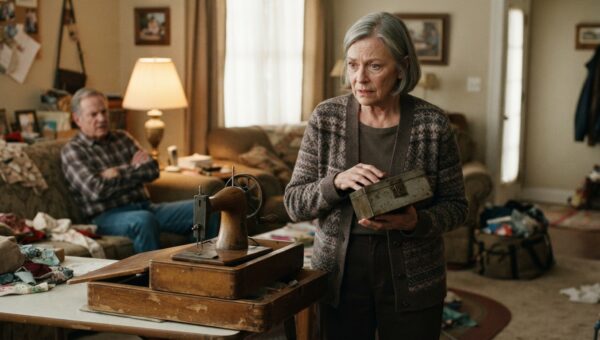
I carried my mother’s oak jewelry box out first. Then her cedar chest, dragging it across the hardwood floor by its brass handles, refusing to ask him for a hand even though the solid wood scraped my shins. Inside that chest were her photo albums, her handmade quilts, and the silver baby rattle my grandparents had given me when I was born.
Treasures to me. Junk to him.
When the trunk and back seat of my Civic were full, I walked back into the living room one last time to leave the brass house key on the kitchen counter.
Gary hadn’t moved. The dish of lemon bars still sat on the coffee table between the torn halves of the Father’s Day card.
“Laura,” he said quietly as I reached the screen door. His voice sounded thin, stripped of the bravado he had possessed twenty minutes earlier. “I was good to your mother. You know that. I took care of her.”
I paused with my hand on the metal latch of the screen.
“You were good to her,” I said. “And she loved you. But you didn’t love her enough to love the only child she had. You just tolerated me like an unwanted piece of furniture that came with the lease.”
He looked away, his jaw tightening, unable to deny it.
“Goodbye, Gary,” I said.
I let the screen door shut behind me with its familiar, dull wooden slap. The morning sun was high now, glaring down on the gravel driveway, bright and unapologetic.
I got into my car, turned the key, and listened to the engine hum to life. The same engine Gary had taught me how to listen to years ago. For a long time, I thought every skill, every lesson, and every small comfort in my life had been a gift from him.
Sitting there in the driveway, looking at the brick house in my rearview mirror, I realized something that took the sting out of the morning: the lessons were still mine.
He hadn’t given them to me out of fatherly devotion; he had given them to me out of routine. But they belonged to me now. I knew how to fix my own car. I knew how to manage my own life. And I had the only things my mother had left behind that actually mattered.
I didn’t cry on the two-hour drive back north.
I rolled down the windows, letting the warm summer wind whip through the car, carrying the faint, sweet scent of old cedar from the back seat. For seventeen years, I had carried the heavy, unpayable debt of feeling like a charity case who owed a good man her eternal gratitude.
When I finally crossed the county line into my own town, the weight was completely gone. I wasn’t an abandoned child looking for a father anymore. I was just a grown woman driving home with her mother’s memories, entirely free.