PART 1
For six months, my husband Arthur transferred two hundred seventy-five dollars every Friday morning into an account labeled home repairs. The funny thing is, our roof still leaked over the laundry room every time it rained hard, and Arthur kept telling me we simply could not afford to hire a contractor. He would sit at the kitchen table with his coffee, rubbing his temples and talking about how inflation had made building materials completely out of reach. I did not accuse him of anything at first. I just started saving the bank alert screenshots on my tablet, filing them neatly into a folder I created one rainy afternoon when the drip from the ceiling sounded like a metronome.
Arthur and I had been married for thirty-two years. You do not spend three decades with someone without learning the cadence of their breathing or the specific way they clear their throat when they are hiding something. But trust is a comfortable habit. You assume the person sharing your bed and your breakfast table operates on the same set of facts you do.
Last Tuesday, that habit finally cracked.
Arthur had left his heavy wool coat draped over the back of the dining room chair when he went out to pick up a prescription. I went to hang it in the front hall closet before company came over. As I lifted the coat, a small, folded piece of paper slipped from the inner pocket and fluttered down onto the hardwood floor.
I picked it up. It was a receipt from a pediatric dental clinic in a town forty miles away.
I smoothed the crinkled thermal paper against my palm and read the line items twice. Two routine cleanings. One set of bitewing X-rays. The date stamped at the top was a Saturday three weeks prior, right in the middle of a weekend Arthur claimed he spent helping his brother clear fallen oak branches after a storm.
Our daughter Clara is twenty-eight years old, living two states away and working as a dental hygienist herself. Arthur has no other child. We raised our only daughter in this house, and her baby teeth were long gone.
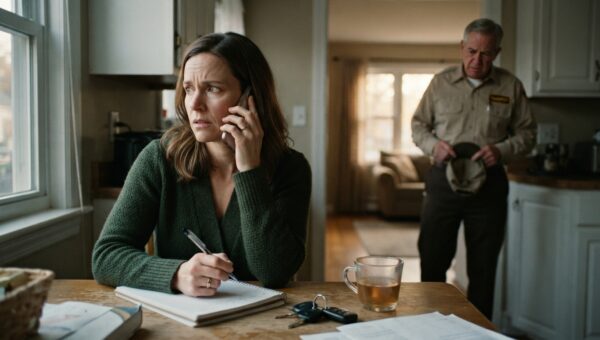
When Arthur came home from the pharmacy, carrying the brown paper bag by its twisted handle, I did not yell or throw things. I simply walked into the kitchen, set the small white receipt flat on the wooden table right beside his dinner plate, and waited for him to sit down.
Arthur looked at the paper. His gaze froze on the clinic letterhead. The color drained from his cheeks in a way that looked heavy and old.
He stared at it for a long, suffocating minute, his fingers tightening around the paper bag until the cardboard crumpled.
Finally, he swallowed hard and said, “I can explain.”
Before the words had even finished leaving his mouth, our front doorbell rang. It was a sharp, persistent chime that cut through the silence of the kitchen.
Arthur flinched. I looked toward the hallway, wiped my hands on my apron, and walked to the front door. When I pulled it open, a teenage girl stood on the porch. She was wearing a faded denim jacket and holding a blue school folder against her chest. When she looked up at me, I saw the exact shape of Arthur’s jaw and the same stubborn slope of his forehead. Stamped across the front of her folder in bold black marker was our exact last name.
PART 2
The girl on the porch blinked against the porch light, her eyes darting from my face to the hallway behind me. For a second, neither of us moved. The autumn wind rattled the dried hydrangea bushes near the foundation, and somewhere down the street a car door slammed.
“Is Arthur home?” she asked. Her voice had a slight tremor, but she held her ground with a defensiveness that felt terribly familiar.
Before I could answer, Arthur appeared behind me in the doorway. His shadow fell over the threshold, and his face went completely gray.
“Chloe,” he said, and the name came out like a breath exhaled in winter.
Chloe. Not a niece. Not a neighbor’s kid needing a ride.
Arthur stepped past me, his boots clicking on the concrete porch, and gently guided the girl off the steps and toward the walkway. I stood in the open doorway, watching them talk in hushed, urgent tones under the amber glow of the porch light. I did not invite her inside, and Arthur did not immediately ask me to. He just stood there with his hands in his pockets, nodding miserably as the girl explained why she had come to our house on a Tuesday evening.
When Arthur finally walked back inside and closed the door, the silence in the hallway felt heavier than the roof timbers.
He did not look at me. He walked straight to the kitchen table, pulled out a chair, and dropped into it.
“She is seventeen,” Arthur said to the wood grain of the table. “Her mother and I… it happened six years ago, right after my mother passed away. You were taking care of your sister in Ohio for those three months. I lost my footing, Sarah. And then I tried to fix it the only way I knew how.”
“By paying for her life with money from our joint account,” I said. My voice was dangerously quiet, stripped of all emotion.
“The two hundred seventy-five dollars every Friday,” Arthur muttered, nodding. “It covers her car insurance and her phone bill. Her mother has been struggling with health issues. Chloe needed dental work. I couldn’t use our regular checking account without you seeing it on the monthly statement, so I opened the secondary online savings ledger six months ago and redirected the extra consulting fees from the warehouse project.”
Six months. He had calculated the exact amount needed to maintain a parallel life while I worried over grocery prices and watched the paint peel off the kitchen window trim.
“And the roof?” I asked, pointing a finger toward the ceiling where the brown water stain stretched across the drywall like a map of a country I had never visited. “Did you forget about the roof, or was keeping a teenager in braces more important than keeping our bedroom dry?”
Arthur finally looked up at me, his eyes shiny with tears that did not earn a single ounce of pity from me. “I was going to fix the roof next spring, Sarah. I swear to you. I just had to keep things stable over there.”
PART 3
The next morning, Arthur went to work, or at least he left the house at his usual time. I did not watch him drive away. Instead, I sat at the kitchen table with my tablet and my coffee, opening our banking portal with fingers that did not shake nearly as much as I expected them to.
When you spend thirty-two years trusting someone, you stop checking the foundation of your financial life. You assume the numbers add up because the person managing them is a good man. But betrayal has a way of sharpening your vision.
I spent four hours downloading statements, cross-referencing transaction dates, and tracing the electronic breadcrumbs Arthur had left behind. The two hundred seventy-five dollars every Friday was only the beginning. Once I started looking further back, before the labeled home repairs account was even created, I found stray cash withdrawals at ATMs near the high school on the north side of town. I found utility payments made from a debit card I did not recognize.
It was not just an isolated mistake six years ago. It was an ongoing architecture of deceit, built brick by brick, paid for with the retirement cushion we had spent decades building together.
By noon, I had printed out forty-two pages of transaction histories. I placed them in a neat stack right in the center of the kitchen table, right over the spot where the pediatric dentist receipt had sat the night before.
When Arthur came home at six o’clock, he found me sitting at the table with a yellow legal pad and a pen. He stopped in the doorway, smelling of stale office air and damp wool.
“Sarah,” he began, taking off his jacket and tossing it over the chair. “We need to talk about how we handle this. I told Chloe’s mother that things have to change. We can’t keep living like this.”
“You are right,” I said, looking up from my legal pad. “Things are going to change. But you are not the one deciding how.”
I slid the stack of printed bank statements across the table toward him. The papers rustled softly against the wood.
“I spent today looking at every transaction since the year your mother passed away,” I said, keeping my tone even and level. “Every ATM run. Every weekend trip to clear brush that never happened. You didn’t just support a child you hid from me for six years. You systematically drained forty-eight thousand dollars from our joint savings while letting this house rot from the top down.”
Arthur stared at the stack of paper, his mouth opening slightly, but no words came out. He tried to reach for the top page, but I pulled my legal pad back.
“I called a lawyer this afternoon,” I continued. “Her name is Brenda Vance, and her office is down on Main Street. She tells me that in our state, funds diverted into secret accounts during a marriage can be accounted for during a formal division of assets. You have two choices, Arthur. You can pack a bag tonight and go stay wherever you were staying on those weekends, or I can file the paperwork tomorrow morning and let Brenda handle the accounting in front of a judge.”
Arthur looked around the kitchen, his gaze sweeping over the cabinets we had painted together, the framed photographs on the wall from our daughter’s wedding, and finally up at the brown water stain on the ceiling above the laundry room.
“Sarah, please,” he whispered, his voice cracking. “Don’t throw thirty-two years away over this.”
“You threw it away,” I said, pointing toward the front door. “Two hundred seventy-five dollars at a time.”
ENDING
Arthur packed his suitcase into the trunk of his sedan just as the streetlights flickered on. I stood by the front window, watching the amber light catch the frost forming on the grass. He did not look back before he backed out of the drive.
When the taillights faded around the corner, the house grew very quiet.
I walked into the kitchen, picked up the bucket we kept under the laundry room leak, and emptied it into the sink. The drip had slowed to an occasional plink against the plastic.
Tomorrow, I would call a local contractor named Dan who lived three streets over. I had the money to pay him now, every last cent of it, sitting safely in an account with only my name on the signature card. I walked over to the kitchen table, picked up Arthur’s empty coffee mug, and set it in the dishwasher. Then I turned off the overhead light and sat down in the dark for a moment, listening to the silence of a house that finally belonged entirely to me.