PART 1
When my mother called me two days before Chloe’s high school graduation, her voice was thin and dry. She told me she just could not manage the crowd at the civic center. Her hip had been acting up, she said, and the parking at the arena was too far of a walk.
I told her I understood. I even offered to pick her up at her front door, wheel her inside in a rental chair, and sit right beside her in the accessible section. But she cut me off quickly. She said she would just watch the local news recap and catch up with Chloe later that weekend.
I hung up the phone and stood in my quiet kitchen for a long minute. It hurt, but I was not entirely surprised. For the past eighteen years, I had grown used to the invisible asterisk attached to my family’s milestones. Whenever my brother Mark’s children had a baseball game, a dance recital, or a middle school promotion, Mother was front and row center, shouting louder than anyone else in the bleachers. But when Chloe was born, Mother visited the hospital twice, stayed for twenty minutes each time, and complained about the hospital parking fees.
I had spent decades making excuses for her. I told myself she was just getting older, or that Mark lived closer, or that boys always held a special place in traditional mothers’ hearts. But standing there in the kitchen, watching my husband load our folding chairs into the trunk for the next morning, the excuses felt thin and frayed. My daughter Chloe had worked her fingers to the bone for four years to graduate in the top five of her class. She deserved a grandmother who could walk a hundred yards across a parking lot to watch her cross a stage.
The graduation ceremony the next evening was everything Chloe deserved. She sat with her classmates in their royal blue gowns, her dark hair pinned back, her smile radiant when she finally spotted us in the middle tiers. After the caps flew into the air and the crowds slowly drained out into the humid evening air, we drove home tired, happy, and full of relief.
We pulled into our gravel driveway around nine o’clock. The porch light was off, which struck me as odd because I always left the automatic sensor on. As I walked up the wooden steps carrying my purse and a light jacket, my foot hit something solid near the welcome mat.
I reached down and picked up a heavy cluster of white lilies wrapped in plain brown paper. There was no greeting card tucked into the stems. But as I pulled the paper back to check for a note, something heavy and metallic slipped from the leaves and clattered softly against the porch boards.
I knelt down in the dim light of the porch fixture. Lying on the wood was a heavy silver link bracelet with a small, worn safety chain. I knew that bracelet instantly. It was the one Mother wore every single day of my childhood, the one she claimed she would pass down to Mark’s wife when the time came.
Tucked underneath the bracelet was a small, stiff piece of orange cardstock. It was a physical admission ticket from the graduation arena. Section 4, Row 22, Seat 14.
My chest tightened. That seat was halfway up the upper deck, tucked against the back wall, far away from the elevator and right where the stairs were steepest.
I turned the ticket over. On the back, written in Mother’s sharp, sloping handwriting, were eight words.
I left before she saw me because I didn’t deserve to clap after what I did to her mother.
I stood there frozen, the paper trembling between my fingers. Chloe walked up behind me, carrying her diploma tube and a box of leftover celebratory cupcakes. She peered over my shoulder, her eyes landing on the silver bracelet in my palm and the words on the ticket.
She was quiet for a long moment, reading it twice. Then she looked up at me, her young face pale in the porch light, and asked the question I had spent my entire adult life dreading.
What did Grandma do to you?
PART 2
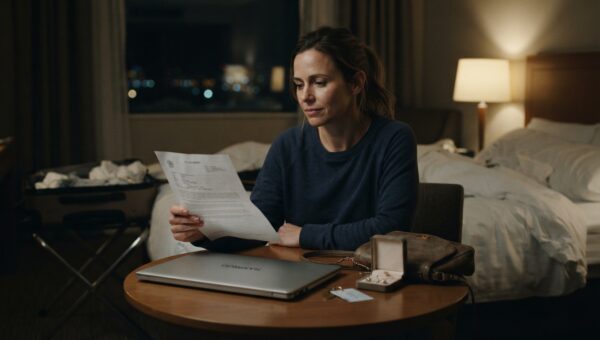
I told Chloe to go inside and put her gown on the couch. I needed a moment, I said, my voice sounding stranger to my own ears than I expected. She looked like she wanted to argue, but she saw the look on my face and quietly unlocked the front door, slipping inside without another word.
I stayed on the porch for a long time, the heavy silver bracelet cold in my palm. The summer air felt thick and heavy, smelling of cut grass and distant exhaust.
For thirty years, I had kept a locked room in the back of my mind. When I was nineteen, preparing to leave for college on a partial scholarship I had earned entirely through my own late nights at the library, my family’s financial situation suddenly imploded. My father had passed away six months earlier, leaving behind a small insurance payout that Mother was supposed to split equally between Mark and me.
Instead, the money vanished overnight. Mother told me at the kitchen table, while pouring herself a cup of black coffee, that my share had been spent on Mark’s first year at a private trade school. When I protested, reminding her that I had worked two jobs at the diner to save my own tuition, she told me that a girl would only get married and let a husband support her anyway, while a son needed a proper start in life.
That was the night I packed my old blue suitcase and walked out the front door. I put myself through night school over six years while working full time as a medical receptionist. I never took a dime from Mother again, and whenever Mark called, he acted like my absence was just some stubborn streak I needed to outgrow. Mother never apologized. She simply built a wall of cold silence, treating me like a stranger who had dropped by uninvited whenever we happened to run into each other at a cousin’s wedding or a funeral.
Now, looking at the ticket stub and the bracelet on the porch, I realized something heavy and unsettling. Mother had not just ignored Chloe out of ordinary preference. She had hidden away in Row 22 of a crowded arena, sitting in the hard plastic seats alone, watching her granddaughter graduate while carrying a secret burden she had apparently kept locked inside her chest for decades.
I walked back inside the house. Chloe was sitting at the kitchen table, the silver bracelet resting on the laminate surface between us. Neither of us spoke for a long time.
“She was there, Mom,” Chloe said softly, her fingers tracing the edge of the ticket stub. “She climbed all those stairs. Way up in the back where nobody would see her. Why would she do that if she didn’t care?”
“Because care and guilt are two different things, honey,” I whispered.
I pulled out my phone and looked at the clock. It was nearly ten o’clock at night. Mother lived forty-five minutes away in the small brick house she had shared with my father, a house that still smelled faintly of old lemon polish and stale cigarette smoke.
I knew I could not sleep. If I let this night pass without opening that door, the silence between us would cement itself into something permanent.
PART 3
The drive out to Mother’s house took forty minutes through winding country roads and dark suburban stretches. Chloe stayed home with her father, but as I pulled out of the driveway, my husband handed me a warm travel mug of coffee and simply said, “Find out what she’s carrying. Then leave it there.”
When I pulled up to Mother’s curb, the front porch light was burning a dim, yellow glow. Her sedan was parked in the driveway, and through the front window, I could see the faint flicker of the television.
I walked up the concrete steps and knocked twice.
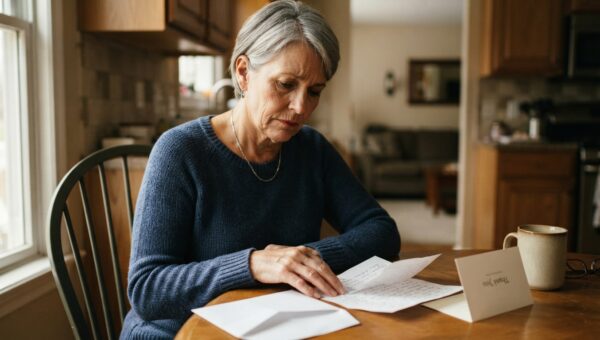
The lock turned almost immediately. The door creaked open, and there stood Mother, wearing her faded floral housecoat, leaning heavily on a wooden cane I had never seen her use before. Her hair was unbrushed, and her face looked smaller, lined with deep shadows that the evening light had hidden.
She did not look surprised. She looked like a woman who had been sitting by the door waiting for a summons she knew she deserved.
“You found the bracelet,” she said. Her voice was barely a rasp.
“I found it,” I said, stepping past her into the small hallway. The smell of lemon polish was still there, mixed with something older and dustier. “And I found the ticket. Row 22. Why were you sitting way up there in the dark, Mother?”
She turned slowly, leaning heavily on her cane, and walked toward the small floral sofa in the living room. She sat down with a heavy sigh, her hands folded over the wooden handle of the cane.
“Because I didn’t belong down on the floor with you and your family,” she said, looking straight ahead at the blank television screen. “I sat up there so I could watch Chloe without her having to look at my face. She has your eyes, you know. The way you looked at me the night you walked out with that blue suitcase.”
“You stayed away for eighteen years, Mother,” I said, standing by the doorway. I didn’t yell. The anger I thought I would feel had burned down into something cold and clear. “You missed every birthday, every holiday, every report card. You acted like Chloe didn’t exist, just like you acted like my education didn’t matter.”
“It wasn’t just Mark’s school,” she whispered, her voice cracking slightly.
I stopped. The room went very still.
“What did you say?” I asked.
Mother looked up at me, her eyes wet with old, trapped tears. “When your father died, there wasn’t an insurance payout that vanished into Mark’s tuition. There was nothing. Your father had let the policy lapse three months before he had his stroke. We were broke. We were drowning in debt to the bank, and the house was six months behind on payments.”
She lowered her head, staring at the worn carpet pattern between her sensible shoes.
“I was so proud, and I was so terrified of looking like a failure to the neighbors,” she continued, her words tumbling out in a rush now, as if the dam had finally broken after thirty years. “When you got that scholarship, I didn’t have the money for your books or your registration fees. Instead of telling the truth, instead of asking you to help us figure it out together, I let you believe I took your money and gave it to your brother. I let you walk out that door because I was too proud to let my own daughter see that I had failed as a mother.”
The silence in the small living room felt heavier than the night outside.
“You let me hate you for thirty years,” I said, my voice barely above a whisper. “You let me think you loved Mark more than me just to save your own pride?”
“No,” she said, looking up, her face twisted with a deep, consuming sorrow. “I let you hate me because I thought it was easier for you to be angry at a monster than to forgive a coward. Mark didn’t get your college money, Evelyn. Mark took out loans he’s still paying off today. I just let you believe the lie because I couldn’t bear to tell you the truth about how poor we really were.”
I stood in the center of her living room, watching the woman who had cast such a long, dark shadow over my entire adult life. She wasn’t a cartoon villain. She was just a small, stubborn, broken old woman who had chosen pride over honesty three decades ago and spent every day since living inside the prison she built for herself.
“You sat in Row 22,” I said quietly.
“I sat in Row 22,” she repeated. “Because it was high enough that nobody would talk to me, and close enough that I could see my granddaughter smile when they called her name.”
ENDING
I reached into my coat pocket, pulled out the heavy silver bracelet, and placed it on the small wooden coffee table beside her lamp.
Mother looked down at the silver links, her fingers trembling as she reached out to touch them.
“Keep it,” I said, turning toward the front door. “You earned it back tonight. But if you want to see your granddaughter again, you’re going to have to walk down out of the upper deck.”
I opened the front door and stepped out into the cool night air, pulling my jacket tight against my shoulders. As I walked down the concrete steps to my car, I didn’t look back at the lit window. But for the first time in thirty years, the space behind me felt entirely empty.