PART 1
When my son, Daniel, told me that Chloe needed complete quiet and zero visitors for the first six weeks after the baby arrived, I nodded and stepped back. I remember sitting at my kitchen table with my coffee cup in both hands, feeling that familiar pinch of disappointment, but telling myself to be sensible. Times had changed. Birth was harder on young mothers now, or so I convinced myself, and the last thing I wanted to be was an intrusive mother-in-law hovering over a newborn crib.
For six long weeks, I kept my distance. I sent occasional text messages to Daniel asking how little Maya was doing, and he always replied with short, reassuring updates. “She is sleeping well, Mom,” or “Chloe is resting.” Sometimes hours would pass before he answered, but I excused it. New parents are exhausted. I filled my days with gardening and volunteering at the community library, making sure I never dropped by unannounced, never left casseroles on their porch, and never pushed for pictures beyond the occasional snapshot Daniel texted.
The silence felt heavy, but I respected the boundary. Or rather, I respected the boundary Daniel drew around us.
Then came a rainy Tuesday morning in April. I needed fresh produce and drove down to the neighborhood market on 4th Street. The aisles were quiet, smelling of damp earth from the floral buckets near the entrance and stale coffee from the bakery counter.
I was reaching past a stack of russet potatoes when someone called my name.
“Helen?”
I turned, blinking against the fluorescent light, and saw Chloe standing near the canned goods with a shopping basket slung over her arm. She looked tired, her dark hair pulled back in a loose clip, wearing an oversized gray cardigan, but her face lit up when she saw me.
Before I could even process the shock of seeing her out in public after six weeks of supposed isolation, Chloe dropped her basket, crossed the space between us, and wrapped her arms around my neck in a fierce, tight hug.
“Oh, Helen, I have missed you so much,” she whispered against my shoulder, her voice cracking slightly. “Why on earth did you disappear on us? Daniel said you were taking a trip to visit your sister in Ohio, but six weeks?”
My arms froze halfway up her back. The cold air from the dairy aisle behind us suddenly felt sharp against the back of my neck.
“Ohio?” I repeated, pulling back just enough to look into her warm, bewildered brown eyes. “Chloe, I haven’t been to Ohio in three years.”
Chloe’s brow furrowed, the small lines between her eyebrows deepening. “What do you mean? Daniel told me you went to stay with Aunt Martha because you weren’t comfortable around the baby yet during flu season.”
“I never said that,” I said, my voice dropping to a flat whisper. “Daniel told me you wanted no visitors. He said you were overwhelmed, that you needed absolute space, and that even grandparents were too much right now.”
Chloe stepped back, her basket slipping an inch down her forearm. The color drained from her cheeks so fast it looked like someone had turned off a light inside her face. For a long moment neither of us spoke. The hum of the refrigeration units filled the aisle between the pasta sauce and the cereal boxes.
Then Chloe reached into the deep pocket of her gray cardigan, pulled out her phone, unlocked the screen with trembling fingers, and thrust it toward me.
“Look,” she said, her voice shaking with sudden fury. “Look at these.”
I looked down at the screen. There was a thread of text messages between Chloe and Daniel, dated across the last month and a half.
“Did your mom text you today?” Chloe’s messages asked. “She hasn’t called in days. Is she okay?”
And Daniel’s replies, neat and cold: “Yeah, she said she’s busy with friends.”
Another one from Chloe: “Please ask her to come over for dinner on Sunday. I miss her.”
And Daniel’s reply: “She said she has plans.”
I stared at the glowing blue bubbles until the letters blurred together. Daniel hadn’t just exaggerated a polite boundary. He had lied to both of us, day after day, week after week, constructing an invisible wall between me and my only granddaughter.
PART 2
The drive home from the grocery store took twice as long as usual. My hands gripped the steering wheel so tightly my knuckles ached, and every red traffic light felt like an intentional insult. By the time I pulled into my driveway, my chest was tight with a cold, hard anger I hadn’t felt in decades.
I didn’t call Daniel. I didn’t text him asking for an explanation while he was sitting at his desk at the insurance firm. I waited in my quiet house, walking from the living room to the kitchen and back again, listening to the ticking of the kitchen clock. Each tick felt like a hammer blow against the trust I had spent thirty years building with my son.
When his sedan crunched over the gravel in the driveway at six o’clock, I was sitting in the armchair by the front window with my hands folded in my lap.
The front door clicked open, and Daniel walked in, loosening his silk tie and tossing his leather briefcase onto the entry table. “Hey, Mom,” he called out, sounding tired in that practiced way he often used after a long day of claims adjusting. “Everything okay? You usually call me by now.”
He rounded the corner into the living room, stopped dead in his tracks when he saw me sitting there in the dim light of the floor lamp, and swallowed hard.
“You’re home early,” he muttered, taking a half-step back toward the hallway.
“I ran into Chloe at the market today,” I said. My voice was unnervingly calm, stripped of all warmth.
Daniel’s face didn’t just pale; it went gray. The professional composure he wore at work vanished instantly, leaving behind the panicked expression of a teenager caught in a lie he knew he could never talk his way out of.
“Oh,” he whispered. Just a single syllable.
“She told me about Ohio,” I continued, standing up slowly from the chair. “She told me about Aunt Martha. And then she showed me her phone, Daniel. She showed me the messages where she begged you to invite me over, and where you told her I was too busy.”
Daniel dropped his gaze to the patterned rug between us. He jammed his hands deep into the pockets of his slacks, his shoulders hunching up toward his ears.
“I didn’t know how else to stop it,” he said, his voice thick and defensive.
I stopped three feet from him. “Stop what? What on earth were you trying to stop?”
He looked up then, his eyes shining with a mixture of fear and stubborn misery that made my stomach turn. “I didn’t want you around the baby right now. I couldn’t handle it.”
“Handle what?” I demanded, the calm finally cracking in my voice. “I am her grandmother. I raised you. I raised your sister. Why would my presence be something you needed to stop?”
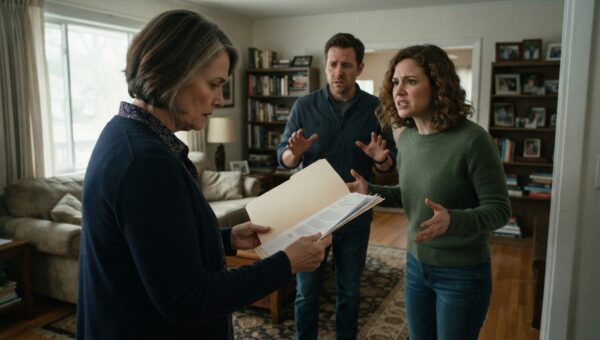
Daniel let out a harsh, jagged breath, turned on his heel, and stalked down the hallway toward the master bedroom. For a second I thought about staying put, but my legs carried me after him before I could think better of it. He pushed open the bedroom door, walked over to the closet shelf, and reached behind a stack of old tax boxes. When he turned back around, he was holding a thick, manila folder labeled with the letterhead of the Oakridge Pediatric Clinic.
PART 3
Daniel walked past me back into the living room and dropped the folder onto the coffee table right beside my coffee mug. The cardboard tab was creased and worn from being pulled in and out of a hiding place many times over the past six weeks.
“Open it,” he said, his voice dropping to a harsh whisper. “Read the intake notes from Maya’s two-week checkup.”
My fingers felt clumsy as I untied the red string holding the flap shut. I pulled out a stapled packet of medical forms and diagnostic printouts. My eyes scanned the clinical jargon until they hit a section highlighted in yellow by a nurse’s marker.
It was a genetic carrier screening report and pediatric developmental assessment.
I looked up at my son, uncomprehending. “Daniel, what is this? Maya is healthy. Chloe told me she was sleeping and growing normally.”
“Physically, yes,” Daniel said, running a hand over his face. “She passed the newborn hearing test, her heart is fine, and she’s gaining weight. But at her two-week visit, the pediatrician noticed some unusual physical markers around her eyes and muscle tone. They ran a targeted genetic panel. The preliminary results came back last month.”
He pointed a shaking finger at the bottom of the second page.
“Neurofibromatosis type one,” I read aloud, the words tasting like dry ash in my mouth. “A spontaneous genetic mutation affecting nerve tissue growth.”
“It’s a mild form, the doctor thinks, based on the initial markers,” Daniel said, his voice breaking. “She might just have some skin spots later on, or she might have learning difficulties down the road. We won’t know for sure until she’s older and more tests are run. But when the doctor handed us that folder, Chloe started crying. She was terrified. She kept saying she didn’t know anything about neurological disorders, and she felt like her body had failed our baby.”
I stared at the medical report, the cold reality of it sinking into my bones like winter rain. “And that’s why you kept me away?” I asked, my voice barely a breath. “Because Chloe was upset?”
“No,” Daniel said, looking away toward the dark window. “That’s not why. Or at least, that’s not the whole reason.”
He swallowed hard, his Adam’s apple bobbing.
“When the pediatrician mentioned that NF1 can sometimes be hereditary, or linked to family history on either side, Chloe started asking questions about our family tree. She asked if anyone on my side had ever had chronic nerve tumors, severe learning delays, or unexplained neurological issues growing up.”
A cold weight settled in the center of my chest.
“Your father,” I whispered.
Daniel nodded slowly. “Dad died when I was four, Mom. All you ever told me was that he had a sudden heart attack on a business trip. But when I sat in that doctor’s office last month, I remembered things from when I was a little kid that I hadn’t thought about in twenty years. I remembered Dad’s hands shaking so badly he couldn’t button his shirt. I remembered the way he used to walk with a strange limp on his left side, and the specialists who used to visit our house when we lived in Chicago before he died.”
He turned to face me fully, his eyes wide and pleading.
“You lied to me my whole life about how Dad died, didn’t you? He didn’t just have a heart attack. He had something genetic, something progressive, and you hid it from me. When the pediatrician asked about family history, I realized I didn’t know anything about my own medical background because you spent my entire childhood erasing his side of the family.”
The room was so quiet I could hear the hum of the refrigerator in the kitchen down the hall. Every word he spoke hit me with the force of a physical blow, not because it was unjust, but because it was true.
For thirty-two years, I had carried the secret of my late husband Robert’s deteriorating neurological illness like a shameful secret locked in a trunk. When Robert died in a specialized care facility after losing the ability to walk or speak, I had told everyone, including my children, that it was a sudden cardiac event. I did it out of grief, out of pride, and out of a desperate desire to protect my kids from the stigma of a hereditary illness they might never inherit. I had buried the truth so deeply that I almost forgot it was there myself.
And now, thirty years later, that lie had reached out from the past and caught up with me through my newborn granddaughter.
“I wanted to protect you,” I said, my voice trembling as the tears finally spilled over my lower eyelids. “You were just a baby when your father got sick. I didn’t want you growing up afraid of your own shadow, wondering if every twitch in your hand meant you were going to end up like him.”
“And when Maya was born, and the doctors started asking questions, my first instinct wasn’t to tell my wife,” Daniel said, his voice dropping to a whisper of pure shame. “My first instinct was to hide it from her, just like you hid it from me. I was terrified that if Chloe found out there was something wrong with my family’s health history, she would look at me differently. She would look at Maya differently. And when you called asking to come over, I panicked. I thought if you walked into the house, you’d start asking questions about the baby’s testing, or worse, you’d recognize the symptoms Robert had and tell Chloe the truth before I figured out how to lie my way through it.”
He sat down heavily on the edge of the sofa, burying his face in his hands.
“I’m sorry, Mom. I know keeping you away was cruel. But I was so scared of losing my family that I started doing the exact same thing you did. I built a wall out of lies.”
ENDING
We sat in the dim living room for a long time as the streetlights outside flickered on through the front window.
The anger I had felt driving home from the grocery store had burned away, leaving behind something much heavier and much harder to fix. There was no villain in the room, only two people who had learned the same bad habit of protecting themselves by withholding the truth.
“Does Chloe know about Robert?” I asked quietly.
Daniel shook his head slowly without looking up. “Not yet. I told her the genetic panel was inconclusive and that we needed to wait for the pediatric specialist’s review next month. But she knows something is being kept from her. She can feel it, Mom. Just like I could my whole life.”
I reached out and placed my hand on the arm of the sofa, inches from his bent head.
“We have to tell her,” I said.
Daniel looked up at me, his eyes red-rimmed and fearful. “She’ll be angry. She’ll wonder what else we’re hiding.”
“She will,” I agreed. “And she has every right to be. But if we don’t tell her the truth now, together, this secret is going to poison every single day she spends raising that little girl.”
I stood up, walked over to the entry table where Daniel had tossed his briefcase, and picked up my car keys.
“Get your jacket,” I said softly.
Daniel looked up, surprised. “Where are we going?”
“We are going to your house,” I said, looking down at the metal ring in my hand. “You’re going to tell Chloe the truth about the medical report, and I am going to sit right beside you while you tell her about your father. No more hiding. No more Ohio stories.”
Daniel stared at me for a long moment, the tension slowly draining out of his shoulders. He reached down, picked up the pediatrician’s folder from the coffee table, and tucked it securely under his arm.
As we walked out to the car together into the cool April evening, I left the front porch light burning behind us.