PART 1
I sat on the witness stand in 2009, raised my right hand, and swore to tell the truth.
My son, Darren, sat at the defense table in a navy suit I had ironed for him that morning. His ex-wife, Laura, was across the aisle with a court-appointed advocate. My grandson, Toby, was six years old, sitting in a small private room down the hall with a child counselor.
Laura had filed for emergency sole custody and a protective order. She brought photographs of dark bruises shaped like thumbprints on Toby’s upper arm. She told the family court judge that Darren had come home drunk on a Sunday night, lost his temper over spilled milk, and dragged the boy across the carpet by his arm.
Darren looked me in the eye out in the hallway before the hearing. He held my hands and swore Laura was lying. He told me Toby had fallen off the metal jungle gym at the township park, and that Laura was making up stories to strip him of his parental rights and drain his paycheck for child support.
I knew my son drank. I had smelled bourbon on his breath at Sunday dinners, and I had seen the empty cans hidden in his garage trash bins. I had seen the purple marks on Toby’s arm myself two days before the filing.
But Darren was my only boy. I had raised him alone after his father died, working double shifts at the phone company. I couldn’t accept that the baby I had rocked was capable of hurting his own son. I convinced myself that mothers protect their children, so I looked the judge in the face and testified that Darren was a devoted, gentle father who never had more than an occasional beer.
The judge denied Laura’s emergency order and awarded joint custody with equal time.
Laura walked out of the courtroom holding Toby against her shoulder. When she passed my bench, she didn’t curse. She just looked at me with red, exhausted eyes and said, “You chose a drunk over your grandson, Martha. You’ll have to live with that.”
Within four months, Darren got arrested for operating while intoxicated with Toby in the passenger seat. Laura immediately went back to court with the police report, obtained full legal and physical custody, and moved four hundred miles away to northern Michigan.
For thirteen years, there was total silence.
No school photos came in the mail. No phone calls on Thanksgiving. Laura blocked my number, and Darren drifted away into odd jobs, blaming everyone in the world for his troubles before disappearing out West.
Every single year on September 12, I wrote out a $40 birthday check for Toby. I signed each one, wrote “With love, Grandma Martha” in the memo line, and put it in a decorative cedar box in my dresser drawer. By last year, there were thirteen checks sitting in that velvet lining.
Then, last spring, a cream-colored envelope arrived from a high school in Traverse City.
Inside was a formal printed commencement invitation with Toby’s name embossed in green foil, and a small wallet-sized senior photo. He was nineteen, broad-shouldered, with his mother’s steady brown eyes. Tucked behind the photo was an extra ticket and a note in Laura’s handwriting: “He asked for you to have this. It’s up to you.”
I drove six hours north by myself in my ten-year-old Buick. I sat in the high school bleachers surrounded by families with balloons and flowers. When Toby’s name was called, the principal announced that he was the class salutatorian and the recipient of a $28,000 regional engineering scholarship.
After the ceremony, I stood by the brick pillars near the gymnasium exit, holding my purse with two hands, feeling out of place.
Toby walked toward me through the crowd. He was tall, wearing his dark green gown with gold honor cords draped across his chest. He looked down at me, his face serious and calm, and handed me a sealed white business envelope.
My hands trembled so much I could not tear the paper.
He touched my sleeve gently and said, “Grandma, did you know I begged you to tell the truth that day?”
PART 2
The noise of the graduation crowd seemed to drop away. Families were laughing and taking photos around us, but my eyes stayed locked on Toby’s face.
“What do you mean, Toby?” I asked, my voice barely audible.
“Open it,” he said quietly. “Not here. Read it in your car.”
He didn’t stay to talk. A group of boys in green gowns shouted his name from the lawn, and his mother Laura was waiting near the parking gate. Laura saw me across the walkway. She didn’t wave, but she gave me one stiff nod before turning to walk with her son toward their car.
I walked back to my Buick, sat behind the steering wheel, and locked the doors.
The afternoon sun was beating against the windshield. I slipped my finger under the flap of the envelope and pulled out two folded sheets of yellowed notebook paper, along with a small, lined index card.
The notebook paper was written in the uneven, rounded print of a six-year-old child using a blue crayon.
The date at the top was October 4, 2009. That was two weeks before the custody hearing.
*Dear Grandma,* the first page read. *Daddy got mad because the cup broke. He pulled my arm real hard and it hurt. He said if I tell Mommy he will throw my dog in the road. Please tell the judge I want to stay with Mommy. Daddy smells bad like the brown bottles. You promised you would keep me safe.*
Taped to the bottom of the second page was a small strip of pink construction paper. It was a note my own son had written to Laura three days before court, in Darren’s hurried handwriting: *I found this in his backpack. If you try to hand this to the social worker, my mom will swear on the Bible that he made the whole thing up to get attention. She’ll back me, not you.*
My chest felt hollow, like all the air had been pulled out of the vehicle.
Darren had seen that note in 2009. He had intercepted Toby’s cry for help, kept it in his jacket, and used my blind loyalty as a weapon against his ex-wife and his six-year-old boy. He knew I would stand in front of that judge and defend him, because he knew I was terrified of admitting what he had become.
I picked up the third piece of paper, the lined index card.
This one was written recently, in Toby’s adult hand:
*Grandma, I found that crayon letter in Mom’s lockbox when we moved out of our apartment last year. Mom told me that when she showed you the bruises that fall, you told her boys play rough and that Darren was a good provider. I hated you for a long time. When I got the scholarship, my advisor asked us to write down the people who made us strong. Mom worked three jobs so I could study. She never let Darren near me again. I didn’t invite you here to take your money or hear an excuse. I invited you because I wanted you to see what I built without you, and I wanted you to know that the six-year-old boy in that courtroom never forgot who chose to look away.*
I sat in that parking lot until the school buses cleared out and the gravel was empty.
I was sixty-four years old. I had spent thirteen years telling myself that Laura was bitter, that the courts were unfair, and that my family had been torn apart by circumstances beyond my control. I had kept those $40 checks in a neat little drawer like a mother who had simply been wronged by distance.
The truth was much uglier. I had traded my grandson’s safety to protect my own pride as a mother. I had enabled an alcoholic who drove drunk with a six-year-old boy in the front seat four months after I gave him a clean character reference.
I pulled out my phone and dialed the number Toby had written at the bottom of the index card.
It rang four times before clicking over.
“Hello?” Toby said.
“Toby,” I managed to say, my throat tight. “I’m still in the parking lot. If you’ll give me twenty minutes, I want to come to your mother’s house. Not to defend myself. Just to hand you what belongs to you.”
PART 3
Laura lived in a modest white-sided duplex on a quiet street near the bay.
When I pulled into the short gravel drive, Toby was sitting on the wooden front porch steps, still wearing his dark dress pants and white shirt, with his gold honor cord laid across his knees. Laura stood just behind the screen door, visible only as a silhouette against the hall light.
I walked up the walk with my canvas purse on my arm and the cedar box from my dresser in my hands.
I didn’t try to hug him. I stopped three feet from the bottom step, looking up at him.
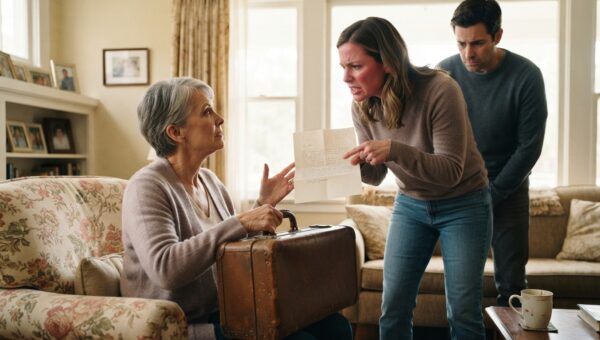
“You were right, Toby,” I said, looking straight into his eyes. “Every word you wrote on that card is true. I saw the marks on your arm in October of 2009. I smelled the liquor on Darren’s coat. And I stood in front of that judge and lied because I couldn’t bear to admit that my son was an abusive drunk.”
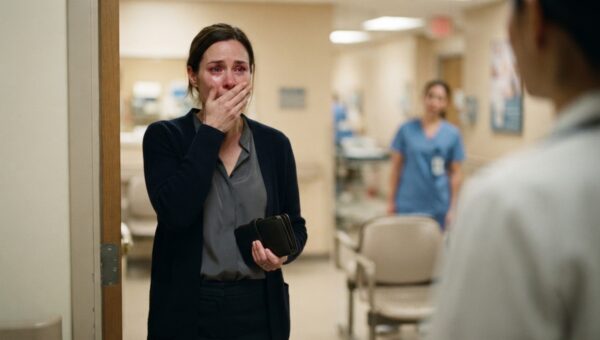
The screen door opened with a quiet creak. Laura stepped out onto the porch. She had gray streaking through her hair now, and her face showed the hard work of raising a boy alone on a retail clerk’s wage.
“Why are you here, Martha?” Laura asked. Her voice was not loud, but it was cold.
“To apologize to both of you,” I said. “I spent thirteen years feeling sorry for myself. I told my church friends that you took Toby away out of spite. That was a lie I told so I wouldn’t have to look at my own face in the mirror. You were the only parent who protected him. You did what I should have helped you do from the start.”
I reached into my bag and set the cedar box on the middle step between us.
“Every year since you left, I wrote a forty-dollar check on September twelfth,” I told Toby. “Thirteen checks. They aren’t worth anything because they’re drawn on an old bank account. But I brought this instead.”
I pulled an envelope from my coat pocket and laid it on top of the wooden box.
Inside was a certified cashier’s check for $28,000, drawn that morning from my local credit union. It was the payout from my late husband’s small pension annuity that had matured when I turned sixty-two, money I had left untouched in a high-yield certificate of deposit.
“What is this?” Toby asked, looking at the bank draft without touching it.
“You earned a twenty-eight-thousand-dollar scholarship for your tuition,” I said. “The news said it covers your classes, but engineering students have to pay for dorms, books, tools, and food. Your mother shouldn’t have to work extra shifts at fifty to cover what your father’s family owed you.”
Laura looked down at the check. Her jaw set hard, and she crossed her arms tightly.
“We don’t need your guilt money, Martha,” Laura said. “We survived thirteen years on fifty-dollar groceries and thrift store coats. Toby has a work-study job lined up in the campus lab. We didn’t ask you for a single dime.”
“I know you didn’t,” I said. “This isn’t an inheritance, Laura. And it’s not a bribe to make you let me be a grandmother. It is restitution for the attorney fees you had to pay in 2009 when I dragged out a custody trial that should have ended the first morning. You spent every dollar you had fighting my lie. That money belongs to Toby’s future, not my bank account.”
Toby picked up the cashier’s check. He looked at the printed numbers, then at his mother.
For nearly two minutes, nobody said a word. The only sound was the wind coming off the water through the birch trees along the road.
ENDING
Toby stood up from the porch step. He folded the bank draft carefully and handed it to his mother.
“Take it for the dorm housing, Mom,” he said quietly. “You won’t have to work the weekend inventory shifts at the warehouse this fall.”
Laura looked at the check in her hand, then looked at her son. Her shoulders dropped an inch, the tight stiffness in her neck finally easing. She didn’t smile, and she didn’t offer to invite me inside for coffee. That would have been unnatural after thirteen years of silence.
Instead, she looked down at me and said, “I’ll open a dedicated escrow account for his student living fees on Monday. He will send you the university receipts for every dollar spent.”
“That’s all I want,” I told her.
I turned to walk back to my car, but Toby stepped down the three wooden steps and caught up to me near the front fender of my Buick.
He reached into his pocket and pulled out the small brass key to his dorm room that the college had mailed him with his enrollment packet. He didn’t hand me the key, of course, but he reached out his right hand, the same arm Darren had bruised thirteen years ago, and offered a firm, adult handshake.
“Thank you for saying it out loud, Grandma,” he said. “That mattered more than the money.”
“You did this yourself, Toby,” I told him, pressing his calloused hand between both of mine. “You built a good life with clean hands. Don’t ever let anyone make you doubt who you are.”
He nodded once, turned, and walked back up the porch steps where his mother was waiting.
I made the six-hour drive back to Ohio the next morning.
The house felt different when I walked in through the back kitchen door. The decorative cedar box was gone from my dresser drawer, leaving the top shelf bare except for my jewelry dish and my reading glasses.
I haven’t heard from Darren in four years. If he ever calls from whatever state he is wandering through, asking for money or making excuses for his life, I know exactly what I will say to him. The days of shielding a grown man from his own cruelty are finished.
Last week, an envelope arrived in my mailbox with a Michigan postmark.
Inside was a printed receipt from the university bursar’s office showing a payment of $3,450 for first-semester campus housing, marked paid in full. Stapled to the corner was a three-by-five photo of Toby standing in front of the engineering building with a stack of textbooks under his arm.
Written on the back in neat pencil was: *First day of thermodynamics. Thanks, Toby.*
I took a magnet and placed the picture squarely in the center of my refrigerator door, right beside my grocery list. It doesn’t undo the testimony I gave in that courtroom in 2009, and it doesn’t give me back the thirteen years of birthdays I missed. But every time I walk into the kitchen to make my morning coffee, I look at that boy’s face and know that the truth finally found its way home.