PART 1
For twenty-six years of marriage, Arthur treated me like hired help he didn’t have to pay. When David and I went over for Sunday dinner, I was the one who cleared the plates, washed the good china, and packed up the leftovers while Arthur and David watched the game in the den. Arthur never raised his voice, but he had a way of looking right past you, as if you were just a piece of furniture that happened to dust itself. He called me by my name, but it always sounded like an order. Bring me my glasses. Hand me the remote. See if there is any coffee left.
David used to apologize in the car on the drive home. He would put his hand over mine and say, My dad is from a different time, Sarah. He respects you in his own stubborn way. I told David it did not matter. Families are complicated, and when you marry someone, you inherit their people warts and all. We built our lives twenty minutes away, raised our two kids, and kept showing up for holidays because that is what you do.
Then David got sick. It was pancreatic cancer, and it moved faster than the doctors could track. He was gone in eight months. Those final weeks, Arthur visited the hospital twice. Both times he sat in the corner chair, stared at his shoes, and left after twenty minutes because the sterile smell made him anxious. He did not cry in front of me. When David passed away at fifty-two, the silence in our house was heavier than grief. It felt like the air had turned to lead.
Brenda, my sister-in-law, flew in from Ohio for the funeral. She stayed for three days, complained about the guest room mattress, and told me I needed to figure out my finances immediately because David had not been careful with his life insurance. She left before the thank-you notes were even written. Arthur’s other two children, Mark and Linda, live out west and sent flowers with generic cards. None of them called after the first month.
Except Arthur. He did not call, but he needed a ride to his cardiologist in town.
The first time I pulled into his gravel driveway after David died, the house looked smaller. The white paint was peeling around the back porch, and the lawn needed mowing. Arthur came out to the car wearing his stained cardigan and his old loafers. He did not say thank you when I unlocked the passenger door. He just settled himself in, adjusted his cap, and said, You are late. The appointment was for ten.
It was nine-forty. I didn’t correct him. I just put the car in drive and took him to his appointment.
Over the next fourteen months, those drives became my entire routine. Every Tuesday was the pharmacy and the grocery store. Every other Thursday was the endocrinologist or the eye doctor. My own grief was waiting for me at home, but in Arthur’s car, I had a job to do. I carried his oxygen tank when his breathing got shallow. I held his elbow on the icy sidewalk outside the medical center. He never thanked me. He would just grunt when we reached his front door and tell me when to pick him up next week.
My friends told me I was crazy. They asked why I was spending my retirement running errands for a man who had treated me like a servant for three decades. My daughter, Chloe, told me straight out that Brenda and Mark should be paying for a home health aide. But I kept going. Maybe it was stubbornness. Maybe it was because Arthur was the last living link I had to David. When I looked at Arthur’s crooked nose and the way his ears stuck out, I saw David looking back at me.
Then came a Tuesday in November.
Arthur had been feeling dizzy all morning, but he insisted on raking leaves in his front yard until he stumbled and hit his porch railing. By the time I arrived to check on him, he was pale and sweating through his shirt. I did not wait for his permission. I called an ambulance and rode in the back with him all the way to Mercy General.
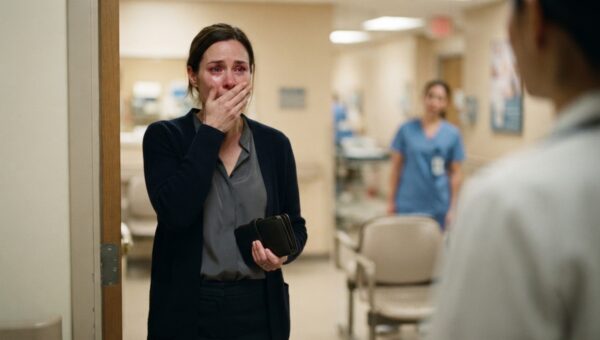
In the emergency room bay, the monitors were clicking and nurses were moving in and out with IV bags. Arthur was lying on the stretcher with his eyes closed, looking smaller and frailer than I had ever seen him. A young nurse with tired eyes came over to my chair and handed me a worn leather wallet held together by a rubber band.
His belongings from intake, she said gently. You are his emergency contact, right? Make sure you keep this safe. We are moving him upstairs for observation.
I took the thick, battered leather. It smelled of old mints and leather conditioner. I opened it up to slide it into my purse, checking the slots to make sure his Medicare card and driver’s license were secure. Behind the cloudy plastic window of the insurance card slot, something caught my eye. It was not a medical card. It was a small, faded photograph with curled edges.
I pulled it out with trembling fingers. It was a picture of David and me taken thirty-two years ago, standing on the tiny front porch of our very first rented apartment in town. We were both smiling, sun-browned, and wearing cheap clothes we had bought at the discount store. I had my arm wrapped around David’s waist, and he was laughing at something the person behind the camera had said.
I turned the photograph over.
On the back, written in Arthur’s shaky, old-fashioned handwriting with a black ballpoint pen, were six words.
The daughter I was too proud to call mine.
Tears spilled over my lashes before I could stop them. I pressed the photo against my chest, staring at the linoleum floor while the monitors hummed around us. For thirty-two years, I had believed I was nothing to him. I was just the girl who took his son away, the outsider who didn’t fit into their old-money town. All that time, while I was scrubbing his kitchen floor and listening to his complaints, he had carried that picture in his wallet.
I was still wiping my eyes with the back of my sleeve when his cell phone buzzed loudly on the metal tray beside the bed.
PART 2
The screen lit up with a flashing name that made my stomach drop.
Brenda.
I stared at the glowing phone for three seconds. The emergency room was noisy, with a doctor talking loudly down the hall and a cart clattering past, but that screen felt like a spotlight. I pressed the answer button and brought the phone to my ear.
Hello, Brenda, I said, my voice still thick with tears from the photograph in my hand.
She did not say hello. She did not ask if her father was alive or what hospital we were in.
Did Dad sign the house over yet? she asked, her voice sharp and hurried. Mark talked to the lawyer in Columbus this morning. If he doesn’t sign the quitclaim deed before the end of the month, the tax penalties on the estate transfer are going to eat up half the equity. I told him months ago to get it done, but you know how stubborn he is. Have you got the papers in your bag?
I stood frozen beside the metal rolling tray. My hand was still clutching Arthur’s worn leather wallet and the faded photograph of David and me. The warmth of the discovery in the ER bay drained out of me in a single second, replaced by a cold, sharp anger.
Brenda, I whispered, looking down at the screen. Your father is in the emergency room. He just took a bad fall and they are admitting him for heart observation.
There was a short pause on the line. I thought for a moment she might apologize, or at least ask which hospital. Instead, she let out a heavy, irritated sigh that crackled through the speaker.
Oh, for heaven’s sake. Always a drama whenever he needs attention. Look, Sarah, can you get him to sign the papers while he is lying there in bed? Just put the pen in his hand. The lawyer said as long as his signature is witnessed, it doesn’t matter where it happens. If we wait until he comes home, Mark and I will have to fly out again, and you know how expensive flights are right now. Just get it done.
Before I could answer her, a raspy, weak voice cut through the air from behind the privacy curtain of the stretcher.
She is not getting anything signed for you, Brenda.
My heart gave a hard thump. I turned around quickly.
Arthur was propped up on one elbow against the hospital pillows. His face was gray and his hospital gown hung loosely over his frail shoulders, but his eyes were wide and bright with a fierce, burning clarity. He was looking straight at my hand, where the phone was still pressed to my ear.
Dad? Brenda’s voice squawked through the phone speaker, loud enough for anyone in the bay to hear. Is that you? Put Sarah back on. Listen, Dad, we need to talk about this deed before the tax deadline. You promised Mark and me—
Arthur reached out a shaking, liver-spotted hand and took the phone right out of my fingers. He didn’t look like a feeble old man anymore. He looked like the patriarch who had ruled his household with an iron fist for fifty years.
I promised you nothing, Brenda, Arthur said into the phone, his voice scraping like gravel across concrete. You haven’t called me in four months except to ask about my property. You didn’t come to your brother’s memorial service because you said plane tickets were too high. And now you are calling a hospital room to see if I am dead yet so you can grab the deed.
Dad, don’t be ridiculous—
I am not being ridiculous. I am finally seeing things clearly, Arthur snapped, cutting her off completely. Sarah has been driving me to every doctor appointment in this county while you and Mark were dividing up my furniture before my heart even gave out. The house goes to her. I signed the new papers with my attorney last Tuesday. You and Mark are getting your inheritance from the bank account, and not one cent more.
There was a sharp gasp on the other end of the line, followed immediately by a dial tone. Brenda had hung up.
Arthur lowered the phone slowly. His hand was shaking so badly he almost dropped it on the blanket. I reached out and took the phone from his grip, setting it carefully on the bedside table.
For a long minute, neither of us said anything. The monitors kept clicking. A nurse walked past the doorway, her rubber-soled shoes squeaking against the floor.
Arthur turned his head on the pillow and looked up at me. His mouth worked for a second, as if he were trying to swallow something heavy in his throat.
You shouldn’t have had to drive me all those times, Sarah, he said quietly, his voice cracking slightly at the edges. I was too proud to ask right. And I was too proud to tell you what I thought of you after David died. I thought if I acted like my usual self, you wouldn’t see how much I was hurting too.
I pulled the chair closer to the bed and sat down, my knees nearly touching the metal frame. I didn’t cry this time. I just reached out and placed my hand over his dry, veined knuckles.
You were a pain in the neck every single Tuesday, Arthur, I said, a small, genuine smile pulling at the corner of my mouth. And your driving directions were terrible.
Arthur let out a dry, rattling chuckle that turned into a small cough. He squeezed my hand back, surprisingly strong for a man half his size.
PART 3
Arthur spent three days in the cardiac unit. The doctors adjusted his medication and told him to avoid heavy yard work, which he grumbled about constantly. During those three days, my phone buzzed repeatedly with hostile text messages from Mark and missed calls from Brenda. They demanded copies of the new deed, accused me of manipulating an elderly man on his deathbed, and threatened to contest the will in probate court.
I didn’t answer a single one of them. I forwarded every message to the attorney Arthur had named, a sharp-eyed woman named Carol Vance who had handled our family trust back when David was alive.
When I met with Ms. Vance in her second-floor office overlooking the town square on Friday morning, she slid a certified copy of the recorded deed across her mahogany desk.
Your father-in-law came in here two weeks ago, all by himself, Ms. Vance said, adjusting her glasses. He drove his old Buick right into my reserved space, parked crooked, and told me he wanted to make sure his house went to the only person who showed up when his heart started failing. He was entirely of sound mind, Sarah. We recorded the audio statement just in case his children tried to make trouble. There is nothing Mark or Brenda can do.
I looked at the document with my name on it. It wasn’t about the money or the real estate value. It was about validation. For twenty-six years, I had felt like an invisible attachment in that family, tolerated only because I was married to David. Now, looking at Ms. Vance’s embossed seal, I realized that loyalty had a weight of its own.
When I discharged Arthur from the hospital and drove him back to his small, faded house, things were different between us. The silence in the car wasn’t stiff anymore. It was quiet and steady.
He didn’t make me carry his bags inside. He insisted on carrying his own small overnight duffel, walking slowly up the front steps with his cane. When we got inside the kitchen, he didn’t bark an order for coffee or complain about the thermostat.
He walked over to the kitchen counter, opened the small wooden recipe box where he kept his stamps and spare keys, and pulled out a small, flat cardboard box. He set it on the table between us.
Open it, he muttered, looking away toward the window.
I lifted the lid. Inside were a dozen old photographs of David as a boy, along with a few loose snapshots of David and me during our early married years, pictures I hadn’t seen in decades. Right at the bottom was the original negative of the photo I had found in his wallet in the emergency room.
He kept those in his desk drawer all those years, hidden under his tax forms, Arthur said, his voice dropping low. He loved you, Sarah. He told me once, before he got sick, that he didn’t know how I could be so blind to how hard you worked to keep our family together. I told him he was wrong. I was stubborn. It took me losing him to realize David was right about almost everything.
I didn’t say anything for a long moment. I just reached into the box and picked up a picture of David standing by our first rusted sedan, laughing so hard his eyes were closed.
ENDING
Brenda and Mark stopped calling by December. They hired a local attorney in Columbus to review the estate file, but once their lawyer saw the audio recording and the notarized deed from Ms. Vance, they let the matter drop. They didn’t come home for Christmas, and Arthur didn’t ask for them.
Instead, Christmas dinner was just Arthur, Chloe, and me at my kitchen table. Arthur ate two helpings of pot roast and even told a dry joke about his cardiologist that made Chloe laugh out loud. He wasn’t a warm, affectionate man even then; he was still Arthur, stubborn and sharp-edged and set in his ways. But when he left that evening, he gave my shoulder a firm squeeze and told me I was a good driver.
Arthur passed away peacefully in his sleep six months later, just as the spring weather was turning warm. When we cleaned out his house, we found no more hidden notes. There was nothing left to explain.
Today, the faded photograph from the ER wallet sits in a simple wooden frame on my living room mantel, right next to a picture of David. Sometimes, when the house is quiet and the afternoon sun hits the glass just right, I look at the six words written on the back in that shaky black ink.
I don’t think about the twenty-six years of washed dishes or the silence across Sunday dinner anymore. I just remember the man who finally learned to say what he meant before it was too late.