PART 1
Maya has lived in my house since the day her mother died in a car wreck ten years ago. She was six then, clutching a small plastic duck and staring at the hallway wall like she expected her mother to walk right back through the front door. I raised her because there was nobody else who could, and because she was the only piece of my daughter I had left.
We had a quiet, predictable life in our small Ohio town. I worked part time at the county records office until I retired, and Maya grew up into a quiet, serious girl who kept her room clean and her grades near the top of her class.
On her sixteenth birthday, she did not ask for a phone upgrade or brand-name clothes or a party with her friends. She sat at the kitchen table across from me, her hands folded over a piece of loose-leaf paper, and asked for one thing. Permission to get a part time job at the diner down on Main Street. She said she wanted to start saving her own money so she would not have to ask me for cash when school field trips or club fees came up. I looked at her serious brown eyes, so much like her mother’s, and I said yes. I thought it was a healthy step toward growing up.
Three months later, I was not so sure. Maya was constantly exhausted. She worked every weekend shift the diner manager would give her, plus a few hours on Wednesday evenings scrubbing counters. She never bought herself a soda, never went to the movie theater with her classmates on Friday nights, and still refused to spend a single dollar of her earnings. I worried she was driving herself into the ground trying to save for a used car before she even had her learner’s permit. I kept telling her she did not need to rush, that sixteen was too young to look that tired around the eyes. She just smiled a tight, practiced smile and told me she liked keeping busy.
Then the phone rang on a Tuesday afternoon while I was folding laundry. It was the high school guidance counselor, a kind woman named Mrs. Gable. She asked if I had a few minutes to talk about Maya.
She told me she had noticed Maya skipping lunch most days, which alarmed me because I packed her an apple and a sandwich every single morning. When Mrs. Gable gently pressed Maya about it, the truth came out. Maya had not been eating her own lunch because she was using her own money to pay off other students’ lunch accounts in the cafeteria.
Not one student. Four. Kids whose parents had fallen behind on payments and were facing embarrassment in the lunch line.
I thanked Mrs. Gable, hung up the phone, and felt a strange mix of pride and heavy unease settle in my chest. I waited at the kitchen table until Maya walked through the front door after her shift at the diner, her backpack slung over one shoulder, looking thinner than she had six months ago. I asked her why she was paying for other kids’ lunches. She dropped her backpack by the door, shrugged, and said, “They needed it, Grandma. It’s not fair that kids get made fun of over food.”
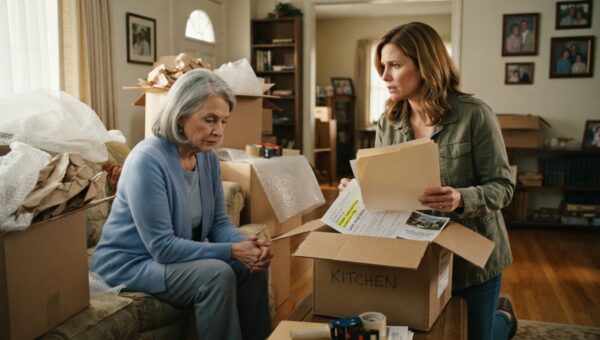
I didn’t yell at her. I couldn’t. But as she walked past me toward the hallway, I picked up her heavy canvas backpack to move it out of the doorway. The bottom zipper was half open, and a crisp, folded white envelope slid out onto the linoleum floor. I picked it up. Inside was a formal hospital billing statement with my name and address at the top. The total amount due was $3,870 for the emergency room visit I had last November when my blood pressure spiked.
At the bottom of the page, stamped in bright red ink, was a notation showing that an initial payment of $1,935 had already been processed two weeks ago. Half the balance, paid in full. My name was on the bill, but I had never sent a dime of that money.
I looked up at Maya, who had stopped in the hallway. Her face had gone entirely white. I held out the paper and asked her where this came from. She looked terrified, backing up a step until her shoulder hit the wall, and whispered, “Grandma, I wasn’t supposed to tell you who gave it to me.”
PART 2
I stayed at the kitchen table for a long time after Maya spoke those words, the hospital bill flat and cold beneath my fingertips. The numbers stared back at me: $3,870 total, with $1,935 receipted away. That was more than half of what Maya earned working eighty hours a month at the diner for minimum wage plus whatever small tips people left on sticky tables.
“Sit down, Maya,” I said, keeping my voice lower than I felt. My chest was tight, the old familiar panic from my November health scare threatening to return. “Tell me what this is about. Right now.”
Maya pulled out the wooden chair opposite me, her fingers digging into the edge of the seat. She stared at her sneakers instead of my face. She explained that back in November, right after I came home from the hospital looking pale and shaking, she had found the first collection notice hidden underneath a stack of coupons on the counter. I thought I had hidden all the mail from her. I had always tried to keep the ugly, stressful parts of adult life away from her shoulders. I thought children were supposed to be protected from debt and insurance denials and interest rates.
“You couldn’t sleep for three nights, Grandma,” Maya said, her voice shaking slightly. “You kept talking about how we were going to pay the deductible and buy groceries too. You thought I was asleep in my room, but I wasn’t. I heard you crying in the kitchen.”
That broke something inside me. I had prided myself on being the strong one, the steady anchor after her mother died. I never once let her see me cry over money, or so I thought. But children notice everything. They smell the tension in a room before a single word is spoken.
“So you got a job,” I said.
“I got the job because of the bills,” Maya admitted, a tear finally spilling over her lashes and cutting a clean path down her dusty cheek. “I wanted to pay off the whole thing before you got another warning letter in the mail. But… I didn’t have enough by myself yet. Not with buying the lunch accounts for the kids whose parents lost their jobs at the plant.”
I leaned forward, resting my elbows on the worn laminate table. “And the other half, Maya? Who paid the first half of this hospital bill? You said someone gave it to you.”
Maya swallowed hard, her throat bobbing. She reached into her jacket pocket and pulled out a folded piece of lined paper with a phone number and an address written in unfamiliar handwriting.
“I found him online,” Maya whispered. “My uncle. Your son, David.”
PART 3
The name hung in the kitchen air like smoke. David. My only son, who had packed up his car seven years ago after a bitter argument about responsibility and money, drove out to Colorado, and never once looked back. No birthday cards, no holiday calls, no inquiry about how his teenage niece was surviving after her mother’s death. I had crossed his name off my calendar years ago. To hear Maya say she had tracked him down through social media records felt like a physical blow.
“You contacted him?” I asked, my voice barely audible.
“I had to,” Maya said, her chin lifting with a stubbornness that reminded me entirely of her late mother. “I messaged him three months ago. I told him you were working yourself sick trying to keep the house running and paying off your medical bills while raising me. I told him you wouldn’t ask anyone for help because you were too proud. So he sent a check directly to the hospital billing office. That’s why his name isn’t on the statement. He told me not to tell you because he knew you’d send the money back.”
I sat back in my chair, staring at the lined paper in her hand. My son, who had abandoned us when things got hard, had quietly sent nineteen hundred dollars to clear my name at the hospital, not by talking to me, but by letting a sixteen-year-old girl shame him into doing the right thing.
“I didn’t want charity from him,” Maya continued quickly, wiping her face with her sleeve. “I just wanted what was fair. He owes you, Grandma. He owes us. But mostly, I just wanted you to be safe. I’m sorry I kept it a secret.”
The anger I thought I would feel toward David evaporated, replaced by a profound, heavy sorrow for the girl sitting across from me. She had carried the financial weight of an adult household on her shoulders for months, walking to school on an empty stomach because she cared more about other people’s dignity than her own breakfast.
We talked for two hours after that. I told her that no matter how tight money got, she was never, ever to take on adult debts again. I explained that we were a team, and hiding things from each other defeats the entire purpose of being a family. She listened, really listened, and promised she would talk to me whenever things got heavy.
The next morning, I called the hospital billing department myself. I verified that the remaining balance of $1,935 was still outstanding. Using my own retirement savings account, the small cushion I had guarded for years, I paid the exact remaining balance in full over the phone. I didn’t call David. I didn’t send him a thank-you note. Some bridges are burned too thoroughly to rebuild with a single transaction, and my loyalty belonged to the girl who had spent her weekends scrubbing diner counters to keep a roof over our heads.
ENDING
Two weeks later, Maya came home from school without her backpack heavy with secret worry. She sat at the kitchen table, unpacked a fresh turkey sandwich I had packed for her, and actually ate it instead of giving it away. She still worked her weekend shifts at the diner because she liked having her own pocket money for school dances, but the frantic, hunted look in her eyes was gone.
On the kitchen counter, right next to the fruit bowl, I placed the final zero balance receipt from the hospital, framed in a simple wooden border. Whenever I look at it, I don’t think about the debt or my son’s distant check. I think about a sixteen-year-old girl sitting on the linoleum floor, holding out a paper she was never supposed to show me, proving that we were going to be just fine.