Thirty-four hundred dollars. That was the exact figure missing from the second-floor dresser drawer, and forty-two dollars was what was left in Grandma’s checking account the morning she passed. My uncle Robert stood in her narrow linoleum kitchen just two hours after the coroner left, shaking his head and pointing a thick finger at Elena, the quiet home-care aide who had wiped Grandma’s forehead for the last fourteen months.
“She had sticky fingers from day one, Julian,” Robert told me, his voice pitching up into that tight, righteous whine he used whenever he wanted an argument settled before it started. “Look at the tea tin on the mantel. It’s cleaned right out. Mum trusted her, and this is how she pays us back.”
Elena didn’t yell. She just stood by the sink with a worn leather purse clutched against her coat, her eyes red-rimmed from crying over a woman she had cared for better than any of us.
“I never touched a dime of her money,” Elena whispered, her voice shaking so hard she could barely get the words out. “Ask her about the groceries. Her card was declining every Tuesday for three weeks straight.”
Robert waved a hand like he was swatting a fly. ” Excuses. Everyone has excuses when they get caught with their hand in the cookie jar.”
I had known Robert my whole life. I knew how he operated down at the county road department, always working some angle, always complaining about how tight money was while driving a three-year-old truck. But standing there in Grandma’s kitchen with the kettle still warm on the burner, I didn’t want to look closer. It was easier to nod along with Robert. It was easier to let him take charge of the paperwork, the funeral flowers, and the clearing out of the pantry.
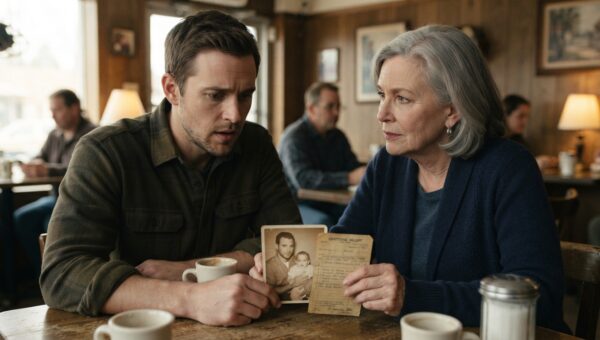
The trouble started three days later when Elena intercepted me in the parking lot behind the pharmacy. She wasn’t crying anymore. She looked tired, the kind of bone-deep exhaustion that comes from working double shifts at the nursing home and then spending your evenings sitting by a dying woman’s bed. She reached into her canvas tote and pulled out a thick rubber-banded wad of crumpled white slips.
“These are from the Piggly Wiggly and the corner pharmacy,” Elena said, shoving the papers toward my chest. “I paid for her eggs, her milk, her water pills, and her oatmeal out of my own pocket since November. Look at the dates, Julian. Look at when the card started getting rejected.”
I took the bundle. The paper was that thin, cheap thermal kind that fades if you leave it in the sun too long. The ink was already turning a pale purple at the edges.
“Why didn’t you tell me?” I asked, feeling a strange, heavy knot form right behind my ribs.
“I tried,” she said, her voice dropping to a harsh flat line. “I told your uncle three separate times that the account was bouncing at the register. You know what he told me? He told me Mum was just confused about her balance and to use my own cash until he could sort it out with the bank.”
I sat in my sedan for twenty minutes after she drove away, staring down at those grocery slips. The total came to four hundred and eighty-six dollars and twenty cents. A woman making minimum wage at two different facilities had spent half a week’s grocery money on a woman who wasn’t even her kin, while Robert lived twenty minutes away in a split-level with a riding mower in the shed.
That evening, I pulled every bank statement out of Grandma’s oak filing cabinet and spread them across my own kitchen table. I didn’t turn on the overhead light, just the little brass lamp by the window. The house was dead quiet except for the hum of the refrigerator. I started with January and worked my way forward, running my thumb down the columns of numbers, matching deposits and withdrawals line by line.
Grandma’s Social Security check hit on the third of every month. By the tenth, the balance was usually sitting pretty around three thousand. But starting back in September, something weird started happening to the column. Every single Friday, without fail, between 4:15 and 4:45 in the afternoon, there was a three-hundred-dollar withdrawal flagged at the ATM machine inside the Shell station on Fourth Street.
That station was three blocks from the county road department office where Robert worked as a senior estimator.
I checked October. Same thing. Every Friday. Three hundred dollars. I checked November. Same pattern, right up until the day the account hit four dollars and twelve cents and the card started spitting out insufficient funds notices at the grocery store checkouts.
My hands went cold. I didn’t call Robert. Not yet. I waited until Saturday morning when I knew he would be down at the hardware store buying supplies for his weekend deck project. I let myself into Grandma’s house with the spare key Robert had given me, the one he thought only he and I possessed.
The house smelled like lemon oil and stale peppermint, the way it always had when she was sitting in her high-backed rocking chair by the front window. The old green tea tin was still sitting on the mantelpiece, right where Robert had tossed it after declaring it empty on the day of her passing. It was a metal cylinder painted with faded yellow roses and a peeling gold rim, an old thing she had kept since the sixties to store her buttons and spare change before she started hiding her grocery money inside it.
I walked over, picked it up, and popped the lid off. It rattled against the brass rim. The inside was totally bare except for a faint gray smudge of old dust at the bottom.
I turned the tin upside down to shake out any stray lint, and something caught on the inner lip of the lid. A piece of yellow masking tape, old and dry at the edges, was stuck right across the metal seam. I reached out with my thumb nail and hooked the corner of the tape, peeling it back slow so it wouldn’t tear.
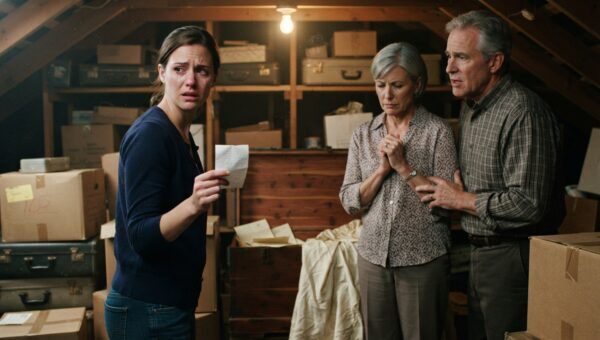
Beneath it was a small strip of receipt paper, torn jagged from a register roll. Grandma’s handwriting was shaky at the end, the letters slumping downward like she was writing while lying flat on her side in the hospital bed, but I knew those loops anywhere.
If he says I gave it willingly, ask him about Friday the 14th.
I sat down right there on the edge of her floral sofa, the tea tin resting heavy in my lap, and stared at the words until the living room window started going gray with the late afternoon shadow. Friday the 14th was November fourteenth. That was the day Robert had taken her to the clinic for her quarterly blood work, stopping at the bank on the way back. That was the day Elena had called me crying because Grandma had come home shaken up, refusing to talk about what happened in the car.
I didn’t wait for Sunday dinner at mother’s house. I drove straight out to Robert’s place on the north side of town, the tires of my sedan throwing wet gravel across his driveway. His truck was parked by the side garage with the tailgate down and a pile of pressure-treated lumber stacked in the bed.
He opened the front door in his stocking feet holding a can of beer, his face dropping that easy family smile the second he saw the look in my eyes.
“Well, look who decided to show up,” Robert said, leaning his shoulder against the doorframe. “You got the rest of Mum’s costume jewelry sorted out yet? I told you we should have just taken the whole lot to the appraiser in town.”
I didn’t step inside. I reached into my coat pocket, pulled out the printed bank statements folded to the November pages, and held them out flat in the palm of my hand.
“You told me Elena stole from her,” I said. My voice didn’t shake. It just came out hard and flat, like stones sliding over gravel.
Robert blinked, taking a slow sip of his beer. “Well, she did. The tin was empty, wasn’t it? What more proof do you need, Julian? The girl had access.”
“She didn’t have access to the ATM on Fourth Street every Friday at four-thirty in the afternoon,” I said, stepping one pace closer until the screen door was right between us. “Because Elena doesn’t even drive a car, Robert. She takes the bus from the south side, and she was here with Grandma until six every single night.”
The color didn’t drain from Robert’s face all at once. It sort of mottled, patches of red spreading up his neck while his mouth stayed half-open around the rim of the can.
“What are you talking about?” he muttered, his eyes darting down to the papers in my hand. “Mum authorized those. She wanted me to have a little extra cushion for the property taxes this year. She always helped out when things got tight.”
“She didn’t help you out on November fourteenth,” I said, and then I stopped. I let the silence stretch out between us until the only sound was the refrigerator humming through the kitchen window behind him. “She told me about that day before she went. She left it in writing, Robert. Right where you forgot to look.”
He set the beer can down on the porch railing so hard the aluminum dented against the wood. “She was eighty-eight years old, Julian. Her head wasn’t right at the end. You know how she got when the pain meds kicked in. She imagined things.”
“She remembered Friday the 14th just fine,” I said. “She remembered you standing right over her hospital bed at the clinic demanding she sign the slip after she told you no three times.”
Robert took half a step backward, his hand catching the edge of the screen door. “She was my mother. I looked after her when you were too busy with your job down in the city. I earned every penny of that.”
“You didn’t earn a damn thing,” I said. “You stole from an old woman who couldn’t walk across the room by herself, and then you tried to put it on a woman who was spending her own grocery money to keep her fed.”
I pulled the tea tin out of my other pocket and set it right on the wooden porch post between us, the faded yellow roses catching the last pale streak of sunset.
“You’re going to write a check to Elena for four hundred and eighty-six dollars by tomorrow morning,” I told him, looking straight into his eyes until he dropped his gaze to the floorboards. “And if you ever come within a mile of her or my house again, I’m taking those bank statements straight down to the county prosecutor’s office myself.”
He didn’t say anything back. He just reached out, gripped the edge of the screen door, and pulled it shut with a heavy, final click that rattled the glass in the frame.
I walked back to my car without looking back once. The drive home took twenty minutes through the valley fog, the headlights cutting weak yellow paths through the damp air. When I got back to Grandma’s house, I didn’t turn on the lights. I walked straight into the kitchen, set the empty brass tea tin down on the clean laminate counter, and closed the lid over the slip of paper until it clicked shut in the quiet room.