PART 1
My father remarried six months after Mom died, and I spent half a year trying to tell myself that grief makes older men do desperate things.
Mom had been gone twenty-four weeks when Dad brought Sandra to Sunday pot roast. Sandra was fifty-eight, twelve years younger than Dad, wore bright turquoise jewelry, and talked about fresh energy before the plates were even cleared.
Two weeks later, she moved her matching luggage into the brick ranch on Orchard Lane where Mom had canned green beans and hung floral curtains for thirty-two years.
I tried to be happy for him. When Sandra started packing Mom’s pie dishes and linen tablecloths into cardboard liquor boxes, I kept my mouth shut. When she replaced Mom’s braided living room rug with gray vinyl plank flooring, I swallowed the knot in my throat. I only asked for one boundary.
“Leave the cedar chest in the attic, Sandra,” I told her on a Saturday in August, while Dad was in the backyard cleaning his mower deck. “That chest was a wedding present from Mom’s grandfather. Her wedding dress is in there, along with Dad’s letters from his Navy days in San Diego and my baby albums. Nobody is tripping over it up there.”
Sandra wiped down the banister with lemon oil, smiled without showing her teeth, and said, “Of course, Laura. We all need our keepsakes.”
Last Saturday, I came over to help Dad replace a broken latch on the basement storm door. Dad was at the hardware store picking up screws. I walked up the narrow attic stairs to grab the extra metal hinges Mom used to keep in the corner eave.
The floorboards in the west corner were bare.
The spot where the heavy cedar chest had sat on two oak runners since 1988 was completely empty. Even the faint square outline in the attic dust had been swept clean.
I walked down the stairs with my hands shaking on the rail. Sandra was in the kitchen, slicing yellow squash at the island.
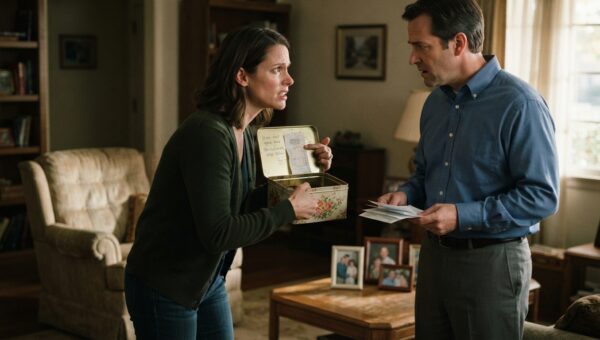
“Where is Mom’s cedar chest, Sandra?” I asked.
She didn’t drop the paring knife. She slid the squash rounds into a glass casserole dish, wiped her thumb on a paper towel, and turned around with that practiced, patient sigh she always used when she wanted me to feel unreasonable.
“I called the thrift drop-off on Thursday, Laura,” she said, looking straight at my forehead. “Your father’s doctor said the attic dust was aggravating his bronchial tubes. Nobody needs that old clutter sitting around gathering mold. It went to charity. You can write off the donation value if you really want to.”
“I told you my mother’s wedding dress was in that chest,” I said, my voice barely carrying across the counter.
“Things are just things, dear,” she said, turning back to her vegetables. “Your father needs to look forward, not backward.”
I didn’t yell. I didn’t wait for Dad’s truck to pull into the driveway.
I got into my car and drove down Route 36. There were only four second-hand resale and charity shops within twenty miles of town. The Goodwill on Commerce had no furniture drop-offs recorded for Thursday. The church mission pantry on Maple Street had only taken bags of winter coats.
The Habitat ReStore across the county line had two dressers and a broken table on the loading dock.
My last stop was New Life Resale, an independent charity shop tucked behind the feed mill on Railroad Avenue.
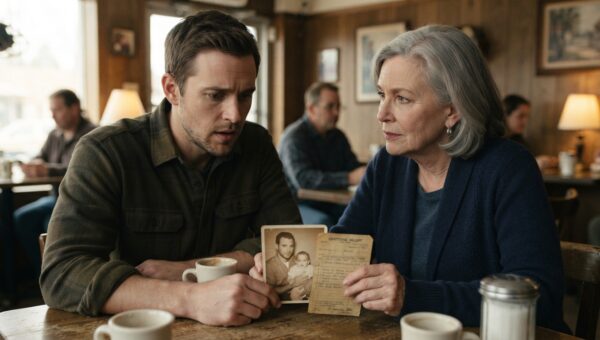
The bell over the glass door jingled when I pushed it open. The shop smelled of cedar shavings, damp coats, and old books. Behind the wooden register counter stood an older woman with wire-rimmed glasses and a blue volunteer apron named Peggy.
I walked right up to the counter. “Did a woman drop off an antique aromatic cedar chest on Thursday afternoon? Heavy brass hasp, carved acorn leaves on the front panel, about four feet wide?”
Peggy adjusted her glasses and nodded immediately.
“Yes, we got it,” Peggy said. “Came in on the Thursday three o’clock truck. Beautiful piece of solid red cedar. But a man bought the whole chest an hour ago.”
My ribs felt tight. “Did you empty it out first? Did you take out the dress or the old photo albums?”
“No, honey,” Peggy said, shaking her head. “He bought the chest as a locked lot for eighty-five dollars cash. He said he was a private estate liquidator and wanted the contents intact. He loaded it straight into the back of an old green pickup.”
Peggy turned the metal clip wheel on the counter and pulled out the yellow store carbon copy of the register ticket.
“He filled out the resale slip for the tax exempt,” she said, sliding the paper across the counter.
I looked down at the receipt.
The buyer’s signature at the bottom was written in heavy, jagged blue ballpoint ink. It wasn’t an estate liquidator from the city.
The printed name and phone number on the slip belonged to Sandra’s thirty-four-year-old son, Travis.
PART 2
The yellow slip felt thin and brittle between my fingers.
Travis lived twenty miles out on a rural route outside Marion. He worked occasional weekend security shifts at an auto auction and spent the rest of his time tinkering with lawnmowers in a gravel driveway that was usually blocked by three non-running trucks.
In the eight months Sandra had been in our family, Travis had come to Dad’s house four times. Every single time, he had asked Dad to cosign for a trailer title or front him three hundred dollars for truck tires. Dad had always refused, telling him that family helped with meals and hard labor, not open checkbooks.
“Did he say where he was taking it, Peggy?” I asked, looking up from the counter.
Peggy looked down at the carbon copy, her lips pulling tight. “He asked me if the paper tags on the latch were original brass. When I told him the hinges alone were worth forty dollars to an antique dealer, he laughed and said he had a buyer meeting him out at the flea market barn on Route 23 before five o’clock.”
The dashboard clock in my sedan read three-twenty.
The Route 23 flea market barn was an unheated pole building where local traders sold vintage tools, cast-iron pans, and old farm signs out of plywood stalls every Saturday and Sunday.
I didn’t call Sandra. I didn’t call my father. If Sandra knew I had the receipt from Railroad Avenue, she would call Travis, and that green pickup would vanish down a back country road before I ever saw my mother’s handwriting again.
I pulled out of the resale shop gravel and took the state route north.
The sky over the cornfields had turned a heavy, bruised gray with early winter damp. As I drove, my mind turned over the last six months like an old deck of cards.
Sandra hadn’t donated that chest to clear attic dust for Dad’s lungs. She had donated it to a charity shop with a minimal processing fee, knowing Travis could walk in forty-eight hours later, hand over eighty-five dollars in cash for an untracked receipt, and haul away an antique piece without Dad ever seeing it leave in his stepson’s truck. If Dad ever asked about the chest, Sandra had her clean story ready: an honest donation to poor families, with Laura just being sentimental and bitter about old furniture.
I reached the gravel parking lot of the flea market barn at three-fifty-five.
Six rows of pickup trucks and rusty vans were parked under the bare willow trees. Near the third open bay door, parked backed-up against a wooden loading ramp, sat Travis’s dark green Chevrolet with a dented tailgate.
The cedar chest was sitting in the open truck bed.
Travis was standing on the gravel beside the bumper, smoking a cigarette, talking to an older man wearing a leather cap who was examining the carved acorn trim with a pocket flashlight.
I parked my sedan directly across the narrow gravel lane, blocking Travis’s rear bumper, cut my ignition, and stepped out into the wind.
“Step back from the truck, please,” I told the man with the flashlight.
Travis jumped, dropping his cigarette into the wet gravel. He looked at my car, then at my face, his shoulders pulling up toward his ears.
“Laura?” Travis stammered, trying to step between me and the tailgate. “What are you doing out here?”
“I’m here for my mother’s chest, Travis,” I said.
“I bought this fair and square at a thrift store in town,” he said, his voice rising, trying to find an edge of anger to cover the stammer. “I’ve got a receipt in my wallet. I’m a licensed picker. My mother told me the charity had a piece coming in that was worth flipping. It’s my legal property.”
“It’s not your property,” I said. “And you haven’t opened that brass lock yet, have you?”
Travis hesitated. His eyes shifted toward the cab of his truck. “The lock was stuck. The gentleman here was just about to help me pry the latch with a pry bar.”
“If you touch that latch with an iron bar, Travis,” I said, pulling my phone from my coat pocket, “the sheriff will be out here before you get the lid up. That chest was stolen from 418 Orchard Lane on Thursday morning.”
“It was donated!” Travis yelled, his face turning red. “My mother signed the donation manifest with the truck driver!”
“Your mother isn’t on the deed to Orchard Lane,” I told him. “And she didn’t own the property inside that chest.”
The man in the leather cap looked at Travis, clicked his flashlight off, and put it in his pocket. “I don’t need this kind of grief on a Saturday afternoon, son. Keep your cedar.”
The man walked away toward the barn entrance, leaving Travis standing alone by his tailgate with his hands shoved deep into his canvas jacket.
PART 3
Travis looked at the open truck bed, then at the gray gravel at his feet. The swagger went out of his posture all at once, leaving him looking like a boy caught with his fingers in the church collection plate.
“Look, Laura,” Travis mumbled, his voice dropping into a whine. “Mom told me there was cash inside. She swore to me on her life.”
The cold air seemed to stand still around us.
“What cash?” I asked.
“Mom said your mother kept an old tin coffee can under the quilts,” Travis said. “She found a handwritten note in the back of your dad’s desk drawer three weeks ago. A personal ledger from 2018 where your mother wrote down that she had twelve thousand dollars in emergency cash tucked inside the bottom cedar drawer for a rainy day. Mom said the chest was sitting up in that attic doing nobody any good, and your dad refused to give her access to his primary savings account.”
My mother had kept emergency money.
In 2018, when Mom had her first stroke, she was terrified of nursing home liens and bank freezes. She had always been a child of parents who lived through the Depression, people who believed that paper money in a drawer was safer than numbers on a computer screen at First State Bank.
“Sandra used you to steal it,” I said.
“She told me if I bought it from the charity for eighty-five bucks, the paper trail was clean,” Travis said, wiping his nose with the back of his sleeve. “She said I could keep three thousand for helping her haul it, and she would take the rest to pay off her credit card in Columbus before your dad saw the statements. She told me she couldn’t pry the lock at the house because your dad was home every afternoon.”
“Get the tailgate down, Travis,” I said.
Travis didn’t argue. He unhooked the chains, lowered the rusted metal gate, and helped me slide the heavy red cedar chest toward the edge.
I reached into my purse, pulled out my late mother’s brass key from my own key ring, the small notched key she had given me on my thirtieth birthday, and slid it into the brass hasp.
The cylinder turned with a stiff, heavy click.
I lifted the lid. The sharp, clean scent of pure cedar rolled out into the chilly November air, unchanged and untouched.
On top lay Mom’s ivory satin wedding dress, carefully folded inside a blue tissue-paper wrap that had yellowed along the creases. Underneath were three thick photo albums with green cloth covers, and a bundle of letters tied with a piece of red seamstress tape: Dad’s letters from the naval shipyard in 1968.
In the bottom right corner, tucked underneath a stack of hand-quilted baby blankets, sat the faded blue Hills Bros. coffee can.
I lifted the plastic lid.
Inside was a stack of clean, banded one-hundred-dollar bills, clipped together with a note in my mother’s round, teacher’s cursive: “For Laura’s girls, when they start college.”
It was twelve thousand dollars, untouched since the spring of 2018.
Travis stared into the can, his jaw working silently. He looked like he wanted to reach out, but he kept his hands locked in his coat pockets.
“Help me load this into my trunk, Travis,” I said. “Or I call Dad right now from this gravel lot.”
Travis took the front handles without another word. Together, we lifted the four-foot chest out of his pickup bed and angled it into the back of my station wagon, sliding the seats down until the hatch could latch securely over the bumper.
I shut the hatch with a firm, solid thud.
“What are you going to tell him?” Travis asked, leaning against his fender with his head down.
“I am not going to tell him anything,” I said, opening my driver’s door. “You are.”
ENDING
We drove back to Orchard Lane in a convoy.
My station wagon pulled into the driveway first, followed twenty seconds later by Travis’s green pickup. Dad’s truck was already parked by the garage; he had come back from the hardware store and was standing on the back porch with a screwdriver in his hand, looking confused by the sight of both of us arriving together.
Sandra walked out of the kitchen screen door, wiping her hands on an apron. When she saw Travis step down from the cab of his truck with his head hung low, the color drained completely from her lips.
“Travis?” Sandra said, her voice high and sharp. “What are you doing here?”
I walked to the back of my wagon, opened the hatch, and pulled the moving blanket back from the carved cedar lid.
Dad set his screwdriver down on the porch railing. He walked down the wooden steps with slow, heavy strides, his old work boots crunching on the pea gravel. He looked at the chest, then at the yellow receipt from New Life Resale that I held out in my left hand.
He didn’t read every line. He saw the date, the eighty-five-dollar price, and Travis’s signature at the bottom.
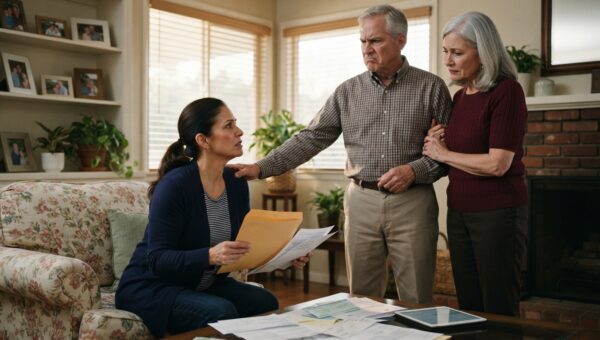
“Travis,” Dad said. His voice was very quiet. It was the low, steady rumble he used when I was twelve and had lied about a broken cellar window. “Did you take your sister’s mother’s things out of my attic?”
Travis didn’t look at Sandra. “Mom gave me the key to the back porch on Thursday morning, Arthur. She told me to meet the charity truck down at the end of the lane so you wouldn’t hear the gate.”
Dad turned around. He looked at Sandra, who was standing on the bottom porch step with her fingers digging into the fabric of her apron.
“Arthur, he’s lying,” Sandra stammered, taking a hurried half-step backward toward the door. “Travis has always been irresponsible with money. He found out where the truck went and bought it himself to spite me. I was only trying to help you breathe easier in this house.”
Dad didn’t raise his voice. He walked past her up the steps, opened the screen door, and stepped into the kitchen.
We heard the heavy metal drawer of his desk open and shut.
Thirty seconds later, Dad walked back out onto the porch holding Sandra’s small leather handbag and the spare set of keys to the front door. He laid the keys on the top rail and handed the purse to her.
“You have two hours to call your sister in Marion to come get your clothes, Sandra,” Dad said.
“Arthur!” she cried, her voice cracking into a shrill sob. “We are married! You can’t just throw your wife out over an old box!”
“The box isn’t the problem, Sandra,” Dad said, looking directly into her face without blinking. “You stole from a dead woman, and you used your own boy to do it. The clothes in your closet are yours. Everything else in this house belongs to the thirty-two years that came before you.”
He turned and walked back inside, letting the screen door click shut behind him.
Sandra left at six o’clock that evening in her sister’s minivan. She packed four suitcases and three cardboard boxes of her turquoise jewelry and cosmetic jars, leaving the gray vinyl flooring and the squash casserole still sitting cold on the kitchen island.
Travis drove his green pickup away without saying goodbye to either of them.
Dad and I spent Sunday afternoon carrying the heavy cedar chest into the spare bedroom on the main floor, the room that used to be my nursery. We set it against the south wall under the double window where the afternoon sun comes through the glass.
I opened the blue coffee can on the kitchen table and showed Dad the twelve thousand dollars.
Dad looked at Mom’s handwriting on the paper band, touched the edge of the blue seamstress tape on his old Navy letters, and wiped his eyes with a clean flannel handkerchief from his pocket.
“She always was looking three years down the road,” Dad whispered.
We didn’t put the money back in the attic. On Monday morning, Dad and I walked into First State Bank and deposited the cash into a high-yield college trust for my two daughters, exactly as Mom had written on the paper.
The chest sits in the spare bedroom now, unlocked and dusted.
Every Sunday when I come over to cook pot roast for Dad, I open the lid for five minutes just to let the smell of clean red cedar drift down the hallway into the kitchen.
Some things in an old house can be painted over or replaced with gray vinyl, but the things that matter are built out of solid wood.
They don’t break, they don’t rot in the dark, and no amount of lies can keep them from finding their way back home.