PART 1
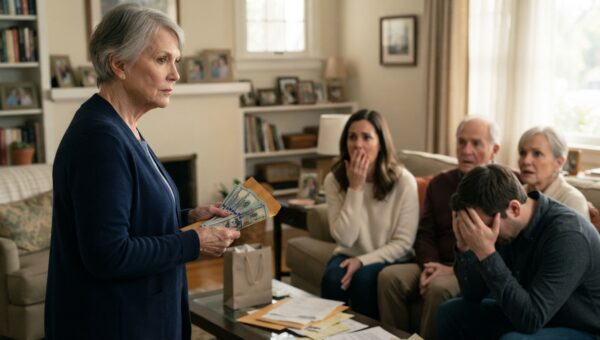
At my retirement dinner, my two sons argued over who would take me now that I had free time.
We were sitting in a booth at the rib house on Route 23 in Delaware, Ohio. I was sixty-four years old, wearing the floral blouse my late husband gave me for our thirtieth anniversary, and celebrating the end of thirty-one years as a payroll coordinator for the county road department.
On the vinyl seat beside me lay a modest brass desk clock from my coworkers and a card signed by twenty road crew foremen.
My sons didn’t ask about the clock. They didn’t ask how it felt to turn in my office keys.
Before the waitress could clear our salad baskets, they started carving up my calendar like a piece of unclaimed luggage.
“Mom needs to be at our place Monday through Thursday,” my younger son, Kevin, said, dipping a fry in ranch dressing. “Amber is going back to full-time shifts at the medical clinic next month. Daycare for the twins is nineteen hundred dollars a month, and that’s just robbery. Having Mom watch the girls saves us twenty-two thousand a year, plus she gets quality time with her grandbabies.”
My oldest son, Brian, set his beer mug down with a heavy clatter. “That doesn’t make sense, Kevin. You live twenty-five miles out.
My commute into Columbus is forty minutes each way, and our property taxes on the new build jumped four hundred dollars. Mom gets her full county pension starting next month, plus Dad’s survivor benefit. If Mom moves into our daylight basement suite, she can contribute six hundred toward our mortgage note and help Amanda with the boys after school. That’s real family security.”
They spoke across the table as if I were a piece of lawn furniture waiting to be dragged into someone’s garage for the winter.
For seven years, ever since my husband, Ray, died of a sudden stroke, my boys had treated my small split-level on Sycamore Street like a free storage locker and an emergency loan window. Whenever Brian’s transmission slipped, he came to my kitchen with a sad face and a cup of coffee. Whenever Kevin and Amber wanted a long weekend in the Smokies, they dropped the girls on my porch with four bags of dirty laundry and an empty tank of gas.
I had spent my whole life being the quiet woman who smoothed the wrinkles and paid the difference.
I let them talk until Kevin started writing days of the week on a paper napkin.
“I already made plans,” I said, keeping my voice mild and steady.
Both of them stopped. Brian gave a short, dismissive laugh and leaned back against the red vinyl.
“What plans, Mom?” Brian joked. “Where are you going, Florida?”
I didn’t answer with an argument. I reached into my canvas shoulder bag, pulled out a four-by-six glossy photograph, and slid it across the center of the table.
The picture showed a small, one-story yellow wood-frame cottage with white trim, sitting on a gentle grassy bank thirty yards from the dark, quiet water of Indian Lake. The front porch had two sturdy cedar rocking chairs, and an old aluminum fishing boat was tied securely to a short wooden dock.
Brian picked up the print, frowning as he turned it into the overhead booth light.
“Whose cabin is this?” Brian asked. “How could you afford a lake place?”
Before I could open my mouth, my older sister, Evelyn, who had been sitting quietly on my left nursing a glass of iced tea, raised her glass toward the ceiling.
“Should I tell them,” Evelyn said, looking straight at Brian and Kevin, “what their mother has been doing every single Saturday for the last eleven years?”
PART 2
The table went completely still. A busboy cleared the empty rib platter behind Kevin, the plates clattering against the plastic bus tub.
Kevin looked from Evelyn to the photograph in Brian’s fingers. “What are you talking about, Aunt Evelyn? Mom spent Saturdays doing grocery shopping and laundry.”
“No, boys,” Evelyn said, setting her glass down on the paper place mat with a soft, deliberate tap. “Your mother spent Saturdays earning her own life while you two were busy asking her for handouts.”
Brian’s face tightened up. “Nobody asked for handouts. We borrow occasionally, and we always pay her back when things settle down.”
“You still owe her four thousand dollars from your kitchen remodel in twenty-twenty-two, Brian,” I said quietly.
Brian looked away, his jaw working silently against the side of his cheek.
The yellow house in the photograph had not happened by accident, and it had not come from a magic windfall.
Eleven years ago, in the fall of 2015, my husband Ray had spent his last months struggling with early heart failure. The medical copays were bleeding us dry, and Brian and Kevin were in their late twenties, constantly stopping by our house to ask for help with security deposits, car tires, and credit card balances. Ray had looked at me from his hospital recliner one evening and said, “Marian, you give every scrap of bread off your plate until your own ribs show. When I’m gone, those boys will eat you alive if you don’t build a fence.”
Two months after Ray passed, Evelyn found an ad in the weekly county shopper. An elderly widower outside Russells Point was selling a half-acre lot on the north channel of Indian Lake. The lot had a neglected 1958 cedar cottage with rotted porch footings, a leaking roof, and a tax bill that was two years behind. The owner didn’t want a bank involved; he offered a private land contract for thirty-eight thousand dollars, with five thousand down and four hundred dollars a month.
I didn’t have five thousand extra dollars in our checking account, because Brian had just taken three thousand to settle an old credit card before his wedding.
So Evelyn and I made an arrangement.
Evelyn ran an estate appraisal and vintage furniture restoration business out of a barn near Marysville. Every Saturday morning at six-fifteen, while my sons were still asleep in their beds, I drove forty minutes west to Evelyn’s barn. I learned how to strip milk paint off oak dressers. I learned how to re-cane cane-bottom chairs, rebuild antique drawer glides, and wire vintage porcelain lamps.
Evelyn paid me twenty dollars an hour in clean, legal contract wages. Every Saturday night, I took home one hundred and sixty dollars.
That money never touched the joint checking account my sons knew about. It went straight into a separate account at the Logan County Credit Union, labeled strictly for the Russells Point property.
“You worked in a barn?” Kevin asked, his voice cracking with embarrassment. “Every Saturday? Why didn’t you just tell us you needed cash?”
“Because every time I had an extra nickel in my purse, Kevin, you had a flat tire or a late utility bill,” I told him. “If I told you I had four hundred dollars a month to spare, you would have told me your girls needed private gymnastics lessons. You never asked how I was doing on Saturday mornings. You only called me on Saturdays when you needed someone to watch your dogs.”
PART 3
Brian threw the photograph back onto the table.
“So you bought a vacation shack,” Brian said, crossing his arms and leaning hard against the booth. “Fine. Congratulations. But that doesn’t change reality, Mom. You’re sixty-four. You can’t live out on a lake by yourself in the middle of an Ohio winter. You have to sell the Sycamore house anyway. You can’t maintain three bedrooms and a half-acre yard on your pension alone.”
“I am not maintaining the Sycamore house,” I said.
I reached back into my shoulder bag and pulled out a manila envelope. Inside was a signed purchase agreement from a young couple who worked at the state patrol post down the road.
“The Sycamore house went under contract on Monday morning,” I said. “For two hundred and eighty-five thousand dollars. The closing is set for the twenty-eighth of this month.”
Both of my sons stared at the paper.
Kevin sat up straight, his eyes widening. “You sold our childhood home? Without telling us? Without letting us walk through the rooms?”
“You walked through those rooms two weeks ago, Kevin,” I said. “You walked through them to borrow my lawnmower and take two cases of my canning jars. You didn’t look at the walls. You didn’t care about the childhood home until you thought about the equity.”
“What happens to the money?” Brian asked. The entitled, sharp edge in his voice cut through the restaurant chatter. “Dad helped pay for that house for twenty years. Half that equity belongs to this family’s future. You can’t just take nearly three hundred thousand dollars and disappear to a swamp.”
“It isn’t a swamp, Brian,” Evelyn snapped, leaning across the table until she was inches from his face. “It’s a fully winterized two-bedroom home with new copper plumbing, double-pane vinyl windows, a brand-new metal roof, and zero debt. Your mother didn’t just pay four hundred dollars a month for eleven years. She drove out there every Saturday afternoon with a crowbar, a paint roller, and a bucket of drywall mud. She paid the final contract note off last September. She owns the deed free and clear.”
Brian’s face went completely red. He looked around the dining room, suddenly aware that two elderly women in the booth behind us were watching him with cold, disapproving eyes.
“We are your sons, Mom,” Brian whispered, his hands flat on the table. “We have children. We are trying to build lives in a terrible economy. You’re sitting on a quarter-million dollars from Dad’s house, and you’re walking away from your own blood?”
“I gave you twenty-four years of my life, Brian,” I said. My voice did not shake. “I paid for your trade school tuition. I paid for Kevin’s community college credits. When your father died, I gave you his truck and his entire tool chest, which you sold to a stranger six months later for six thousand dollars so you could take a trip to Cancun.”
Brian froze. He had told me in 2017 that the truck engine had seized and he had junked it for four hundred dollars.
“I found the title transfer at the county title office three years ago when I registered my boat trailer, Brian,” I added quietly. “I never brought it up because I knew you would lie about it. But I made a promise to myself that afternoon that I would never be your safety net again.”
Kevin looked down at his paper napkin, the lines of his childcare schedule still scrawled in blue ballpoint ink.
“Mom,” Kevin said, his voice dropping to a low, pleading tone. “What about the twins? Amber really needs help. We were counting on you.”
“Amber’s mother lives eight miles from your house, Kevin,” I said. “And you have a paid-off second car you can sell if daycare is too tight. You are thirty-four years old. It is time for you to be a father instead of a dependent.”
I picked up the four-by-six photograph from the table and slipped it back into my purse.
“The closing proceeds from Sycamore Street are going into a conservative municipal bond fund that pays me twelve hundred dollars a month in tax-free interest,” I told them. “Combined with my pension and my Social Security, I have more than enough to pay my heating oil, my boat registration, and my groceries for the rest of my life. My lake house is mine. The keys are in my pocket. And the spare bedroom is a sewing room, not a nursery.”
ENDING
I paid the dinner bill myself.
I laid fifty dollars in cash on the table to cover my meal and Evelyn’s tea, leaving an extra ten-dollar tip for the waitress. Neither Brian nor Kevin reached for their wallets. They sat in the booth, staring at their cold fries while Evelyn and I put on our coats.
We walked out into the crisp October night air.
Brian tried to call my cell phone on Sunday afternoon, leaving a four-minute voicemail talking about how stressed he had been with work and how he hadn’t meant to sound ungrateful. Kevin sent a text message with pictures of the twins eating pancakes, asking if I wanted to come over for dinner on Tuesday before the movers arrived.
I didn’t call Brian back, and I texted Kevin a polite, brief reply saying I was busy packing boxes with Evelyn.
The closing on the Sycamore house went through on October twenty-eighth without a hitch. The title company wired two hundred and eighty-one thousand four hundred dollars into my new investment account. I gave my sons their father’s remaining personal items: Ray’s high school yearbooks, his hunting jacket, and two boxes of old family photograph albums. I kept Ray’s pocket watch and the silver wedding band from my left hand.
I moved to Indian Lake the first weekend of November.
The lake in the late fall is quiet and gray, with mist rising off the water in the early mornings before the sun cuts through the bare willow trees.
My yellow house is warm. I spent eight hundred dollars to have a local contractor service the wood stove in the living room, and the dry split hickory keeps the front rooms at seventy degrees all day.
Brian and Kevin have not visited yet.
They know where the house is, and I told them the front door is unlocked on Sunday afternoons if they want to bring the grandchildren up for a boat ride and a bowl of soup. But the boundary is drawn in iron now. They know there are no checks waiting on my kitchen counter, and they know my calendar is no longer theirs to write on.
Yesterday afternoon was sunny, the first real warm day of spring.
I sat out on the front porch in one of the cedar rocking chairs, drinking a cup of black coffee while the water lapped against the dock pilings. In the grass near the shoreline, the yellow daffodils I planted four years ago were in full bloom, bright against the dark mulch.
I looked down at my hands.
My knuckles were thick from years of office typing and eleven years of sanding raw oak in Evelyn’s cold barn. They were tired hands, but they were free.
I took a slow sip of my coffee, leaned back against the cedar slats, and watched the fishing boats head out across the channel into the open water.