PART 1
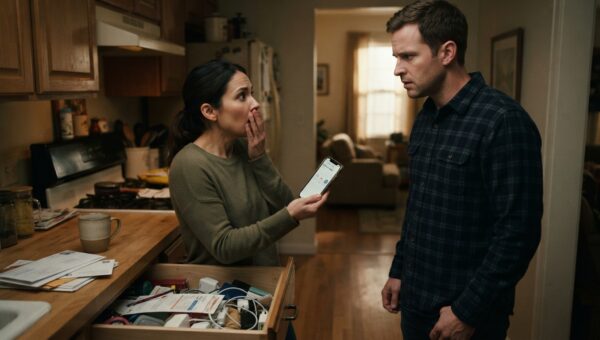
Our neighbor, Mrs. Gable, brought me a printed photograph after Sunday service.
We were standing on the church sidewalk beside my station wagon, holding our bulletins while the congregation filtered toward the parking lot. Mrs. Gable did not make small talk about the sermon. She reached into her vinyl handbag, pulled out a four-by-six glossy snapshot, and slid it into my fingers.
The photo came from her driveway security camera, looking across the shared fence line toward our backyard. The white timestamp along the bottom corner read 1:14 AM, Thursday.
In the grainy night glare of the motion floodlight, my husband, Dean, was walking across the wet grass carrying a twin foam mattress toward the aluminum storage shed by the back hedge.
I stared at the glossy paper until the corners bent under my thumbs.
Dean was fifty-two. He worked forty-five hours a week as a shift lead at an industrial pump plant, paid our $1,670 house rent on the first of every month with a certified cashier check, and called himself strict, not cruel. When my sixteen-year-old son, Toby, stopped sleeping in his bedroom last autumn, Dean told me the boy had chosen to be out. Dean said Toby was staying on friends’ basements and fold-out sofas across town because Toby refused to live under adult rules, take his dirty boots off at the threshold, and finish his high school algebra homework.
For six months, I believed Dean.
I had spent those six months driving past the town skatepark, checking behind the convenience store on Route 6, and leaving voicemails on Toby’s prepaid phone that went straight to a generic recording. Toby would show up at the house once every few weeks around dinner time, wolf down two plates of whatever was on the stove without sitting down, grab clean socks from the laundry room, and leave before the evening news started. Whenever I begged Toby to stay, Dean would stand in the kitchen doorway with his arms crossed over his company polo, clearing his throat until the boy slipped out the back screen door.
“He’s running the streets because he wants freedom without chores, Martha,” Dean told me over and over. “A boy that age has to learn what cold pavement feels like before he respects a warm room. Let him get tired.”
I went home after church with the snapshot tucked flat inside my Bible.
Dean was out in the garage until dusk, changing the oil in his riding mower. I made a pot of vegetable beef soup, waited until Dean fell asleep in his recliner in front of the Sunday night baseball game, and walked out the back door in my wool socks and rubber garden clogs.
It was twenty past nine. The grass was soaked from the automatic sprinkler cycle that had run at eight.
I walked down the stepping stones to the eight-by-ten aluminum shed behind the hedge. The brass padlock was hanging open on the hasp, unclicked.
I pulled the metal door open. The track gave a low, scraping rattle.
The air inside smelled of damp potting soil, weed killer, and wet cotton. In the back corner, squeezed between my plastic lawn chairs and the rusted wheelbarrow, lay the twin mattress from the photo.
It was pushed against the corrugated metal wall, damp along the bottom edges where water had seeped under the threshold. On top of it lay Toby’s faded blue high school track blanket, four thick textbooks, two spiral notebooks, and one pair of worn running shoes with duct tape holding the left sole together.
Toby was sitting on the corner of the foam with his knees pulled to his chest, wearing his hooded sweatshirt with the hood pulled low.
He didn’t run. He didn’t yell. He looked up at me with dark circles under his eyes, his breath misting in the cold air under the single flashlight beam.
“Toby,” I whispered. My throat felt like it was full of dry gravel. “Why didn’t you tell me you were out here?”
He rubbed the heel of his hand across his mouth, his knuckles red and raw from the chill.
“Because Dean said you’d choose him,” Toby said.
A heavy footstep crunched on the wet turf behind me.
Dean was standing three feet from the shed door in his sweatpants and slippers, his face completely flat.
“The boy needs to learn how to keep hours, Martha,” Dean said.
I did not argue. I did not scream. I turned around, reached into my cardigan pocket for my phone, and pressed the three numbers I should have called months ago.
PART 2
“Hang up that phone, Martha,” Dean said.
His voice didn’t jump. It had that flat, mechanical weight he used when a junior line mechanic questioned his shift schedule. He reached out with one broad hand to grab my wrist, but I pulled my arm back and stepped sideways, putting my body directly between Dean and the open shed door.
“Step away from the door, Dean,” I said.
The screen of my cell phone lit up against the wet grass. The dispatch operator answered on the second ring: “Richland County 911, what is the address of your emergency?”
I gave our rental address on Sycamore Road without taking my eyes off Dean’s face.
“My sixteen-year-old son has been locked out of our home into an unheated outbuilding,” I told the dispatcher. “I need a deputy here right now.”
Dean let out a short, dry laugh through his nose and shook his head, looking down at his slippers. “You’re calling the county over a stubborn teenager, Martha? You think the sheriff cares about a kid who won’t do his chores? Hang the damn phone up before you embarrass us in front of the whole street.”
“A deputy is en route, ma’am,” the dispatcher said in my ear. “Keep the line open. Is anyone armed?”
“No,” I said. “Just send the car.”
I kept the phone pressed against my jaw. Toby stayed on the mattress, his fingers curled into the wool of his blue blanket.
“Get your boots on, Toby,” I said quietly, not looking back into the shed. “Grab your schoolbooks.”
Toby scrambled off the damp foam. He shoved his feet into the running shoes with the taped soles, gathered his four books against his ribs, and stepped out onto the wet grass beside me. When Toby walked past Dean, he flinched, pulling his shoulders inward until he was small.
That small flinch told me everything I had spent half a year refusing to see.
Dean didn’t try to block Toby. He stood on the path with his hands jammed into his sweatpant pockets, watching us walk toward the kitchen porch.
“You’re making a spectacle out of nothing, Martha,” Dean called after us. “I pay sixteen hundred and seventy dollars every month to keep a roof over your heads while you work twenty hours a week at the dry cleaner. You think you can carry this lease without my paycheck? You think your part-time wages will keep the lights on?”
We walked into the kitchen and shut the heavy storm door.
Under the bright fluorescent bulbs, Toby looked even worse than he had in the dark. His skin had that gray, chalky look that comes from sleeping on damp bedding in thirty-degree weather. He had lost at least fifteen pounds since August. His wrists stuck out of his hoodie sleeves, thin and pale, and the knuckles of his right hand were scabbed over from scraping against the shed’s corrugated tin walls.
I took the photograph Mrs. Gable had given me out of my Bible and laid it flat on the laminate counter.
Toby looked at the image of Dean carrying the foam pad through the dark yard.
“When did he start putting you out there, Toby?” I asked.
Toby dropped his textbooks onto a kitchen chair. “Back in November. The first week the frost hit. He told me that if I wasn’t through the front door by nine-thirty, the deadbolt stayed turned. When I knocked on your bedroom window, he came around the corner of the house with his work flashlight and told me that if I woke you up, he would pack your things and leave you with the rent.”
My hands shook as I set a kettle on the burner.
“Dean told me you went to stay with your friend Marcus,” I whispered.
“He texted you from my phone, Mom,” Toby said, pulling his old flip phone from his pocket. “He took my phone off the counter every night at nine. He sent those texts saying I was crashing at Marcus’s garage so you wouldn’t call the police. Then he put the padlock on the shed door every morning at five-thirty before he left for the plant, so you wouldn’t see the blanket if you went out to get the garden hose.”
A pair of headlights cut through the front blinds, sweeping across the kitchen cabinets.
A white county cruiser pulled into our gravel driveway, its light bar pulsing slow amber and blue against the siding.
PART 3
Deputy Miller walked through the back door three minutes later, wiping his boots on the rug.
He was a man in his forties who had coached youth baseball in town, with tired eyes and a leather citation binder under his arm. He looked at Toby sitting on the stool with his taped shoes, looked at the wet textbooks on the table, and then looked at me.
“Mrs. Miller?” the deputy asked.
“Yes,” I said. “This is my son, Toby. He is sixteen.”
I handed Deputy Miller the security photograph from Mrs. Gable.
The deputy studied the 1:14 AM timestamp, then looked out the window toward the back hedge where the shed sat in the dark.
“Where is your husband, ma’am?”
“He’s in the garage,” I said.
Deputy Miller walked down the back steps with his heavy flashlight. I stood on the porch with Toby. Through the open garage bay, I could hear Dean’s voice, loud, confident, and dismissive.
“The boy is out of control, Deputy,” Dean was saying. “He won’t follow house rules. I put a spare pad out there so he’d have a dry spot if he came home late after curfew. It’s discipline. A father has a right to set boundaries in his own home.”
Deputy Miller didn’t argue. He shined his flashlight into the shed, took three photographs of the damp mattress, the moisture pooling along the floor runner, and the exterior padlock hanging from the iron hasp.
When Deputy Miller walked back up the porch steps, his jaw was set tight.
“Mrs. Miller,” the deputy said, “the nighttime temperature dropped to twenty-six degrees on Thursday night. That outbuilding has no heat, no insulation, and no secondary exit. Locking a minor child out of a primary residence in freezing conditions constitutes child endangerment under Ohio law.”
Dean walked up the steps behind the deputy, his face finally showing the first crack of genuine alarm. His voice lost its smooth, reasonable tone.
“Endangerment?” Dean shouted, stepping onto the porch. “I pay the bills here! I signed the lease with the landlord! Martha doesn’t make enough to buy groceries, let alone pay sixteen hundred and seventy dollars in rent! If anyone leaves this property, it’s the boy!”
Deputy Miller turned around on the top step, placing his hand firmly against Dean’s chest.
“You step back right now, sir,” Deputy Miller said, his voice dropping into a hard, professional register. “You’re going to pack a bag for the night. You’re leaving the property until the juvenile division conducts a welfare assessment.”
“I am not leaving my house!” Dean yelled.
“Then you’ll ride in the back of my cruiser on a charge of fourth-degree domestic child endangerment,” Deputy Miller said flatly, pulling his radio off his shoulder strap. “You have ten minutes to get your keys and your wallet.”
Dean looked past the deputy’s shoulder directly at me. His eyes were wide, hot with fury and disbelief.
“Martha, you tell him,” Dean demanded. “Tell him we handle our family ourselves. If I walk out that gate, my paycheck doesn’t touch this household account on Friday. You’ll be on the street in thirty days.”
I looked at Dean.
I looked at the man I had married three years ago, a man I had defended to my sister, a man I had let run our household ledger because I was terrified of being poor and alone after my first marriage fell apart. I had let his sixteen hundred and seventy dollars buy his authority, and in return, my son had slept six months on damp foam behind an aluminum wall while I slept under a down comforter sixty feet away.
“Get your coat, Dean,” I said.
My voice was barely louder than a whisper, but it cut through the cold air like an iron rod.
Dean stared at me for five seconds, his chest heaving under his sweatpants. He saw no tears on my face. He saw no hesitation.
He turned on his heel, walked into the bedroom, and came back three minutes later carrying his duffel bag and his work boots. He walked down the gravel driveway without looking back, climbed into his truck, and drove out toward the highway with the deputy following right behind his bumper.
ENDING
The house was so quiet after the cruisers left that I could hear the refrigerator compressor humming in the corner.
I didn’t go to bed. Toby and I spent the rest of the night in the kitchen.
I stripped the wet sheets and damp blankets off the twin bed in his old room, carried the foam pad from the shed out to the curb for Monday morning trash pickup, and dragged our clean guest mattress down from the hall closet. I washed three loads of his clothes with hot water and pine detergent.
At seven o’clock on Monday morning, I walked into the rental office on Main Street.
Our landlord, Mr. Henderson, was an older man who had known my parents from the grain elevator days. I laid the police report summary and the photograph from Mrs. Gable on his desk.
“Dean’s name is on the primary lease, Mr. Henderson,” I said. “And Dean is not coming back. I make twelve hundred dollars a month at the cleaners, and I picked up twenty hours a week cleaning the dental offices on Route 4 starting tomorrow night. I can pay you eleven hundred a month, or Toby and I can vacate by the end of the week so you can re-rent it.”
Mr. Henderson looked at the photograph of the damp mattress in the shed. He didn’t say a word for nearly two minutes. He took his reading glasses off, rubbed the bridge of his nose, and pulled our lease agreement from his desk drawer.
“Your daddy never owed a nickel in this town, Martha,” Mr. Henderson said quietly. “You pay twelve hundred on the first. I’ll modify the lease into your name alone, and we’ll call the rest an offset for yard care until Toby finishes his diploma.”
Dean was formally charged three weeks later with misdemeanor child endangerment in county municipal court.
Under the pretrial diversion agreement worked out by his public defender, Dean was placed on two years of probation, ordered to complete an anger management program, and served with a formal protection order requiring him to stay five hundred feet away from Toby’s school and our rental home.
He didn’t send his paycheck on Friday. He moved into a small single-wide trailer out by the industrial park, and his sister came by on a Wednesday afternoon with a rented trailer to haul away his tools and his recliner.
I didn’t miss the furniture.
Working sixty hours a week between the dry cleaner and the night cleaning crew is hard on my lower back and my feet. My hands are rough from bleach, and we don’t eat beef roast on Sundays anymore; we eat beans, rice, and whatever vegetables are on sale at the discount market.
Toby’s weight started coming back by mid-April.
He brought his algebra grade from an F up to a C-plus before the spring semester ended. On Tuesday and Thursday afternoons, he works three hours stocking shelves at the hardware store, bringing home seventy dollars a week in cash that he puts straight into an empty glass pickle jar on our kitchen shelf to help with the gas bill.
Last night, the temperature dropped into the low thirties, the kind of wet, bitter autumn rain that makes the windowpanes rattle in their wood frames.
At nine o’clock, Toby walked out of the bathroom with his hair damp from a hot shower, wearing a clean pair of gray flannel pajama pants and thick wool socks.
He stopped by the kitchen table, where I was sitting with my cleaning route ledger and a mug of black tea.
“I’m going to turn in, Mom,” Toby said.
“Okay, honey,” I said, looking up from my notebook. “Did you finish your history reading?”
“Yes, ma’am,” he said.
He hesitated for a second, then walked across the linoleum and leaned down, wrapping his arms around my neck in a quick, clumsy hug that smelled of warm soap and clean laundry.
I held him tight against my sweater until he let go.
I listened to his bedroom door shut down the hallway. Ten seconds later, the light under his door clicked off, followed by the soft, familiar creak of the bedsprings as he pulled the quilt up to his chin.
I locked the back deadbolt, turned off the overhead kitchen light, and left the porch lamp burning bright into the dark.