My Buick had barely kissed the concrete parking bollard outside the feed store when Brenda was standing at my passenger window, her hand already out for the ring of brass keys I had carried since my husband passed. It was a stupid little scrape, a gray scuff on the right-front fender that took off about two inches of paint and nothing else.
But Brenda looked at it the way a coroner looks at a train wreck, her chin tucked tight and her breath hitching like she was bracing for a funeral.
“Mom, you can’t keep doing this,” she said, her voice dropping into that low, trembling register she used whenever she decided I was becoming a public hazard. “Your vision at dusk isn’t what it used to be. Let me take the keys. Just for a couple of weeks, until we figure out the insurance estimate.”
I handed them over because I was tired and because my hip had been aching since the first frost. That was the first mistake. By Tuesday, she had my grocery list, my spare checkbook, and my debit card tucked into the side pocket of her canvas tote. She told me it was just too hard for me to stand in those long lines at the Piggly Wiggly with my arthritis acting up, and honestly, it sounded nice not to have to smell the bleach and wet cardboard down the aisles.
I stayed home, watered my geraniums on the front porch, and trusted that my only daughter was simply being the dutiful child she swore she was.
The weeks dragged on in a quiet, gray blur of saltines and daytime television. Brenda came by every three or four days with two plastic bags of groceries, a carton of skim milk, and a receipt she always tucked face-down beneath the toaster. She never stayed long, just long enough to empty the trash, check my blood pressure cuff, and tell me how tight money was getting with the new heating oil prices. I gave her an extra hundred dollars out of my tin twice that month, just because I knew how hard things were for her down at the title loan office where she worked part-time.
Then came Thursday at the register. I had finally insisted on riding along with her because I needed air, and while she was off arguing with the deli manager about a bruised head of cabbage, I pushed my cart up to checkout lane four.
Young Terry, who had known my family since he was knee-high to a tractor, was ringing up our few items. He scanned the bag of flour, paused, and looked at me over the top of his wire-rimmed glasses with a strange, pinched expression.
“Everything alright with these gift card orders, Martha?” Terry asked, his fingers hovering over the plastic keys. “Brenda’s been buying three or four fifty-dollar Visa cards every Tuesday like clockwork. Seems like an awful lot of hardware store and gas station plastic for one little house.”
My mouth opened, but before I could get a sound out, Brenda was right there behind me, her hand gripping the handle of my cart so hard her knuckles turned the color of lard. “Terry’s just mixed us up with another customer, Mom,” she said, her voice too bright, too steady, whistling right past the truth. “You know how these part-time kids get confused with the inventory codes. Come on, let’s get the car loaded before the rain starts.”
She didn’t let me answer him. She steered that cart right out the sliding doors and into the gray drizzle, her jaw set so hard I could see the muscle twitching right beneath her ear. We rode home in silence, the windshield wipers slapping back and forth with a dull, wet thud that seemed to match the pounding in my temples. She dropped me at the front step, carried the two bags inside, and told me she had to get back to the office before her shift started at noon.
That night, after the house went completely dark and the only sound was the refrigerator clicking on and off in the kitchen, I couldn’t breathe. My chest felt like someone had wrapped a wet leather strap around my ribs and pulled it tight. I didn’t care about the rain or the mud on the back steps; I pulled my old wool coat over my nightgown, shoved my bare feet into my gardening clogs, and walked out the back door toward the detached garage where Brenda had parked my sedan.
The garage smelled of old lawnmower oil and mouse poison. I had to pull the emergency chain on the side door because the automatic opener had been acting up ever since Brenda had her friend look at the wiring. I climbed into the driver’s seat, pulled the latch for the glove box, and let the small plastic door drop open into my lap.
Inside, beneath a crumpled roll of mints and three expired insurance cards, sat a thick blue spiral notebook with dog-eared pages.
I reached out and picked it up, my fingers shaking so badly I dropped it twice against the rubber floor mat before I managed to hold it steady under the weak amber glow of the ceiling bulb. I opened to the first page, and the breath went completely out of my lungs. It wasn’t my handwriting, and it certainly wasn’t Brenda’s heavy, rushed scrawl. It was small, neat, careful printing, the kind they teach girls in the middle school annex down on 4th Street. My granddaughter Chloe’s handwriting. Every single line was ruled with a red ballpoint pen, listing dates, store names, dollar amounts, and card numbers down the margin.
October twelfth. Fifty dollars. Home Depot. October nineteenth. One hundred dollars. Shell Oil. October twenty-sixth. Seventy-five dollars. Walmart.
There were twenty-four entries in all, spanning the exact six weeks Brenda had been managing my errands under the banner of convenience. Page after page of my pension being siphoned off five and ten dollars at a time, converted into little plastic rectangles that my daughter must have used to pay her own bills or buy things she never let me see. And right there at the very bottom of the final page, squeezed into the corner beneath a total that made my stomach heave, was Chloe’s signature narrow script.
“Proof for Grandma.”
An arrow was drawn from those three words right down to the bottom fold of the paper, pointing toward the fuse box cover underneath the dashboard. I didn’t wait to think. I reached down, pulled the plastic panel back with my fingernails, and felt around in the dark until my fingers brushed against a thick stack of folded paper receipts held together with a rubber band.
I sat there in that cold, damp garage for I don’t know how long, turning those little slips of white thermal paper over in my hands one by one. Every date matched. Every card number matched. My daughter had been standing in my kitchen drinking my coffee while using my own money to bail herself out of whatever hole she had dug, and she had used my age and my bad hip as the excuse to lock me out of my own life.
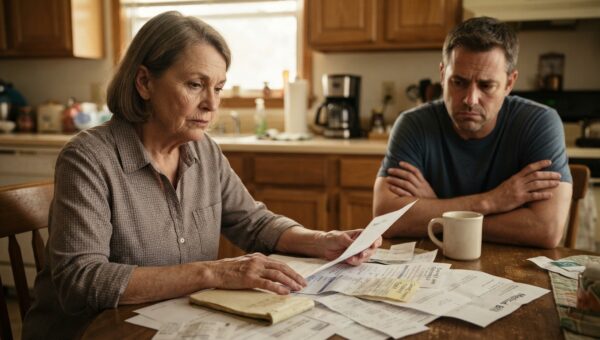
By morning, the rain had stopped, leaving the windows streaked with yellow dust from the cornfields. I didn’t call her. I didn’t wait for her to come by with the skim milk. I sat at the laminate kitchen table with the blue notebook spread open on one side and the stack of thermal receipts piled neatly on the other, a cold cup of tea growing skin on top right beside my elbow.
When the front door clicked open at ten o’clock and Brenda walked in carrying a brown paper sack from the pharmacy, she stopped dead in the entryway. She didn’t even take off her coat. She looked at the table, looked at my face, and the little bit of color she had left drained right out of her cheeks until she looked like tallow.
“Mom,” she started, her voice small and thin like paper tearing. “What is all this?”
I didn’t yell. I didn’t even stand up. I just tapped my finger once against the corner of Chloe’s notebook where the neat little letters spelled out the truth.
“Sit down, Brenda,” I said, and for the first time in months, my voice didn’t shake at all. “We need to talk about your daughter, and we need to talk about why she had to do your job for you.”
Brenda dropped the pharmacy bag on the counter, the small cardboard box of aspirin rolling out and hitting the linoleum with a sharp little clatter. She pulled out the wooden chair opposite me, her shoulders caving in as she looked down at the numbers she thought she had hidden away in the dark.
“She found the statements in the recycling bin two weeks ago,” Brenda whispered, her hands flat on the table, trembling so hard she couldn’t keep her fingers still. “She saw the charges on the app when she was using my phone for her school project. She told me I had to stop. She said if I didn’t tell you, she was going to write it all down herself.”
“And you kept doing it anyway,” I said. It wasn’t a question. It was just the weight of what she was, sitting right there between our coffee cups.
“I have the car payment, Mom. The furnace repairman wouldn’t take a check. I was going to pay it back before you ever noticed the balance dropping,” she said, her voice rising into that old, familiar whine that used to work when she was twelve and caught stealing candy from the five-and-dime. “I was just trying to keep things afloat until the spring.”
“You weren’t keeping anything afloat,” I told her, my eyes fixed on the neat blue lines Chloe had drawn. “You were just sinking the boat with both of us in it.”
I reached over, picked up my brass house and car keys from where she had tossed them on the counter the night before, and dropped them into the pocket of my cardigan. Then I picked up my bank card, wiped the corner clean with my thumb, and laid it right beside my cup.
“You’re not doing my shopping anymore, Brenda. And you aren’t driving my car to the grocery store or anywhere else,” I said, looking straight into her eyes until she had to look away at the wall. “We are going down to the bank together this afternoon, and we are changing every password on that account. If you need help with your bills, you come to me like an adult and we talk about it in the light. But you never, ever take what isn’t yours while pretending you’re doing me a favor.”
She didn’t argue. She didn’t try the gaslighting or the tired sighs about my memory. She just sat there with her head bowed, her fingers twisted together in her lap, looking smaller than she had in years.
That afternoon, after the bank manager had finished resetting the limits and printing out three months of clean statements without a single gift card line on them, I drove myself home in my own Buick, keeping both hands steady at ten and two on the steering wheel.
When I pulled into the gravel drive, Chloe was sitting on the front porch swing with her schoolbooks open in her lap, her red hoodie zipped up against the wind. She looked up as I shut the engine off, her face tight and uncertain, like she was waiting for the roof to cave in.
I didn’t say anything from the car. I got out, walked slowly up the wooden steps, and sat down on the swing right beside her. I reached into my pocket, pulled out the blue spiral notebook, and laid it gently on top of her algebra book. Then I reached over, took her small, cold hand in mine, and squeezed it until I felt her fingers relax and squeeze back.
“Thank you, sweetheart,” I said, and for the first time in six weeks, the tightness in my chest finally let go.