The side porch at my parents’ house is where I learned I was the dependable daughter, not the daughter getting the house.
I was 45, holding a grocery-store cake with a crack down one side, when Mom told me she and Dad planned to leave their house to my sister, Tessa. Mom said it gently, like she was explaining a seating plan.
I didn’t answer. I set the cake down on the counter and noticed the little paper tag from the bakery was still stuck to my sleeve. I kept picking at it while everybody else moved on to coffee.
I’d been sending my parents $2,000 every month for eight years. The money wasn’t a surprise to them. The paper behind it was.
I didn’t tell Tessa about that paper. I didn’t tell her a lot of things, which is part of why I can’t make myself the innocent one in this story.
I live in a railroad town in Nebraska. I’m a bookkeeper at a plumbing supply place, and I’m the kind of person who keeps old bank statements because I’m afraid I’ll need them later. I go to church most Sundays. I’m not especially good at forgiving people, but I’ve learned how to say the words without making a scene.
My parents, Ray and Gloria, bought their house in 1988. It’s a plain two-story place with a narrow porch and a kitchen drawer that sticks unless you lift it. Dad used to say the drawer was the only thing in the house he couldn’t fix. He was joking, mostly.
Tessa is three years younger than I am. She has two kids, Mason and Ellie, and for a long time she was the one who needed help right now. A car repair. A school fee. A late rent payment after her divorce. I helped when I could, but I didn’t have children, and I had a steady job. In my family, that turned into the same thing as having extra money.
I told myself I didn’t mind.
That part is only half true.
The payments started when Dad’s hours got cut and Mom’s prescriptions got more expensive. They weren’t in danger of losing the house then, but they were leaning on credit cards and skipping things they shouldn’t have skipped.
Mom had started cutting her blood pressure pills in half to make them last. Dad told me after church one Sunday, while I was putting away folding chairs.
I offered to help. He asked if I could manage $2,000 a month until he got steady work again. I could. My mortgage was paid down, and I didn’t have anyone to support but myself. I said yes before I asked enough questions.
Dad was the one who brought up the note. He said he didn’t want to treat the money like a gift because he wanted me to get it back. Mom didn’t like the word loan. She called it family helping family. We sat at my kitchen table and worked out a simple written agreement: they’d owe me whatever I paid, with no interest, and we’d review it every year.
The first page had a total of $2,000. The second had my parents’ signatures.
The paper wasn’t pretty or lawyer-made. It had a coffee ring near the bottom and a staple mark from where Dad attached the monthly bank records.
I put it in a folder. That was all.
Or so I told myself.
At first, Dad picked up extra shifts. Then his knees got bad, and Mom’s health took more of her time. The monthly payments kept going. The $2,000 covered the mortgage, the prescriptions, the heat bill, and whatever had come due that week. Some months Mom called to say she only needed $1,400. I sent the full amount anyway, then heard later that the rest went toward the roof or the water heater.
I kept track. That’s what I do for work. I made a spreadsheet, checked every transfer against my statements, and updated the running balance. When I look at it now, I can see how careful I was with the numbers and how careless I was with the people.
I could have asked Dad when he planned to pay me back. I didn’t. I could have told Tessa that the money was a loan. I didn’t do that either. Some of it was pride. Some of it was fear that she’d think I was keeping score. And, if I’m honest, some part of me liked being the person Mom called when the furnace quit.
That sounds ugly. It’s still true.
Tessa got married again in 2021. I paid for the catered lunch after the courthouse because she was embarrassed about not having a real wedding. I don’t think she asked me to. I offered, then acted like it was nothing when she thanked me. The kids hugged me around the waist, and Ellie got frosting on my coat. I remember that better than I remember the ceremony.
My parents told Tessa about the house that winter. Not in a formal way, as far as I knew. Mom mentioned that the kids could have rooms there someday. Tessa started talking about where a bunk bed might go. I didn’t say anything because I thought it was just talk, the kind people make when they picture the future.
Then my 45th birthday came.
I’d invited everyone over to my parents’ place because Mom said she wanted to make dinner. I brought the cake. Dad had put out the good plates, the ones with blue flowers that only come out for company. Mom sat beside Tessa and said she and Dad had decided the house should go to her.
Mom’s reason was that Tessa had kids and I didn’t.
I looked at Dad. He kept rubbing one thumb over the side of his coffee cup. Tessa looked at me, then at Mom. I could tell she didn’t know what to say. I think she expected me to be hurt, but not hurt enough to make it uncomfortable.
I didn’t make it uncomfortable. I cut the cake.
The piece I gave Dad was too big. I remember that stupid little thing. I remember the paper tag still on my sleeve from the bakery, though I’d picked at it until the corner came loose. I remember Mom asking if I wanted the last piece and my saying no.
The next week, I stopped the monthly transfers.
I didn’t announce it. I didn’t call and threaten anyone. I changed the automatic payment from my phone while I was on my lunch break, then sat in my car with my hands resting on the steering wheel until my break was over. I told myself it was sensible. I was 45, and I had to think about my own future.
That was true. It was also the first time in eight years I let my parents feel what it was like without my help.
They called three days later. Dad said the mortgage payment was due. I told him I had stopped sending money because Mom had made it clear the house was going to Tessa. The line went quiet. He said he understood, which I didn’t expect.
Mom called after him. She said I was turning a birthday comment into something it wasn’t. I told her I wasn’t angry about the house itself. I was angry that she had treated the years of payments like they didn’t count because I didn’t have children.
Mom said she’d never said they didn’t count. I could hear her moving dishes around as she spoke, which is what she does when she wants a conversation to end without hanging up.
I said I’d call later. I didn’t. For a month, I sent no money and had very little to say.
The house didn’t fall apart in that month. My parents used their savings for the mortgage and bills. Dad picked up a few bookkeeping jobs for a man from church. Mom stopped giving Tessa the idea that the house transfer was already settled, though I didn’t know that yet.
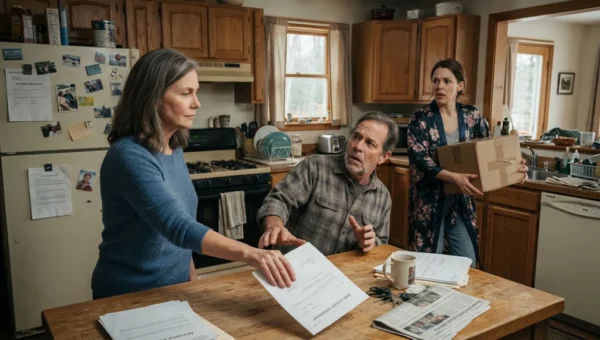
Then Tessa came to my door on a Thursday evening. She had the note in her hand.
I knew it before she said anything. The old folder had been at my parents’ house for safekeeping after Dad needed the statements for a loan review. I’d forgotten it was still there. I had also forgotten that Tessa had begun sorting through their papers because Mom asked her to help prepare the deed transfer.
She didn’t come in at first. She stood on the porch with her coat unzipped and one hand shaking around the folded paper. I could see the coffee ring through the thin sheet.
“You’ve been keeping this from me,” she said.
I asked if she wanted to come inside. She came in, but she didn’t sit down. She placed the note on my kitchen table and pushed it toward me with one finger.
She’d read the total. She’d read Dad’s handwriting, the line saying the payments were a loan. She’d seen the bank record showing that I’d sent $2,000 a month for eight years.
She was mad, and honestly, I understood why. She had thought the money was help given freely. She’d thought the house was something Mom and Dad wanted to give her because she had kids. Now she saw my name attached to nearly every month of their lives for eight years, and she thought I’d waited until the house was promised to her to bring out a bill.
I hadn’t. But I could see why it looked that way.
I told her Dad had asked for the note and both parents had signed it. I told her I hadn’t planned to collect on it. That was true until the birthday. After that, I didn’t know what I planned.
Tessa asked why I’d never told her. I said I didn’t want her to feel guilty. She gave a short laugh that wasn’t a laugh, really. She said she would have felt guilty anyway.
Then she asked how much I expected them to pay back.
I didn’t have an answer ready. I had a spreadsheet, but no answer. There’s a difference. I said I didn’t know, and she shook her head like that was the worst answer I could have given.
She told me she’d called Mom after reading the note. Mom had said the payments were family help and that Dad had wanted the paperwork because he worried I’d be angry later. Tessa said Mom made it sound like I’d pushed them into signing.
I said I didn’t. Then I stopped talking, because I’d spent eight years acting like the note didn’t exist. I couldn’t expect everyone else to understand it the way I did.
Tessa left the paper on my table and sat down. She had brought it all the way from our parents’ house, but she didn’t take her coat off. We talked for almost two hours. I can’t repeat most of it. We went over old fights, who got help, who was expected to be grateful, and who got to ask for more.
I told her I’d helped because I loved our parents. I also told her I’d wanted someone to notice. That was the part I hadn’t planned to say.
Tessa looked down at the note. She said she had thought I was judging her for needing help. I told her I did judge her sometimes. I had also resented that she could ask our parents for help while I was sending them money and then feel ashamed when she needed more. It was not my best hour. It was probably the most honest one we’d had in years.
We didn’t hug. She left the note on the table and said she’d talk to our parents with me, if I wanted.
I did.
We met at their house that Sunday after church. Mom had made soup. Dad kept checking the clock, even though nobody had anywhere to be. Tessa brought the note. I brought my spreadsheet. We set them beside each other on the table.
Dad said he had meant to pay me back. The years went by, and the house needed things, and the payments went toward their life. Mom said she thought I’d given the money because I wanted to help. She said she didn’t understand that the note would still matter after all this time.
I told her the note mattered because I’d needed it to matter. I’d been careful about the numbers so I wouldn’t have to be honest about the hurt.
Nobody yelled. That made it harder, somehow. Dad rubbed his thumb against the coffee cup again. Mom kept smoothing the edge of the tablecloth.
We looked at the numbers. I had sent $192,000 in all. Their mortgage balance was $68,400, and the house needed a few repairs before it could be sold. Their savings weren’t enough to cover a long stay in assisted living if either of them got much worse. The promise to leave the house to Tessa had been made without asking what the house could afford, or what they needed.
That was the part none of us wanted to say. The house couldn’t be an inheritance and a retirement plan at the same time.
We called a realtor from church. She said the house might sell for around $318,000 if they fixed the porch steps and cleared out the old shed. The exact number came later, after the inspection. I’m skipping some of the dull calls and forms. There were many.
My parents agreed to sell. They would move into a small apartment near the pharmacy and the clinic. The money from the sale would pay the mortgage and costs first. I would receive $120,000 from what was left. I agreed to forgive the other $72,000.
I don’t want that to sound noble. I was angry about it. $72,000 is not a small amount to erase, even if I had never planned to ask for all of it. I also knew my parents had spent the money to stay in their home and keep up with their bills. I didn’t want to take the house out from under them just to prove a point.
Tessa agreed not to take the house. She also agreed to help with the move, and to take Mom to her appointments twice a month. I would handle the bills and check in with Dad about the apartment. Neither of us thought it was fair that those jobs should fall to me because I was the organized one.
Mom apologized, but she didn’t say much. She said she’d been thinking about Tessa’s kids and had let herself believe that was the same as being fair. Dad said he should have brought up the note years ago. I heard both of them. I didn’t suddenly feel fine.
The house sold for $316,750. That number is in the folder now, written on the same page as the old payments. The buyers wanted the porch steps repaired, and Dad spent two afternoons doing the work himself even though the realtor told him he didn’t have to. He said he couldn’t leave them crooked.
My parents moved into the apartment six weeks later. Tessa and I packed the kitchen. We found a drawer full of rubber bands, old birthday candles, and paper clips that had been bent open and bent shut again. I kept a little jar of the paper clips because Dad had saved them for years.
On moving day, Tessa and I carried the blue-flower plates together. She said she’d been angry because she’d imagined the house as something she could give her kids. I said I knew. She said she still thought I should have told her. I said she was right.
We hugged then. It was awkward, and Tessa bumped the plates against my shoulder. We both laughed, but neither of us pretended everything was fixed.
The apartment is smaller. My parents have one bedroom and a little table by the window. They still need help. I still go over on Sundays, though not every Sunday. Tessa comes too. Sometimes she brings the kids, and sometimes it’s just the three of us sorting mail or taking Dad to an appointment.
After the sale closed, I sat at my kitchen table with the note and the spreadsheet. I wrote the settlement amount on a fresh sheet. I crossed out the remaining balance, then wrote that the rest was forgiven. It took me three tries to make the handwriting neat.
My sister signed under me as a witness. She didn’t have to. She asked if I wanted her to.
I said yes.
The old note is still in my folder, but the last line now says “Settled,” in Tessa’s handwriting.