My stepdaughter Chloe asked me not to be in the family Christmas photo because she wanted just blood relatives this year. I had been married to her father Arthur for nineteen years. I raised her younger brother Kevin, paid for his braces when things were tight, sat through countless freezing school plays in the middle school auditorium, and never once tried to replace her mother.
I stepped aside because I didn’t want a scene in front of the neighbors. After the camera clicked, her eight-year-old son Leo walked over and handed me the heavy silver camera. He looked up at me with those big, clear eyes and said, “Grandpa told me to take one more.”
Arthur stood right beside me on the braided rug, his hand brushing against my sleeve. Then Chloe started shouting because her son had opened the old photo folder on the camera’s memory card instead of the gallery app. There were hundreds of pictures from years I thought Arthur had completely forgotten about, tucked away in a mirrored backup drive he always swore he only used for tractor manuals and deer camp scouting. One photo on the small LCD screen showed Chloe at age twelve holding a handwritten cardboard sign with words I had never seen before in my life.
The living room had been smelling like pine needles and burnt sugar for hours before anyone even took off their coats.
Arthur was out on the side porch chopping kindling because he always gets restless when his children come home for the holidays, and Chloe had been pacing the length of our pine-board floors in her expensive wool boots, complaining about the draft from the front window. She had her blonde hair pulled back into that tight, severe knot she wears whenever she wants people to take her seriously at her bank job.
“We just want a clean look for the mantel this year, Elena,” she had said, not even looking me in the eye while she straightened the wool scarf around her husband’s neck. “Just blood. You understand, right? Keep it simple.”
I remember looking down at my hands, which were stained slightly from peeling potatoes for the beef roast, and feeling the old, familiar weight settle right behind my collarbones. Nineteen winters in this house. Nineteen summers of hauling laundry out to the line while Chloe complained about the humidity and the gnats.
I didn’t argue. I didn’t raise my voice. I just took my apron off and walked over to stand by the radiator near the woodstove, watching Arthur’s broad back through the wavy old glass of the front window as he split another round of oak.
“Go on, then,” I had told her. “Take your picture.”
Arthur came back inside just as the shutter snapped the first time, his face red from the wind and little bits of bark stuck to the knees of his work trousers. He didn’t say a word when he saw me standing by the side table with my hands empty while Chloe and her brother Kevin and her husband posed on the velvet settee. Kevin looked miserable, his boots glued to the floorboards like he wanted to bolt right out the back door, but he stayed because he hates friction more than anything.
Then Leo broke ranks. The boy is eight and misses nothing, trailing around behind his grandfather like a stray hound.
Arthur had handed him the old Nikon digital camera just to keep him busy while the adults fussed over lighting. Leo wandered over to where I was standing, his small thumb swiping across the touch screen with the easy confidence of kids who grow up with glass rectangles in their cribs.
“Look, Grandma,” Leo said, his voice carrying clear over the chatter. “Grandpa has all these old ones saved in a secret box.”
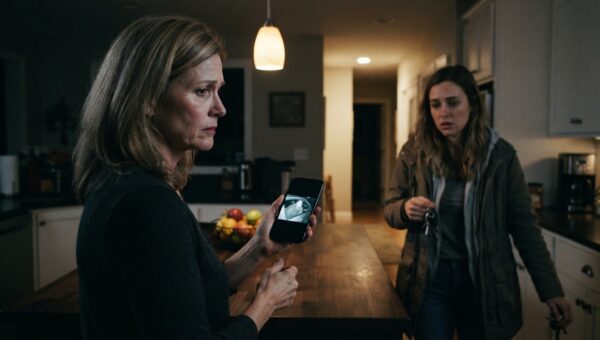
I looked down. The screen was glowing in the dim light of the hallway, showing a thumbnail grid of folders labeled by year, all the way back to 2005. That was the year Arthur and I got married in the small justice of the peace office down in Beatrice, back when the roof leaked and we had to put out plastic buckets every time it rained hard. Leo’s small finger hit one of the folders, and a picture from the winter of 2007 popped up instantly, filling the screen with bright, unfiltered color.
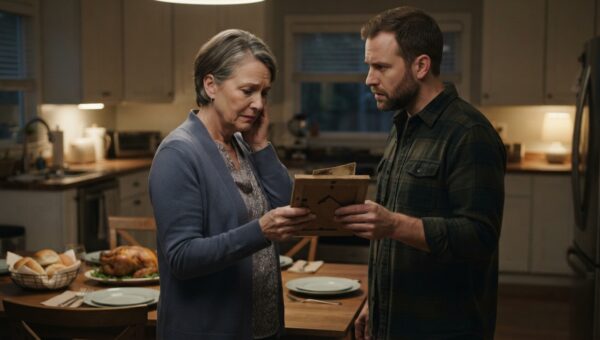
It was the kitchen in the old house on Miller Street before we remodeled. The counters were scarred and yellowed, and the snow was piled high against the screen door outside. A twelve-year-old Chloe was standing right there by the flour bin, wearing an oversized flannel shirt that used to belong to Arthur, holding up a jagged piece of brown cardboard with black marker scrawled across it.
“What is that?” I whispered, mostly to myself.
Chloe stopped laughing instantly. Her head snapped around so fast her earrings clicked against her collar. The color drained right out of her cheeks, leaving her skin looking like curdled milk under the hallway fixture.
“Leo, give me that,” Chloe screamed, her voice cracking into something sharp and ugly that made the dog lift his head from the braided rug. She lunged across the room, her hands outstretched to snatch the camera right out of her son’s small fingers.
Leo ducked behind my skirt, clutching the Nikon like it was a live grenade. “Mom, stop it, you’re scaring me,” the boy yelled, backing up against the wainscoting.
Arthur moved then. He didn’t shout, but he stepped right into Chloe’s path with the slow, heavy inevitability of a tractor rolling out of a barn. He was bigger than her, bigger than all of them, and his face had that flat, granite look he only gets when someone crosses a line he drew twenty years ago.
“Leave the boy be, Chloe,” Arthur said. His voice was low, just above a murmur, but it filled the whole room until the grandfather clock in the corner sounded loud.
“Dad, take that from him! It’s private! It’s junk!” Chloe’s voice went up an octave, shaking with a blind, frantic panic that didn’t make any sense for an old picture on a camera. “You have no right keeping that stuff! You’re making things up!”
“Nothing’s made up on that card,” Arthur said, looking down at her with eyes the color of muddy river water. “I backed up every card we ever shot because people around here have a habit of forgetting what things cost before the paint dried.”
Kevin finally stood up from the settee, his tall frame uncoiling slowly. He looked at his sister like he was seeing a stranger for the very first time. “What is she talking about, Chloe? What’s on the card?”
“Nothing!” Chloe shouted, her hands balling into tight fists at her sides. “She engineered this. She’s been poisoning everyone against me since the day she moved her boxes into this house! She thinks she’s a saint because she cooked dinner!”
I looked down at the screen again, ignoring the noise she was making. The backlight was fading slightly, but the words on that piece of cardboard were clear as church on Sunday, written in thick, messy adolescent handwriting that had smudged near the bottom where her thumb had held it.
Thank you for staying when everyone else left.
The memory hit me so hard my knees went weak for a second. December 2007. It was three days after Chloe’s biological mother, Brenda, cleared out her closet in the middle of the night, left the front door wide open to let the frost in, and took off for Denver with a drywall contractor she met at the bowling alley. Chloe had locked herself in her bedroom for forty-eight hours, refusing to eat the soup I left by the knob, screaming through the pine panels that she hated us, that she hated me most of all for being there while her mother was gone.
I had sat on the floor outside that door until three in the morning, listening to her cry until she ran out of breath, not moving because I knew if I left she’d think she was truly alone in the world. On the fourth morning, she came down the stairs wearing that big flannel shirt, her eyes swollen shut, holding that piece of cardboard like a shield. She didn’t say it out loud. She just shoved it under my nose while I was standing by the stove trying to get the pilot light to catch, then she sat down at the table and ate two bowls of oatmeal without saying a word.
I had forgotten about the sign. Or maybe I had just pushed it down into the dark corners of my mind where I kept all the hard things, because life had to go on and floors had to be swept and school clothes had to be ironed. But Arthur hadn’t forgotten. He had taken the picture while standing by the pantry with his old film-to-digital rig, capturing the exact moment the ice cracked in this house.
“You remember that night, don’t you, Chloe?” Arthur asked, his voice steady and flat. “That was the night your mother’s phone went dead for good. Elena sat on your floor for two days straight while you threw your books at the wall. You weren’t talking about blood relatives then. You were just begging someone not to walk out the front door.”
Chloe stood there in the middle of the Christmas rug, her mouth opening and closing like a fish on a bank. All her sharp edges seemed to melt away into something small and pathetic, her expensive wool coat hanging off her shoulders like she was wearing clothes that didn’t belong to her.
“I was a kid,” she muttered, her voice dropping down to a miserable whine. “I didn’t mean it that way. Things were different.”
“Things were exactly the same,” Kevin said, stepping past her to stand beside Arthur. He looked down at me with that same crooked grin he had when I taught him how to ride his first two-wheeler without training wheels. “You just decided it didn’t fit your story anymore, Chloe. It’s easier to pretend you raised yourself than to admit someone else loved you when you were hard to love.”
Nobody said anything for a second, and honestly that felt heavier than any shouting. The wind outside was rattling the loose tin on the shed roof, making a hollow, tinny sound that filled up the silence between us.
Chloe looked around the room, waiting for her husband to back her up, but he was staring at his boots like he wished he was three counties away. She didn’t say another word about the picture. She just turned around on her heel, grabbed her leather purse from the hall bench, and walked out the front door without her coat, her husband hurrying after her with his arms full of their winter gear.
The front door clicked shut. The latch didn’t quite catch on the first try because the frame has always warped when the temperature drops below zero, so Arthur walked over and kicked the bottom sill home with his heel.
“Well,” Arthur said, blowing out a long breath that smelled faintly of pipe tobacco and cold air. “Supper’s going to dry out if we don’t carve that roast.”
I didn’t cry. I didn’t feel like crying, because the knot in my chest had finally come undone after nineteen years of walking on eggshells to keep a girl from feeling replaced. I handed the camera back to Leo, who took it carefully with both hands and set it down on the sideboard next to the Christmas cards.
“Come here, boy,” I said, holding out my hand.
Leo ran over and leaned against my knee, his small shoulder warm through his sweater. Kevin stood by the window, watching Chloe’s sedan back down the gravel drive with the tires spinning twice in the frozen mud before catching traction.
“Get in the frame, Kevin,” Arthur said, picking up the Nikon and checking the battery level on the back screen. “We’re going to take one more before the sun goes down behind the timberline.”
We didn’t go back to the settee. We stood right there in the middle of the kitchen where the floorboards were worn down to the pale grain by nineteen years of boots and bare feet and heavy winter coats. Arthur set the timer on the little metal tripod he keeps behind the flour bin, then jogged over to squeeze in beside me, his arm heavy and warm across my shoulders. Kevin stood on my other side, resting his hand on the back of my chair, and Leo ducked down right in front, grinning up at the lens with a missing front tooth.
The shutter clicked once, the small amber light blinking twice in the darkening room, recording us just as we were, with no empty spaces left to defend and no stories left to rewrite.