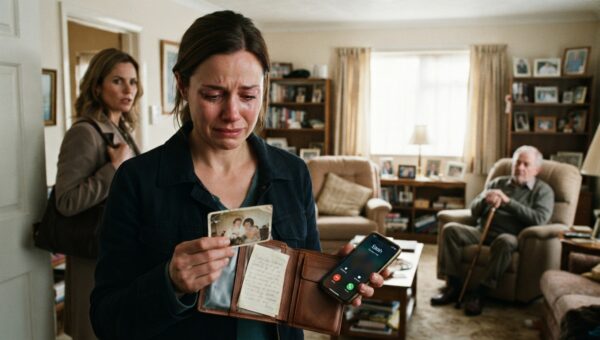
The morning was gray, the kind of heavy, wet Tuesday where the fog hangs so low over the valley you feel like you are walking through a dream. I was at the sink, washing a coffee mug, when the floorboard in the hallway creaked. My hands went still. Nobody had been in this house for twelve years. Not really. I kept the place clean for ghosts.
I walked to the front door and looked through the glass. Nothing. Just the damp mist pressing against the pane. But when I looked down, there it was. A white envelope, slightly damp at the corners, tucked into the frame of the screen door. No stamp. No return address. Just my name, Martha, written in that thick, slanted cursive I hadn’t seen since the trial.
It wasn’t a threat. It was a receipt.
Twelve years ago, the world ended for me on Route 6. Cole was nineteen, a boy who laughed with his whole chest and had a habit of leaving his socks in the kitchen. He was driving home from a shift at the hardware store. Thomas Vance was behind the wheel of an SUV, three times over the limit, crossing the yellow line like the road was his own private property.
“I didn’t see him,” Thomas had sobbed in the courtroom. That was his version of the truth.
He served four years. The judge called it a tragic lapse in judgment. I called it a murder, but nobody asks the mother for the verdict. My life turned into a long, quiet exercise in disappearing. I went to work at the sewing shop, I kept my house, and I went to Grace Fellowship every Sunday because that was where I felt closest to the silence Cole had left behind.
Then, last spring, Thomas walked into the sanctuary.
He didn’t look like a monster. He looked tired. He sat in the third pew, every single Sunday, staring straight ahead at the back of the altar. Pastor Nealy told me it was a miracle. He said Thomas had found the path and needed our support to stay on it.
“He wants to make things right, Martha,” Nealy said to me last week. We were in his office, a room that smelled like old paper and expensive cologne. “Sunday is our unity service.
If you stand up and offer him forgiveness in front of the congregation, you will be the bridge that saves his soul. And honestly, the church needs that kind of story right now.”
I went home and stood in my kitchen. The house felt too big, the walls too white. I thought about the seventeen-hundred-dollar check I received for the funeral expenses from Thomas’s insurance. That was the price tag the state put on Cole. I tried to pray. I tried to find the grace that the Bible says is supposed to fall like rain.
But Friday, I went to the church early. I needed to drop off the flowers for the altar. The sanctuary was empty, the air still and smelling of lemon polish. I went into the vestry to leave the vase, but the door to the office was cracked open. A manila folder was sitting on the desk. It wasn’t hidden. It was waiting.
Inside, I found a ledger for the church building fund. They were raising money for a new wing, a vanity project that had stalled for two years. Under the tab for “Anonymous Contributions,” I saw a series of deposits. The last one was for eighty-five thousand dollars. The wire transfer originated from the Vance Family Trust.
My stomach didn’t drop. It tightened, turning into a hard, cold knot. Thomas hadn’t found the path. He had bought a ticket to heaven, and Pastor Nealy was the clerk.
Sunday morning, I woke up before the sun. I went to the closet and pulled out the navy-blue dress I wore to the cemetery. It still smelled faintly of lilies and damp earth. I put it on, buttoned it to the throat, and walked out the door. The gravel under my boots sounded like crunching bones.
When I arrived at Grace Fellowship, the parking lot was filling up. I didn’t go to the back. I didn’t go to the side. I walked right through the main doors, the wood heavy and solid under my hands. The foyer was buzzing with the usual Sunday chatter. People stopped when they saw me. They knew. They always knew.
I walked down the center aisle. Every head turned. Thomas was in the third pew, exactly where he always was. He looked up, his eyes wide and watery, probably rehearsing the humble expression Nealy had told him to wear. I didn’t stop. I walked right past him, my heels clicking on the hardwood like a metronome.
I went up the steps to the pulpit. Nealy was sitting in the front row, shuffling his notes, but he froze when I reached the mic. He stood up, his face reddening.
“Martha,” he whispered, a sound that wasn’t loud but carried through the silence of the room. “Not now.”
I didn’t care about him. I didn’t care about the board of elders or the choir. I looked at the microphone, adjusted the height, and felt the hum of the electricity beneath my fingers. It was the only voice I had left.
“Brother Nealy asked me to offer a testimony of forgiveness today,” I said. My voice was steady. It surprised me, how steady it was.
The church went quiet. A baby fussed, and the mother hushed it instantly. It felt like the air had been sucked out of the room, leaving a vacuum where only my words could live.
“For twelve years, I have lived with the memory of Route 6,” I said, looking out at the congregation. I saw Mrs. Gable, who always brought me casseroles and pity. I saw the deacons who had signed off on the new building contract. “I have prayed for a way to let go of the anger. I searched for a way to find peace.”
I pulled the folded page from my purse. It was a copy of the ledger. I laid it on the pulpit. It looked small, just a piece of paper, but it held the weight of a twelve-year lie.
“I thought forgiveness was a spiritual act,” I continued. I looked down at Nealy. He was gripping the edge of the pew so hard his knuckles were translucent. “But it turns out, in this church, it is just a business transaction.”
Thomas was staring at the paper. He didn’t look like a penitent sinner anymore. He looked like a man who had lost his bet.
“Pastor Nealy told me that Thomas was a changed man,” I said, my voice rising just enough to hit the back wall. “He told me that my forgiveness would be the final step in his redemption. But he didn’t tell me that the Vance family had paid eighty-five thousand dollars to cover the church’s debt. He didn’t tell me that my boy’s life was being used to pave a new parking lot.”
A gasp moved through the room like a physical wave. Nealy lunged for the microphone, his face a mottled mask of panic.
“Martha, you are confused!” he shouted, his voice cracking. “That money was a gift from a generous donor!”
“A donor who happens to be the man who killed my son,” I said. I didn’t scream. I didn’t cry. I just stated it like I was reading a grocery list. “You sold my grief to balance your books. You sold my son’s memory to finish a wing on a building that doesn’t care if I hurt.”
I took my hand off the microphone. The feedback shrieked, a high, lonely sound that echoed in the vaulted ceiling like a ghost. I didn’t look at Thomas. I didn’t look at Nealy. I looked at the people in the rows, the people who had pretended this was about grace for all these months.
“You can keep your building,” I said. “And you can keep your fake peace.”
I turned and walked down the steps. The silence was so heavy it felt like walking through water. I didn’t look left or right. I kept my head high, my breath coming in slow, steady pulls. I reached the doors, pushed them open, and stepped out into the bright, indifferent morning.
The drive home was a blur of asphalt and green trees. I didn’t think about the church. I didn’t think about the ledger. I thought about the smell of the house.
When I got inside, I walked straight to my bedroom. I took off the navy dress, the one I had worn for twelve years as a uniform of my mourning. I hung it back in the closet, pushing it to the very back behind my work shirts. I slid the wooden latch on the closet door closed with a firm, final click.
I went to the kitchen and sat at the table. The afternoon light was coming through the window, slanting across the wood in long, gold bars. I poured a cup of coffee. It was lukewarm, but I drank it anyway.
I sat there for a long time. I didn’t have a plan. I didn’t have a future. I had a quiet house, a clean conscience, and a table that was finally, truly my own. I looked at the candle in the center of the table. It had been sitting there for years, a relic of a better life. I reached out, touched the wick, but didn’t light it.
I didn’t need the fire. I was finally warm enough.