
PART 1
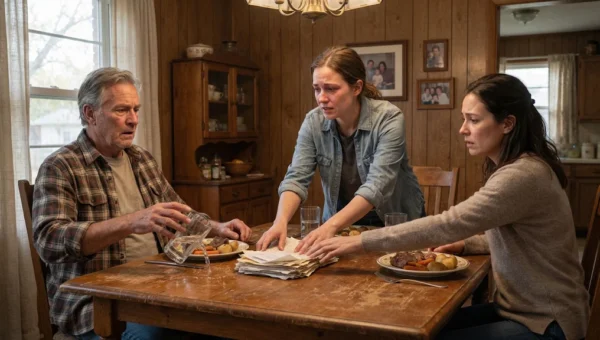
My brother Kyle stood in my driveway, arms crossed, with three of our aunts behind him. He had pulled up in his leased BMW while I was changing the oil on my dented truck.
Aunt Pauline stepped forward. “Your mother is going to lose her house, Marshall. She calls me crying every night.”
I wiped my hands on a shop rag and looked from one face to the next.
“Perfect. Since you all agree, I will call the bank Monday. Which one of you is taking over her $4,700 monthly payments?”
Nobody answered.
Five seconds passed. Even Kyle looked away.
Then Pauline straightened up. “That is not what we are here to discuss. Your mother says you have been hoarding the family money.”
I set down the rag.
“Mom said what?”
I am thirty-four, a civil engineer, and I spend my workdays checking numbers that keep bridges standing. My personal finances are boring. I bought a duplex at twenty-six, live in one half, rent out the other, shop at Aldi, and drive an old truck.
Kyle is thirty-seven. He is charming, persuasive, and perpetually ninety days from his next big break. Before the restaurant, he had lost two jobs. He still convinced Mom that the right opportunity was just around the corner.
Five years earlier, Mom had a paid-off three-bedroom house. She had earned it through twenty-eight years as a school secretary, raising us after Dad left.
Then Kyle dreamed up a barbecue restaurant.
No restaurant experience. No management record. Just a business pitch and a logo.
Mom borrowed $180,000 against the house to fund him.
The restaurant lasted fourteen months.
Then she refinanced again, pulling out another $95,000 for Kyle’s mobile detailing venture. That closed after eight months. There was also a crypto phase nobody likes discussing.
I had already paid $12,000 of Mom’s credit-card debt and covered around $3,200 in car payments. Every time I helped, Kyle found another reason to need money. I would watch Mom relax for a few weeks before the next disaster hit. That chaos followed me home, too. Gina and I divorced two years ago, partly because it never stopped.
Eventually, I said enough.
Two weeks before the driveway confrontation, Mom called about missed mortgage payments.
“How far behind?”
“Fourteen thousand one hundred dollars.”
Three payments. $4,700 each.
Her retirement income was about $2,800 a month. There was no way she could keep making payments that large.
I told her I could not cover them.
So Kyle brought reinforcements.
“You have been sitting on a pile of money while your mother drowns,” Pauline said.
“Did she tell you about the $15,200 I have already paid?”
Aunt Renee glanced at Aunt Cheryl. Kyle shifted his weight.
No, she had not.
Kyle kept his arms folded, but his stare was fixed on the oil stains at my feet. He was happy to let our aunts speak for him.
I asked what happened if I wrote another $14,100 check. Who would make next month’s payment? Or the one after that?
Pauline talked about family duty.
Cheryl, whose husband owned a plumbing company and had recently installed a backyard pool, would not agree to split the overdue amount with me.
All four had come to my house demanding money.
Together, they had offered exactly zero dollars.
They left furious.
But one phrase stayed with me: hoarding family money.
That was not how Mom talked. Someone had coached her.
My friend Dale, another engineer, listened to the story and asked one simple question.
“Have you actually seen the refinance documents?”
I had not.
Mom kept years of paperwork in plastic boxes in her hall closet. I still had a key from when I used to mow her lawn.
While she was out at her weekly card game, I went through the boxes and photographed three refinancing agreements.
At home, I spread the pictures across my kitchen table.
The first loan listed only Mom.
The second listed two borrowers: Diane and Kyle.
My pen stopped moving.
On the third agreement, Kyle’s name had vanished.
He had signed onto a loan, then gotten himself removed before the next refinancing.
I needed to know why.
Mom had previously given me online banking access to pay off her credit card, and it had not been revoked.
I used it to examine her statements and built a spreadsheet late into the night.
The second refinance had provided $95,000.
About $52,000 went to vehicle purchases, equipment, and insurance for the detailing business. Around $3,000 covered household expenses.
That left $40,000.
It had gone out in two transfers, $25,000 and $15,000, to an unfamiliar account.
Not Mom’s checking. Not her savings. Not the business account.
I could not establish who owned it.
I kept looking, following dates and searching for anything that might explain the transfer. What I found made me print one more page for the folder. I kept that page underneath the bank records.
An attorney I consulted looked over the paperwork. Mom’s house was now worth roughly $280,000, with about $310,000 owed against it.
Even catching up on payments would not fix that.
When I asked Mom about the unexplained $40,000, she went silent and hung up. Moments later, Kyle filled the family group chat with accusations that I was unstable, bitter about my divorce, and trying to steal the house.
I did not fight in the chat.
Instead, I asked Aunt Pauline if I could come to Sunday dinner.
I arrived carrying a manila folder.
Everyone was there. Mom sat quietly on the couch. Kyle leaned against the kitchen counter with a beer.
His eyes dropped to the folder.
“Before we eat,” I said, “I would like everybody in one room.”
Seven relatives gathered in the living room.
I laid the first refinancing agreement on the coffee table.
Then the second.
Kyle crossed his arms.
The quiet thickened. Aunt Renee stopped moving the fruit bowl. Pauline sat forward. Mom watched my hands as if she already knew this was not going to be another argument about my bank balance.
I pointed to the unfamiliar transfers. The final page remained beneath my hand.
“Forty thousand dollars,” I said. “Kyle, do you want to tell everyone whose account that was?”
Every head turned toward him.
He set down his beer.
PART 2
Kyle gave a short, dry laugh.
“That was business capital, Marshall. You don’t understand how commercial setup works. Not every vendor takes a direct card payment.”
“A vendor,” I said.
“Yes. Specialized equipment for the vans.”
Aunt Pauline looked at Kyle, then back at me. “Marshall, if it went to his business, that’s between him and the company. You’re treating your brother like a criminal in front of family.”
“I’m treating numbers like numbers,” I said. “The bank records show the second loan closed on March 12th. On March 14th, $25,000 left Mom’s account. On April 2nd, the other $15,000 left. The detailing equipment had already been bought in February on a separate supplier invoice for $28,400. I have that receipt right here.”
I set the supplier invoice on the coffee table next to the bank statements.
Kyle did not pick it up.
“You went through Mom’s closet,” he said. He looked over at our mother, his voice softening into that hurt, wounded tone he had used since we were boys. “Mom, did you hear that? He used your key while you were playing bridge. He snooped through your private things.”
Mom picked at a loose thread on the arm of the couch. Her hands were spotted with age, the knuckles swollen from arthritis. She did not look at Kyle. She did not look at me.
“Diane,” Aunt Cheryl said gently. “Did you know about this forty thousand?”
Mom swallowed. “Kyle said he needed it handled.”
“Handled how, Mom?” I asked.
She stayed quiet.
“I called the title company on Friday,” I told the room. “The closer who handled the third refinance remembered the file because of how rushed it was. She couldn’t tell me confidential details over the phone, but she did tell me that Kyle’s name coming off the title required a quitclaim deed and an assumption agreement. That was signed eight months ago. Right around the time the second loan went into default notices.”
Pauline frowned. “What does that mean in plain English?”
“It means Kyle put his name on the house when cash came out,” I said. “And the moment the payments became delinquent, he had Mom take out a third loan entirely in her name to clear him off the debt. He left her holding every single dollar of liability.”
“I was helping her qualify,” Kyle shot back, his voice rising. “My credit score was dragging her down. The loan officer told us she’d get a better rate if she took it alone.”
“The rate went from 5.2 percent to 8.9 percent,” I said. “The monthly payment jumped to $4,700. Her entire monthly income from her school pension and Social Security is $2,810. Nobody with half a brain thought she could pay $4,700 a month on $2,810. You didn’t do it to get her a better rate. You did it so the bank couldn’t come after your assets when foreclosure started.”
Aunt Renee leaned in, adjusting her reading glasses to look at the paperwork on the glass table. “Kyle, is that true? Is your name off that loan?”
“We made a family business decision,” Kyle muttered. “Marshall is twisting it because he hates that Mom supported me instead of him.”
“I bought my own house,” I said. “I paid my own bills. And over the last three years, while you were leasing that BMW parked in Pauline’s driveway, I gave Mom $15,200 out of my savings to keep the lights on and pay down the cards you ran up.”
“You always bring up money,” Kyle said, shaking his head. “Family doesn’t keep score, Marshall.”
“The bank does,” I said. “And the bank doesn’t care about family duty. The notice of default was filed nineteen days ago. She has forty-one days left before they set an auction date.”
Pauline looked stunned. “An auction? Diane, you told me they just sent a late notice.”
Mom pressed her palms against her knees. A tear tracked down the crease beside her nose, catching on the corner of her lip. “They said they were going to sell it on the courthouse steps if we didn’t pay the $14,100. Kyle told me he was closing an investment deal. He told me he just needed two weeks.”
I looked Kyle dead in the eye. “Tell them about the investment deal, Kyle.”
He picked his beer back up. His fingers were slick on the cold glass. “It’s in process. It takes time.”
“There is no investment deal,” I said.
I picked up the manila folder from the table. The final sheet of paper was still inside.
“You told Mom that $40,000 went to an escrow account for a commercial lease,” I said. “She believed you. She let you move the money because you promised her that within ninety days, you’d be paying her mortgage and buying her a condo in Florida.”
Mom gave a small, choked gasp.
Kyle took two steps toward the coffee table. “Don’t do this, Marshall. You’re crossing a line.”
“You brought three of our aunts to my home to humiliate me,” I said. “You stood in my driveway and called me selfish. You told our mother that her younger son was hoarding money while she lost her home. You made her feel abandoned.”
I opened the folder and took out the last page.
PART 3
I laid the paper squarely in the center of the table.
It was not a commercial lease. It was not a bank statement from an equipment supplier.
It was a certified copy of a judgment satisfaction from the county court records, dated four days after the $25,000 transfer, along with a closing statement from an auto finance group for $15,000.
“The account that received the money belonged to an attorney in Clayton,” I said. “A collection firm representing a private creditor. Kyle had an outstanding personal judgment against him for $24,800 from a failed partnership he never told anyone about. The remaining $15,000 paid off the negative equity on his previous luxury vehicle so he could sign the lease on that BMW sitting outside right now.”
The room went completely still.
Nobody spoke. Aunt Cheryl slowly turned her head toward Kyle.
“A BMW?” Cheryl said.
Kyle’s face darkened. “That car is for business. I have to meet clients. You think high-end commercial clients are going to hire a guy driving an oil-burning pickup like Marshall’s? Image