My phone screen stayed lit in the dark hallway, showing a balance of eighty-seven dollars and forty cents in my checking account because I had spent the last six months pouring every spare dollar of my ER night shift differential into a party nobody thanked me for. The air in my mother’s house smelled like scorched roast beef and damp pine needles from the wreath Evelyn insisted on hanging upside down because she saw it in a magazine.
Down the hall, the kitchen was loud with the kind of forced laughter Evelyn used whenever she wanted everyone to know she was the cleverest person in the room. I stood right there with my boots still unzipped, looking down at the two faded blue sleeping bags my mother had just dropped at my feet like spare rags for a pair of stray dogs.
My name is Gwen York. I am thirty-three years old, and I work the floor at St. Jude’s Memorial in Richmond, which means I spend twelve hours a night keeping people alive while their families scream at me in the waiting room. I know how to stay steady when a monitor flatlines. I know how to breathe through the noise and do what has to be done. But nothing in five years of trauma nursing prepared me for the way my mother looked right past my children to make sure Evelyn’s luggage had enough clearance on the guest room bed.
Lily was six, and she was standing behind me with her fingers hooked into the hem of my jacket, her chin tucked down so low her bangs hid her eyes. Owen was three, already rubbing his face against my shoulder because the four-hour drive up I-81 had worn him out right down to his bones.
We had packed the car before dawn. I loaded the casserole dish my mother demanded, wrapped in three layers of heavy-duty foil because she always checked the crust to see if I skimped on the butter. Somewhere around mile marker eighty, Lily had asked me a question that had been sitting in my own chest like a heavy stone for years. She whispered it against the hum of the tires. Mommy, does Grandma like us? I told her yes immediately because you do not tell your child the truth about people who treat love like a balance sheet.
But the truth was that ever since my father died four years ago, the house outside Bridgewater had turned into a courtroom where Evelyn and my mother sat on the judge’s bench. Dad used to be the buffer between us. He was the one who would sneak out to my car with a jar of apple butter or a twenty-dollar bill tucked into a brown envelope, telling me to buy the kids something nice for their shoes. When he went, the buffer went with him.
Evelyn walked out of the kitchen then, holding a glass of boxed Chardonnay with both hands like it was a holy relic. She took in the sight of us standing in the cold draft from the front door, her gold hoop earrings swinging against her neck. She took a slow sip and looked down at the sleeping bags on the floor. Should’ve booked a hotel, she said, and her laugh sounded like dry leaves scraping across concrete.
Mother came right behind her, wiping her hands on a floral dish towel that still had the store crease in it. She didn’t offer us a cup of coffee. She didn’t ask if the children needed to use the bathroom after four hours on the interstate. She just looked at my bags and then at Lily and Owen. The guest room is saved for the caterer’s coordinator who’s coming down tomorrow from Winchester, she said, her voice dry as salt. And Evelyn’s things take up the other closet. The floor is fine for a couple of nights. They are young. They bounce back.
I did not yell. Nurses do not yell when the vitals drop; we move. I told Lily and Owen to stay right there by the umbrella stand and I walked back out through the front door, letting the heavy oak latch click shut behind me without a sound. The air outside was sharp, smelling of wet gravel and the dead leaves packed into the gutters of my father’s old wraparound porch. My Honda Civic sat idling in the drive, the headlights cutting weak circles through the mountain fog rolling down off the ridge. I climbed into the driver’s seat, pulled my phone from my coat pocket, and opened the folder marked Birthday Gala 2024.
For six months, I had been the ghost investor of my mother’s sixtieth birthday celebration. Evelyn had been posting on Facebook about how she was underwriting the whole affair, showing off pictures of herself at the historic inn in Harrisonburg like she was some kind of local philanthropist. But Evelyn’s credit cards had been maxed out since her divorce two years ago, a fact my mother chose to ignore because Evelyn knew how to laugh at the right jokes and wear the right shade of lipstick. Whenever my mother complained about the cost of growing old, I had swallowed my pride and taken the extra twelve-hour shifts, trading Christmas Eve for New Year’s Day, missing Lily’s first school play so I could cover the shortfall for the live jazz trio. The venue deposit of two thousand four hundred dollars, the four hundred and fifty dollars for the custom carrot cake with cream cheese frosting, the catering balance of five thousand three hundred and ninety-seven dollars. Every single line item bore my legal signature. Every contract was backed by my personal Visa ending in four zero nine two.
My fingers were shaking against the glass screen, but the numbers were as clear as a triage chart. Clara Vance, the event director at The Heritage Inn, had told me during our last phone call that the final cancellation window without penalty closed at eight o’clock tonight, exactly forty-eight hours before the sixty guests were scheduled to sit down under the chandeliers. I looked at the dashboard clock. It was eight-sixteen in the evening. I had missed the strict deadline by sixteen minutes. But Clara knew me. Clara was the one who had taken my payments month after month while Evelyn was off visiting friends in Virginia Beach.
I pressed the call button and waited through three long rings, listening to the static hiss of the mountain tower. When Clara answered, her voice was brisk and businesslike, tired from a long week of setting up tables. Heritage Inn, Clara speaking. Clara, this is Gwen York, I said, and my voice sounded lower than normal, flat and steady the way it gets when I am standing over a gurney. I am calling about the York reservation for this coming Saturday night. The entire block. The whole thing. Clara let out a sharp breath on the other end of the line. Gwen. Oh, honey, we are right in the middle of final linens. Your sister was just on the phone ten minutes ago asking if we could add an extra cheese board for the arrival table. Evelyn isn’t paying for the cheese board, Clara, I said, and I watched my breath frost the inside of the windshield. I am. And I am calling to cancel the entire contract under clause twelve-b for non-performance of venue guarantees.
There was a long pause on the line where you could hear the distant clatter of silverware being sorted in the inn’s kitchen. Clause twelve-b covers financial guarantor withdrawal due to material breach of contract terms, Clara said slowly, her professional tone shifting into something sharper. Are you certain, Gwen? Your mother’s party is the biggest event we have on the books this weekend. The band is already paid half their retainer. I am certain, I said, and I felt something loosen in my chest like a knot being cut with a scalpel. Cancel every single vendor associated with the name York. Cancel the jazz trio. Cancel the cake. Cancel the catering hall and the four hotel rooms reserved for out-of-town guests. Issue the full refund back to the card on file immediately. And Clara? Make sure the cancellation notice goes out to the primary email address on the account tonight. My mother’s email. Not Evelyn’s.
It took Clara four minutes to process the terminations through the terminal. Four minutes of sitting in the dark car while the engine ticked as it cooled down in the mountain air. When Clara came back on the line, she didn’t sound angry; she sounded like a woman who had seen too many family wars play out over buffet contracts. It’s done, Gwen, she said quietly. The deposit refund of eight thousand two hundred and forty-seven dollars has been queued for return to your card. You should see it clear by Monday morning. The venue is officially dark for Saturday night. Thank you, Clara, I said, and I hung up before she could ask me why I sounded like I was standing in the rain.
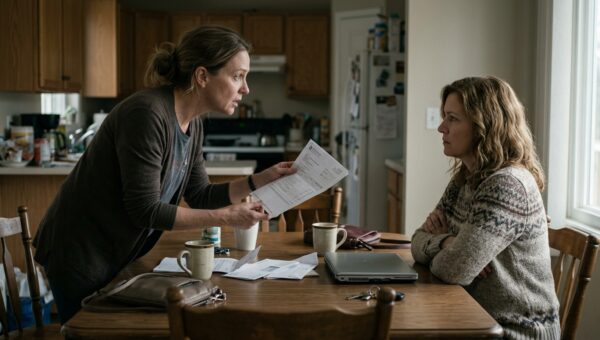
I sat there for another minute with my hands resting on the steering wheel, feeling the chill start to creep up through the floorboards of the car. The glove compartment still held the printed receipts I had kept hidden from Evelyn for half a year, receipts that proved every single cent of that party came from my night shifts in the ER. I pulled the papers out, flattened them against my knee with the palm of my hand, and opened the car door. The gravel crunched under my boots as I walked back toward the warm light spilling out of the farmhouse windows. Through the glass, I could see Evelyn pouring herself another glass of wine while Mother sat at the laminate kitchen table, pointing at a seating chart with a yellow highlighter.
When I pushed the front door open, the warm air hit me like a wall, carrying the smell of burning fat and old floor wax. Lily and Owen were still sitting right where I left them by the umbrella stand, both of them staring silently at the flat blue sleeping bags on the floor. Evelyn didn’t even look up from her wine glass as I walked down the hall. Did you leave the headlights on, Gwen? You are draining the battery right in front of everyone, she said, and she let out that same dry, rattling laugh. I didn’t answer her. I walked straight into the kitchen, pulled the stack of cancellation notices from my coat pocket, and dropped them right in the middle of Mother’s yellow highlighter marks on the kitchen table.
Mother looked down at the papers, her glasses sliding halfway down her nose. What is this, Margaret said, her voice dropping into that sharp, irritated register she used whenever dinner was five minutes late. I told you we don’t have time for your paperwork tonight. Look at the date, Mother, I said, and my voice didn’t shake once. That’s the cancellation receipt from The Heritage Inn. The venue is dark. The catering is gone. The jazz trio isn’t showing up on Saturday, and neither am I. Evelyn slammed her wine glass down so hard the stem snapped, sending red liquid splashing across the white laminate like an open wound. Are you out of your mind? she screamed, her face twisting into something ugly and small. We have sixty people coming from Richmond and Roanoke. Mom’s friends from the church are driving in at ten o’clock in the morning. How are we supposed to explain that there is no party?
You can tell them whatever you want, I said, and I reached down to take Lily by the small, cold hand while I scooped Owen up against my hip. You can tell them that you tried to throw a party with money that didn’t belong to you, or you can tell them the truth for once in your life. But you won’t be using my name to do it anymore. Evelyn lunged forward, her hands clawing at the air between us like she wanted to shake me until my teeth rattled. You can’t do this! You signed those papers for Mom! It’s her birthday! It’s a gift! A gift is something you give because you love someone, Evelyn, I said, backing toward the front door while Owen buried his face in my neck. What I was doing was buying crumbs of approval from people who wouldn’t even give my children a bed to sleep on. And I am entirely finished paying for things I can’t afford.
Mother didn’t scream like Evelyn did. She just sat there in her floral armchair with her hands folded over her apron, her face as gray as river mud. She looked at me with those cold, flat eyes that used to make me check my uniform twice for lint before I walked out the door. You are ungrateful, Margaret whispered, and the silence in the kitchen felt heavier than any code blue I had ever run. Just like your father. Always thinking you’re smarter than the rest of us. Maybe so, I said, and I turned my back on both of them for the very last time.
The drive down the mountain was pitch black, with the fog hugging the windshield so tight I could only see ten feet of white line at a time. Lily fell asleep against the passenger door before we even hit the interstate, her small breathing steady and soft in the dark. I didn’t drive back to Richmond. I turned south toward Charlottesville and pulled into the glowing, amber-lit parking lot of a quiet lodge off the bypass where the night clerk didn’t ask any questions when I laid my hospital badge on the counter for a credit card hold. The room smelled of fresh linen and bleach, clean and neutral and entirely empty of anyone else’s expectations.
By Saturday evening, while sixty bewildered guests were probably standing in the dark gravel parking lot outside a locked and empty inn in Harrisonburg, I was sitting in the corner booth of the lodge’s bright, wood-paneled dining room. The morning fog had finally cleared off the Blue Ridge peaks, leaving the high ridges sharp and blue against the autumn sky. A waitress with a silver name tag set a heavy ceramic plate of hot waffles and real maple syrup between Lily and Owen, and they went at it with plastic spoons like it was Christmas morning. I held my heavy white coffee mug with both hands, feeling the heat soak right through my palms, and watched the light climb up the sides of the mountain through the high plate glass window, clean and quiet and entirely my own.