PART 1
My son, Greg, called on a Tuesday evening to invite me to his housewarming party. He and his wife, Amanda, had just closed on a four-bedroom colonial in Oakridge Estates, a gated subdivision three towns over with black wrought-iron streetlamps and manicured turf.
“The party starts at four on Saturday, Mom,” Greg told me over the phone. He cleared his throat twice, the way he always did when he was about to deliver bad news. “Listen, don’t bring Martha or the girls from your bowling league.
Amanda says this gathering is mostly for the subdivision neighbors, her father’s partners, and the HOA board. They’re important people. We want to keep it small and focused on the new community.”
Martha had driven Greg to his orthodontist appointments when he was twelve. The sting went straight to my ribs, but I swallowed it down. I was fifty-eight, a retired payroll clerk who had spent thirty years balancing ledgers for the county road department, and I knew how to hold my tongue to keep peace with my only child.
I baked a Dutch apple pie on Saturday morning, using the butter crust Greg had loved since he was a boy. I wrapped the glass pie plate in a red checked tea towel, set it on the passenger seat of my ten-year-old Buick, and drove over forty-five minutes early. I figured I would slip the pie into the kitchen, help Amanda arrange the vegetable platters, and stay out of the way before the important guests started ringing the bell.
When I turned onto their cul-de-sac at three-fifteen, a large white commercial box truck from Valley Moving & Storage was backed halfway up their driveway.
Two young men in gray work shirts were sliding heavy cardboard wardrobe boxes down the aluminum ramp. Beside the garage door sat four large plastic totes, stacked two by two on the concrete.
I pulled my car against the curb, picked up the warm pie plate, and walked up the side lawn.
I thought the boxes contained old holiday garlands or extra patio chairs from Amanda’s mother. I was about to smile and ask why they were getting deliveries right as their guests were due.
Then I looked down at the bright blue packing tape on the top tote.
Taped flat against the lid was a white shipping label with bold black marker: *EILEEN MILLER — MASTER BEDROOM / LINENS.*
Eileen Miller is my legal name.
Beside it sat an open wardrobe carton. Sticking out of the top tissue paper was my late husband’s wool winter overcoat, the one he bought the winter before he died of lung cancer in 2018.
The front door opened. Greg walked onto the porch carrying an armful of coat hangers. The second his eyes found me standing by the ramp with my warm pie, his jaw dropped open. Every bit of color drained right out of his neck.
Amanda stepped out behind him, holding a clipboard and a roll of packing tape. She saw me, shoved Greg back toward the hallway, and came down the concrete steps so fast her heels clicked against the aggregate.
She planted herself directly in front of the boxes, spreading her arms wide enough to block my view of the label.
“Eileen, you’re early,” Amanda said, her voice pitched unnaturally high. “The party isn’t for another forty minutes. Why don’t you wait in your car?”
“Amanda, what are my winter blankets and Frank’s coat doing on your driveway?” I asked.
“They aren’t yours,” she said, without skipping a beat. She gave a sharp, breathless laugh that didn’t touch her eyes. “My aunt has the exact same storage bins, Eileen. These belong to someone else. It’s a mix-up with the warehouse.”
Before I could answer, the moving truck driver walked down the metal ramp. He had a pencil behind his ear and held out a heavy aluminum clipboard with yellow carbon forms.
He didn’t look at Amanda. He looked straight at my face, checked the driver’s license photo on his dispatch sheet, and handed me the pen.
“Mrs. Eileen Miller?” the driver asked. “We pulled these fourteen boxes from Unit 408 at the highway facility, just like the work order said. Should I carry the rest of your personal belongings up to the finished room over the garage, or are you still sleeping over at the Pinecrest Motel on Route 9?”
PART 2
The glass pie dish burned hot against my palms through the red tea towel.
“What did you just say?” I asked the driver.
“Pinecrest Motel,” the man repeated, tapping the yellow carbon receipt with the metal clip. “The work order says your primary home address was vacated on Thursday, your personal items were pulled from temporary bay 408, and the rest goes into the bonus suite above the garage. But the secondary billing note says your current lodging is Room 12 at the Pinecrest.”
I had not stayed in a motel since 2011. I lived in a two-bedroom brick bungalow on Elm Street, a house my husband Frank and I bought in 1994 and paid off four months before his diagnosis.
I turned to Greg. He was standing on the second porch step, still gripping those empty plastic coat hangers like a shield. He couldn’t lift his chin to look at me.
“Greg,” I said. My voice wasn’t loud, but it had the flat, hard edge I used when county road contractors tried to bill us for crushed limestone they never delivered. “What is that man holding?”
Amanda lunged forward and tried to snatch the clipboard from the driver’s hand, but the driver pulled it back against his chest, frowning.
“Give me that,” Amanda hissed at the driver. “This is a private delivery contract. You don’t hand dispatch manifests to guests.”
“She’s the named customer on the bill of lading, ma’am,” the driver said, stepping back toward his truck. “Her name is on the release.”
“Eileen, come inside,” Amanda said, turning to me with her hands out, trying to steer me toward the front door. Her smile looked like it had been painted on with enamel. “Let’s not make a scene on the sidewalk. The Jenkins family from number 42 is going to be here any minute. We can explain everything in the kitchen over some iced tea.”
“Don’t touch my arm, Amanda,” I told her.
I set the hot apple pie down on the flat plastic lid of my own storage tote, right over my name.
I took the driver’s ballpoint pen, turned the clipboard toward the daylight, and read the yellow sheets.
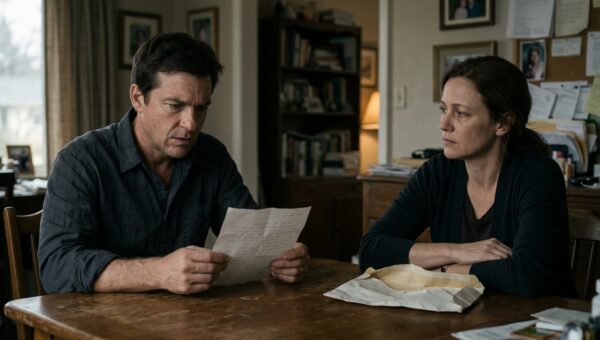
The account was under my name, Eileen Miller. The phone number listed for delivery confirmation was Greg’s cell. But the origin address on the manifest made my knees go loose: *714 Elm Street.*
My house.
The move date had been Thursday, two days ago. That was the day Amanda had insisted on taking me to a day spa in the city for my birthday, paying for a sixty-minute facial and a lunch at a hotel bistro three towns away. She had kept me gone from eight in the morning until four in the afternoon. When I came home that evening, the front rooms had looked normal, but she had rushed me out to dinner before I ever walked down the back hallway to check my bedroom closet or the guest room where Frank’s things were stored.
Beneath the moving company contract was a stapled photocopy of a document from First Heritage Title.
It was a residential purchase agreement for 714 Elm Street.
The purchase price was listed as $245,000, cash settlement, from an investment company called Buckeye River LLC.
The closing date was scheduled for this coming Friday.
On the seller line was my name. But the signature was not mine. It was a digital stamp, verified through an electronic signing portal, sent to an email address I had never seen before: *eileen.miller.trust@gmail.com.*
A white luxury sedan turned into the cul-de-sac, its turn signal clicking, slowing down as it approached the driveway.
“Greg,” Amanda whispered through her teeth, her voice trembling with panic. “The neighbors are here. Get her in the house. Right now.”
PART 3
Greg finally moved. He dropped the plastic hangers on the porch boards and came down the steps, his hands shaking at his sides.
“Mom,” Greg whispered, reaching for my elbow. “Please. Just go upstairs to the room above the garage. It has its own bathroom. It has a television. We did this for you.”
I pulled my arm back so hard his fingers slipped off my sweater.
“You sold my house, Greg?” I asked.
The couple in the white sedan parked across the street. A man in a blue polo and a woman carrying a bottle of wine stepped onto the pavement, smiling and waving toward the porch. Amanda waved back with a bright, terrified hand, then turned her back to them, her face twisting into rage.
“You couldn’t keep that place up, Eileen!” Amanda whispered, leaning into my face, her voice sharp as broken glass. “You’re getting older. The roof on Elm Street needs twenty thousand dollars of shingles, the furnace is twenty years old, and you sit in that big house all alone looking at dead people’s furniture! Greg and I had to stretch our debt-to-income ratio to the absolute ceiling to get this house in Oakridge. The bank required seventy thousand dollars in cash reserves at closing, or the mortgage was denied!”
“So you used my house as your reserve?”
“We are giving you a place to live!” Amanda snapped. “The room over the garage is huge! You get your own private entrance through the mudroom! The money from Elm Street was going to clear our bridge loan and pay for your living expenses here! We were taking care of you!”
“You put my husband’s overcoat in a storage unit on the highway,” I said. “You put my name on a motel registry on Route 9. Did you think I was going to sleep in that motel until your party was over?”
“The garage room wasn’t painted yet, Mom,” Greg choked out, tears finally welling in his eyes. He looked like he was twelve years old again, caught stealing change from my purse. “Amanda said it would be awkward if the HOA board saw your old furniture being hauled in while the party was going on. She booked the motel room for three nights so you’d have a bed until the painters finished on Monday.”
“You were going to let your mother sleep in a truck-stop motel on Route 9 so Amanda’s neighbors wouldn’t see my used furniture?”
Greg didn’t answer. He looked down at the concrete.
The couple from across the street was walking up the driveway now, the man calling out, “Greg! Amanda! Beautiful place! Is this the moving crew finishing up the staging?”
Amanda turned around, putting her hands together in a polite clap, her voice instantly melodic. “Tom! Sarah! Yes, just clearing out the last delivery from the design firm! Come right on inside, the bar is set up in the sunroom!”
She turned back to me, her eyes cold as gravel.
“Take the truck to the motel, Eileen,” Amanda muttered under her breath. “Sign the paper and leave. You aren’t ruining this day for my family.”
I looked at the driver, who was watching Amanda like she was something that had crawled out from under a rock.
“Sir,” I said to the driver.
“Yes, ma’am?”
“Do not unload another box,” I said. “Pack everything that’s on this driveway back into that truck.”
“Wait, what?” Amanda gasped.
“I am the legal owner of 714 Elm Street,” I told the driver, pulling my driver’s license from my small leather handbag. “This signature on your contract is a forgery. The sale of my home has not closed. I did not authorize this move, and I did not authorize the vacation of my property.”
The driver looked at my license, then at the forged digital form on his board. He nodded once, firm and professional.
“That’s all I need to hear, ma’am,” the driver said. He turned to his helper on the ramp. “Bobby! Pack the totes back on the truck. Everything goes back to Elm Street right now.”
“You can’t do that!” Amanda shouted, reaching for the boxes. “We paid the deposit on that truck!”
“Then you can dispute it with corporate, lady,” the driver said, stepping up the ramp. “Because I’m not getting cited for transporting stolen household goods across county lines.”
ENDING
I didn’t yell. I didn’t throw the pie.
I picked up the glass dish from the top of the tote, held it against my apron, and looked at my son one last time.
“I carried you for nine months, Greg,” I told him, keeping my voice very quiet. “I worked thirty years of graveyard payroll shifts so you could graduate from college without five cents of student debt. And you were going to stash me in a six-hundred-dollar-a-week motel room on the state highway so your neighbors wouldn’t know your mother didn’t match your curtains.”
Greg tried to speak, his mouth opening and closing, but nothing came out. He reached toward me, but I stepped around him, walked down the driveway, and got back into my Buick.
I didn’t drive to the motel. I followed the moving truck straight back to Elm Street.
By six o’clock that evening, the two movers had carried every single box, every plastic tote, and Frank’s winter overcoat back through my front door. I paid the driver two hundred dollars cash from my emergency envelope for his trouble, and he helped me set my bed back on its frame before he locked the truck.
On Monday morning at eight-thirty, I walked into the county records office downtown.
I met with Donald Vance, a real estate attorney who had handled my husband’s pension paperwork years ago. When Donald saw the electronic purchase agreement and the fake Gmail address, he had a temporary restraining order and a formal lis pendens notice filed against Buckeye River LLC within three hours.
The investment company backed out of the purchase the minute they received the attorney’s letter, canceling the escrow before any title transfer could be recorded. Buckeye River’s acquisition manager called me personally to apologize, confirming that Greg and Amanda had presented themselves as authorized attorneys-in-fact under an invalid power of attorney they had downloaded off the internet.
Because no deed was ever recorded, my house remained entirely mine.
The fallout hit Oakridge Estates two weeks later.
Without the $245,000 cash from my home sale to satisfy their mortgage lender’s reserve requirement, Greg and Amanda’s financing collapsed. The bank initiated foreclosure proceedings on their bridge loan. They were forced to list the colonial for a short sale at a forty-thousand-dollar loss, move into a two-bedroom rental apartment near the county landfill, and Amanda’s father refused to co-sign another note for them.
Greg called me six times in November.
The first four times, Amanda was yelling in the background about legal fees and how I had destroyed their credit score.
The last time he called, two nights before Thanksgiving, he was alone in his car outside a grocery store. His voice was thin and tired, the arrogance completely gone.
“Mom,” he said into the receiver. “Can I come over for dinner on Thursday? Just for an hour. Just you and me.”
I stood in my kitchen on Elm Street, looking out the window at the backyard where Frank had planted two dogwood trees twenty years ago. The house was quiet, the radiator was humming warm and steady against the wall, and the roof overhead was solid.
“No, Greg,” I said gently. “The people in this house are too simple for you. You have more important things to attend to.”
I hung up the phone.
I walked over to the oven, took out a fresh loaf of sourdough bread, and set it on the cutting board beside the red checked towel. Then I turned off the kitchen light, walked into my living room, and sat down in Frank’s chair to read the evening paper in absolute peace.