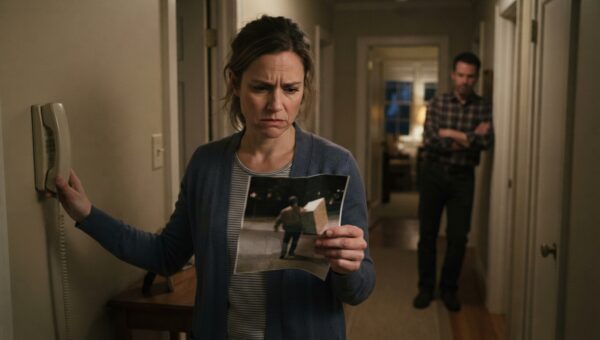
The salt shaker on our kitchen table had a tiny chip on the rim that I had stared at for eleven years, ever since David and I moved into this house with its creaky pine floors and the drafty back porch. Yesterday morning that chip was the only normal thing left in the room. Patricia had arrived without a knock, the way she always did, her sedan crunching on the gravel drive at precisely 9:14 AM. She didn’t wait for David to answer the front door.
She just turned the knob, let herself in with the spare key she kept from before our wedding, and laid a thick manila folder right on top of my cooling coffee mug.
For eleven years, Patricia had never once called me by my actual name. To her face and behind my back, I was always just “her.” If she wanted the butter passed at Sunday dinner, she would say, “Ask her to reach it.” David always told me to let it roll off my back. He said she was from a different generation, that she was just old-fashioned and it wasn’t personal. I tried to believe him because I loved him, or because I thought love meant swallowing those small daily humiliations until they stopped tasting bitter. But Patricia had brought something heavier than usual this time.
She sat down in David’s usual chair without being asked, smoothing her wool skirt over her knees.
David came in from the garage wiping grease off his hands on a blue shop rag, looking confused when he saw his mother sitting there at that hour. He thought she was coming over to drop off garden tomatoes. Instead, Patricia opened the thick cardboard folder, tapped a yellowed sheet of paper with her silver-ringed finger, and looked right past me like I was a coat rack in the hallway.
“It is time we cleared up the ownership of this acreage, David,” Patricia said, her voice dry as autumn corn husks. “Your grandfather’s intentions were quite specific about who the property was meant for. It was never meant to pass to whoever David happened to marry on a whim.”
I reached for the edge of the paper, but Patricia snapped the folder shut with a dry slap that made the salt shaker rattle against the wood. David went pale. He didn’t rush to my side the way he usually did when his mother made a sharp remark.
He just stared at the cardboard cover, his jaw tightening until the muscle jumped near his ear. He looked like a boy caught stealing apples from a neighbor’s orchard, except he was thirty-seven years old and we had shared a bed for over a decade.
“What is that, Patricia?” I asked, keeping my voice lower than I wanted it to be. “What are you talking about?”
Patricia didn’t answer me. She turned her chin toward her son and waited. “Tell her, David. Tell her what your grandfather wrote down before he passed away in the hospital.”
I looked at my husband, waiting for him to flash that easy grin he used whenever his mother started stirring the pot. He didn’t grin. He kept his eyes glued to the wood grain of the table, his shoulders rounding under his flannel shirt. The silence in the kitchen got so heavy I could hear the refrigerator compressor humming through its cycle in the corner.
“David,” I said, my voice dropping an octave. “Look at me. What is she talking about?”
He looked up at his mother first, not me, like he needed permission to speak in our own house. Patricia nodded slightly, a brief, tight downward jerk of her chin. David turned to me then, and his eyes looked hollow, drained of whatever color they usually had when he looked at the sunrise over the back pasture.
“Okay,” David whispered, rubbing the back of his neck with his calloused hand. “There’s something about the house, and about us, that I should’ve told you before we got married…”
The rest of the morning passed in a blur of small, sharp sounds. David tried to explain the grandfather’s trust while Patricia sat sipping water from a glass she had poured herself, looking like a judge presiding over a foreclosure. The gist of it came out in ragged, broken pieces. Eleven years ago, right before our small courthouse wedding, David’s grandfather had added an addendum to the family estate trust. The house and the forty acres surrounding it were left to David under one strict condition. He had ten years to marry someone from within a designated circle of local landowning families, or else the title reverted entirely to a family administrative trust controlled solely by Patricia. If he married outside that circle, he had to secure a signed post-nuptial waiver from his spouse by the ten-year mark, relinquishing all equity claims, or lose the property entirely.
We had passed our eleventh wedding anniversary three weeks ago. Patricia had waited until the exact window closed, believing that the passage of time had trapped us both, and that I would sign whatever humiliating paper she put in front of me just to keep a roof over our heads.
“You knew,” I said, the words coming out flat and cold. “You knew before we even walked into the courthouse.”
David didn’t deny it. He just stared down at his boots. “My grandfather was a hard man, Sarah. You didn’t know him. If I walked away from the farm, I walked away with nothing. I thought… I honestly thought Mom would come around once we were settled. I thought after a few years she would see how hard we worked and tear the paper up.”
“She didn’t tear it up,” I said, pointing a finger at the manila folder. “She brought it here.”
Patricia stood up, smoothing her skirt again, her face impassive. “I am simply protecting what took three generations to build. It was never personal toward you, dear. It is just business. You have ten days to sign the release form at the county seat attorney’s office. David loses the deed either way if you refuse, but if you sign, we can arrange a small monthly stipend for you to find a place in town.”
She walked out the back door without saying another word, letting the screen door slam shut behind her with a sharp twang.
David stayed at the kitchen table, his head in his hands. He started talking about how we could fix it, how maybe we could talk to a judge, how family was complicated and we had to be practical. I didn’t yell at him. Yelling felt too warm for what was happening inside my chest. I just got up, picked up my coffee mug, and walked out to the truck.
I didn’t go to town to cool off. I went straight to the county records office, and from there I drove two towns over to see Thomas Vance, an old real estate attorney whose office smelled of peppermint and wet wool. I didn’t tell David where I was going. When I laid my phone photographs of Patricia’s document across Thomas’s scarred oak desk, he adjusted his wire-rimmed glasses and whistled softly through his teeth.
“Clever old man, your husband’s grandfather,” Thomas muttered, tapping a yellowed page with his pen. “He wanted to keep the land undivided. But look right here in paragraph four. This whole clause relies entirely on voluntary compliance. Without your signature on this post-nuptial release, Patricia cannot seize the title without filing a public partition lawsuit in civil court. And if she does that, the trust terms become public record, which her precious social club back in town would despise.”
“So she has no teeth without me?” I asked.
“None at all,” Thomas said, leaning back in his creaking leather chair. “She needs your pen to make her theft legal. If you don’t sign, David loses the house, but the trust falls apart under its own weight and goes into probate litigation where nobody wins except the state.”
I thanked Thomas, paid him for his hour with cash from my own savings account, and drove back home as the sun was dipping below the tree line. The sky was the color of a bruised plum.
When I walked through the kitchen door, the house was dark except for the stove light. David was sitting at the exact same spot at the kitchen table, his hands folded in front of him, staring at the empty space where Patricia’s folder had been. He looked up when the latch clicked, his eyes red-rimmed and desperate.
“Where were you?” he asked, his voice cracking. “Sarah, where did you go? Mom called twice. She wants to know if we’re driving into town tomorrow morning to meet Mr. Henderson.”
I walked over to the counter, set my keys down with a metallic clatter, and pulled a chair out opposite him. I didn’t sit down right away. I stood there looking at him, really looking at the man I had built a life with, wondering how many other corners he had cut behind my back to keep his mother happy.
“I went to see Thomas Vance,” I said.
David went completely rigid. “Who?”
“Your mother’s lawyer’s competitor,” I said plainly. “I read every word of that grandfather’s paper, David. Not the parts your mother showed us. All of it.”
He opened his mouth, but no sound came out. He looked smaller than I had ever seen him, swallowed by the shadows of the room where we had eaten ten years of suppers.
“She needs my signature,” I continued, keeping my voice steady. “She can’t touch the title without my consent unless she wants a public court fight that would ruin her reputation at the club. She came here today because she thinks I am weak enough to fold.”
David reached across the table, his fingers trembling slightly as he tried to catch my hand. “Sarah, please. We can figure this out. We can find a way to keep the land. It’s my family’s legacy. You know what this place means to me.”
I pulled my hand back and let it rest on the edge of the chipped salt shaker. “It meant more to you than my name did for eleven years. Every time your mother called me ‘her’ at Sunday dinner, you let her do it because you knew about this paper. You let her treat me like a tenant in my own life because you were waiting to see if you’d pass her test.”
“That’s not true,” he choked out, his voice breaking. “I love you.”
“Love isn’t a secret clause in a dead man’s will, David,” I said. “You had eleven years to tell me. You chose silence.”
He sat there for a long time, the refrigerator humming its low, rhythmic drone in the corner. He looked at the kitchen door, then down at his empty hands, and then back at me. The tension in his shoulders seemed to snap, leaving him looking hollowed out.
“I’m not calling her back,” David whispered, the words coming out small and flat. “I’m not signing anything either. If she wants the house that bad, she can take it to court and we’ll lose it all. I’m done.”
He reached into his pocket, pulled out his phone, and slid it across the table toward me. The screen was lit up with a browser tab open to a real estate agency in town, showing listings for small rental houses with modest yards and no history attached to them.
I didn’t say anything. I just pulled the phone toward me, turned it face down on the scarred wood between us, and listened to the quiet settle over the kitchen.