PART 1
“Please, Nana. If you tell them, Daddy will put me out like he did Aunt Deb.”
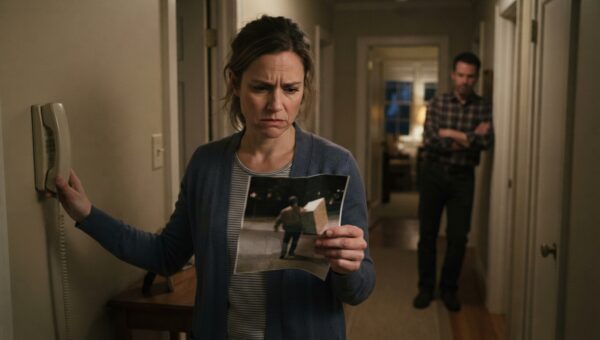
My granddaughter Rilla is sixteen. She sat at my kitchen table with her knuckles white, twisting a paper napkin until it tore into damp gray shreds under her thumbs. She did not cry loudly. She just let the tears fall straight off her chin while she told me she was seven weeks along.
Her father is my son, David. David runs a hard, righteous, churchgoing house where people do not make mistakes twice. He is forty-eight now, an elder at Grace Bible, a man who keeps his shoes polished in straight rows and speaks about God’s order as if he holds the blueprint in his hip pocket. When his younger sister Deborah got pregnant at seventeen, back in 1994, David was the one who set her bags on the front curb. He stood on the porch with his arms folded and told our father that a girl who dishonored the home had no right to eat at the table. My late husband backed him up. I was weak back then. I stayed in the kitchen with my apron pulled up to my mouth, weeping into the dishcloth while Deb walked down the asphalt carrying two cardboard boxes.
That was thirty-two years ago. Deb still will not sit at our table for Thanksgiving. She lives forty miles west in an apartment behind a dry cleaner, working second shift at the postal annex, her spine stiff whenever my name comes up.
Now Deb’s niece was sitting in that exact same chair, looking at me with the same wide, dark eyes.
“I won’t let him do that to you,” I told Rilla. “I need you to give me until tomorrow morning to think this through. You stay the night in the spare room. Just sleep.”
She went down the hall at ten. I stayed up. I made a pot of decaf that I did not drink.
I looked at my checkbook lying on the counter next to the bread box. My regular checking had $312 in it. In my small passbook savings at the credit union, I had exactly $3,000 left from my husband’s life insurance payout five years ago. Three thousand dollars, a paid-off two-bedroom ranch house, and an old Buick that needed new front calipers. That was the whole extent of my safety.
If I kept quiet, I became an accomplice against my own boy. David would find out eventually. A pregnancy does not hide itself forever in a small county where everyone shops at the same Piggly Wiggly and sits in the same pews. When he found out I kept it from him, he would cut me off completely. He would keep his younger kids away from me. He would tell the congregation his mother had turned her back on righteousness.
But if I called him, I broke Rilla’s heart. More than that, I knew David. He would not comfort her. He would demand a confession in the living room with the family Bible open on his knees, and then he would cast her out to prove his own purity to the men he served with on the deacon board.
At six in the morning, the kitchen was still cold. I pulled my cardigan tight around my ribs and picked up my phone. My thumb hovered right over David’s contact.
I did not press call. Instead, I scrolled down past the family group chat to an old number I had not dialed in eleven months.
I pressed Deborah’s name.
She picked up on the fourth ring, her voice rough from third shift. “Ma? Is somebody dead?”
“No,” I said. “Nobody is dead. Deb, I need you to come over here before eight o’clock. Don’t tell your brother.”
PART 2
Deborah did not answer right away. Down the line, I heard the heavy clatter of her locker door slamming shut at the sorting facility.
“If David is over there, Ma, I’m hanging up,” she said.
“David isn’t here,” I said. “Rilla is.”
The silence stretched so long I thought the call had dropped. Then Deb’s voice lost its edge and dropped down low. “What did she do?”
“Just come,” I told her.
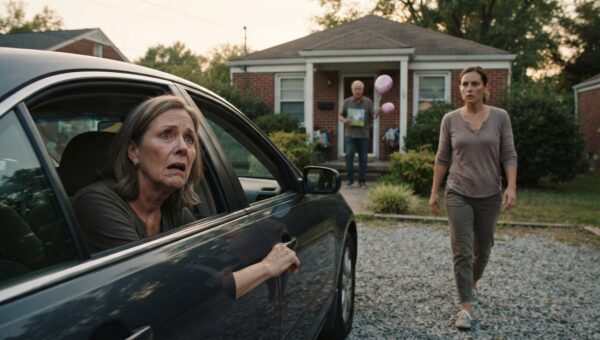
Deb got to my house at twenty minutes past seven. She had gray streaking through her hair now, cut short above her collar, and she wore her blue postal jacket with a smudge of black ink on the sleeve. She did not hug me when she stepped through the screen door. She just stood on the linoleum, looking around the kitchen like someone checking for tripwires.
“She’s still asleep in the back,” I said quietly, pointing toward the hall. “She’s seven weeks, Deb. She told me last night. She said David will put her out like he did you.”
Deb looked at the table. She saw the shredded napkin still sitting in a neat pile near the sugar bowl where Rilla had left it. Her jaw worked back and forth.
“David won’t put her out,” Deb said flatly.
I looked at her. “You don’t know him now, Deb. He’s harder than he was back then. He thinks every sin has to be paid for in public.”
“You don’t know him either, Ma,” Deb said. She pulled off her work jacket and threw it over the back of the kitchen chair. She sat down heavily, the way our father used to when his knees gave him trouble. “You think David is pure iron. You think he threw me out in ninety-four because he couldn’t stand sin in the house.”
“He quoted Leviticus to your father on the porch,” I whispered. “I heard him.”
Deb reached into her canvas tote bag. She did not pull out a cigarette or a coffee thermos. She pulled out a small, worn leather wallet, unzipped the inner pocket, and set a folded piece of paper on the table between us. It was yellowed at the creases, soft like cloth from being handled for thirty years.
“What is that?” I asked.
“Read it,” she said. “I kept it because every time I thought about coming to your Sunday dinners, I looked at it to remind myself who was sitting at the head of the table.”
I picked up the paper with shaking fingers.
It was a handwritten receipt on lined spiral notebook paper, dated October 14, 1994. The handwriting was tight and narrow, leaning hard to the right. I would know it anywhere. It was David’s handwriting from his first year at the community college.
It read: *Received from Deborah Miller, $850 cash, for clinic fee and travel. To be repaid when financial aid clears.*
Underneath his signature, someone else had stamped a receipt mark from a private women’s health clinic in Richmond, three counties north.
I stared at the blue ballpoint ink. My chest felt tight, the air suddenly thin in the kitchen.
“David took you to Richmond?” I asked, barely able to hear my own voice.
“David didn’t take me,” Deborah said, her voice steady and merciless. “That wasn’t for me, Ma. In nineteen ninety-four, I wasn’t the one who got pregnant. It was Becky Warren. David’s high school sweetheart. The girl he was courting while he was leading the youth choir.”
PART 3
The clock over the stove clicked as the minute hand moved to seven-forty.
“Becky?” I whispered.
“David came to me in the middle of the night,” Deb said. Her eyes were fixed on mine, not angry now, just clear and cold. “Becky was sixteen. David had just turned eighteen. He told me if our father found out, Daddy would pull him out of college and make him marry her on the courthouse steps. His whole future would be ruined. He begged me to help him get her to Richmond without anyone knowing. He took eight hundred and fifty dollars of my college savings that I earned waitressing at the diner.”
“Then why did you leave?” I asked, my voice cracking. “Why did David put your bags on the curb?”
“Because three weeks later, Daddy found the clinic paperwork in the glove compartment of the family station wagon,” Deb said. “David left it there. Daddy came into the kitchen screaming, waving that paper in the air, asking who brought shame into his house. David stood right there by the refrigerator, Ma. He looked Daddy right in the eye, pointed at me, and said, ‘It’s Deb’s. I found it in her purse and I was trying to figure out how to tell you.'”
The room seemed to shrink down to the smell of old linoleum and cold coffee.
“He blamed you,” I said.
“He blamed me,” Deb said. “And when Daddy told me to get out, I looked at David. David gave me this look like he was going to die right on the spot if I spoke up. He was my big brother. I thought if I took the hit, he’d pay me back and make it right later. But he didn’t. He packed my boxes himself so I couldn’t talk to you alone. He walked me to the road, handed me my bags, and told me never to come back and ruin his name.”
The hallway floorboard creaked.
Rilla stood in the doorway in her oversized gray sweatshirt, her hair tangled, looking from me to Deborah with terrified eyes.
“Nana?” she whispered.
I stood up. My knees were stiff, but I did not feel weak anymore. Thirty-two years of guilt, thirty-two years of believing I had failed my daughter by letting my righteous son protect our home, evaporated like mist off a pond.
“Come here, baby,” Deborah said, opening her arm.
Rilla walked straight to her aunt and buried her face against Deb’s shoulder.
“I’m going to call your father now,” I told Rilla.
She pulled back, panic flashing in her face. “Nana, no! Please!”
“He isn’t going to put you out,” I said. “He isn’t going to say a single word against you.”
I took my phone off the counter and dialed David’s cell. He answered on the second ring.
“Morning, Mama,” he said, using his church voice, smooth and hurried. “I’m on my way to the office. Can I drop by this evening?”
“No,” I said. “You need to come to my kitchen right now. Rilla is here. Deborah is here. And I have your nineteen ninety-four notebook paper on the table.”
David stopped talking. In the background, his truck’s turn signal clicked twice, then went silent.
“Mama,” he began, his voice losing its lift.
“Twenty minutes, David,” I said, and hung up.
ENDING
David arrived in eighteen minutes. He did not knock. He opened the kitchen door in his pressed button-down and khaki trousers, his car keys clutched in his fist. His eyes darted straight to the kitchen table.
The yellowed clinic receipt was sitting right next to the salt shaker.
Deb sat on one side of the table with her hands flat. Rilla sat beside her, holding Deb’s wrist. I stayed on my feet by the stove.
David looked at the paper. Then he looked at Deborah. For five seconds, the deacon disappeared. The man who stood before church boards vanished, and the eighteen-year-old boy who hid behind his sister’s back stood in front of us, his shoulders slumping under his starched shirt.
“Mama,” he said, his voice completely flat. “Rilla shouldn’t be hearing this.”
“Rilla is the reason you are here,” I told him. “Your daughter is seven weeks pregnant. She spent all night terrified that you would throw her into the street the way you threw Deborah out.”
David’s face went gray. He turned toward his daughter, his mouth opening, but no words came out.
“You aren’t throwing anybody out,” I said. “You aren’t giving any sermons in your living room. You aren’t calling the elders. You are going to sit down, and you are going to tell Rilla that you love her and that you will support her in whatever choice she makes for her life.”
“Mama, you don’t understand the pressure—”
“I understand thirty-two years of silence,” I said. “I have three thousand dollars in the credit union. If you say one word of judgment to this child, Rilla moves into my spare room today, and I will walk into your church on Sunday morning with this receipt in my hand and hand it directly to Pastor Thomas.”
David stared at me. He had never heard me speak in that tone. In all his forty-eight years, I had always backed down, smoothed over the edges, and kept the peace at any cost.
He looked down at his shoes. His shoulders dropped another inch.
“I won’t put her out,” he said quietly.
“Tell her,” Deborah said, her voice like iron.
David looked at Rilla. He stepped over to the chair, pulled it out, and sat down. When he reached out his hand, it was trembling. Rilla did not take it immediately, but she did not pull away either.
“I’m sorry, Rilla,” he said, and for the first time since he was a boy, his voice broke completely. “I’m not putting you anywhere. We’ll figure it out.”
We sat in that kitchen for two hours. We did not fix thirty years of damage in a morning, and Deborah did not pretend everything was forgiven. When David finally got up to leave with Rilla so they could talk to her mother together, Deb stood up too.
She picked up her yellowed paper from the table, folded it carefully along its old creases, and slipped it back into her wallet.
“You can come over Sunday, Deb,” I said as she reached for her jacket. “Just you and me. No David. No church.”
Deborah stopped at the door. She looked back at me, then down at the table where the paper had rested for twenty minutes.
“I get off at two,” she said.
She opened the screen door and walked out into the morning light, leaving the door unlocked behind her.