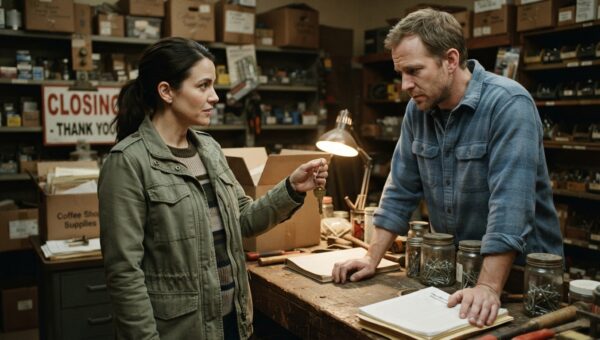
The smell of wet wool and floor wax always stays in the hallway outside Mr. Harrison’s office, no matter what month of the year you go in there. It is an old smell, heavy and familiar, the kind that belongs to buildings where people only go when they are dividing things up or signing papers they do not fully understand.
When Mom passed away peacefully in her sleep last month, the grief knocked the wind out of me so hard I could barely stand up straight in the kitchen. But for Brandon, it was not about grief at all. For Brandon, it was time to collect.
The funeral was on a Tuesday. We stood by the grave while the gray dirt went down over the box, and Brandon spent most of the service checking his phone for text messages about his real estate deals. By Thursday morning, Brandon had already scheduled an appointment with Mom’s estate attorney, Mr. Harrison. He didn’t even wait for me to agree; he just texted me the address and a message: Don’t be late. We need to get the house liquidated before the winter market dips.
When we sat down in the attorney’s wood-paneled office, Brandon looked like a man attending a closing meeting for a highly profitable merger.
He had his tablet out, a spreadsheet already open with neat little columns and formula totals glowing against the glass. He didn’t even look at me when I sat down in the leather armchair. He just adjusted his cuffs and got straight to business.
“Let’s make this quick, Harrison,” Brandon said, leaning back with that easy confidence he always wore like an expensive coat. “Mom’s house is worth about $650,000 in this market. Her savings accounts should have around $200,000. Under the old family trust, it’s a 50/50 split. I’ve already contacted a listing agent. Chloe can have some of the old furniture, but we need the house cleared by the end of the month.”
Mr. Harrison, a man who had been Mom’s legal counsel and close friend for thirty years, didn’t look at Brandon’s spreadsheet. He didn’t nod or reach for his pen. He slowly took off his glasses, folding them with a small click against the blotter, and looked at my brother with a look that combined profound pity with immense satisfaction.
“Brandon,” Mr. Harrison said quietly. “Your mother updated her estate plan fourteen months ago. And I think you are operating under a massive misunderstanding regarding her assets.”
Brandon frowned, his thumb hovering over the screen of his tablet. “What misunderstanding? I know what she had. I looked at the papers when we did the family meeting six years ago.”
The room got very quiet. I remember looking at the small brass lamp on the corner of Mr. Harrison’s desk, noticing a tiny smudge of dust on the base that nobody had bothered to wipe away. For five years, I had been the one coming over every Tuesday and Thursday to wipe down tables, check blood pressure cuffs, and make sure Mom took her small white pills on time. Brandon hadn’t visited for Christmas in three years, claiming his consulting business was just too demanding, but he had kept very careful mental notes about what the property was worth.
“Things change, Brandon,” Mr. Harrison said, his voice level and steady. “People change their minds when circumstances shift.”
“Nothing shifted,” Brandon said, sitting up straighter and tapping the screen of his tablet. “Mom had a stroke five years ago, but her mind stayed sharp. She always said it was split down the middle. Me and Chloe. Equal shares. That’s what the trust said.”
“The old trust did say that,” Mr. Harrison agreed, opening a thick manila folder that had been sitting quietly under a stack of old land deeds. “Until fourteen months ago. That was right after you came to visit, do you remember?”
Brandon blinked, the confident smirk slipping just a fraction around the edges. “I stopped by to talk to her about an investment opportunity. Every family member helps each other out when an opportunity comes up.”
“You asked your mother for a forty thousand dollar advance on your inheritance to fund a commercial strip-mall venture in Akron,” Mr. Harrison said, not raising his voice at all. “When she told you she couldn’t liquidate her CDs without taking a massive penalty because she needed those funds for her daily care, you walked out of this office and didn’t speak to her for the rest of her life. You didn’t call on her birthday. You didn’t call when she had pneumonia in January. Nothing.”
Brandon’s face went tight, the blood rushing into his neck. “That’s family business, Harrison. That has nothing to do with the legal standing of the estate trust.”
“It has everything to do with it,” Mr. Harrison said, sliding a single sheet of heavy cream-colored paper across the polished mahogany desk. “Fourteen months ago, the day after you left her house and told her she was being selfish with her own money, your mother sat right where you are sitting now. She was crying so hard she couldn’t hold her pen.”
I stared down at the grain of the wood on the desk, remembering that week. Mom had spent three days sitting by the front window with her old woolen shawl over her shoulders, refusing to eat her toast, staring out at the gravel drive as if Brandon might turn his car around. She had looked so small in that big armchair, her hands shaking every time she tried to pour her tea.
“She realized something important that afternoon,” Mr. Harrison continued, tapping the corner of the document. “She realized that her liquid savings were nearly gone, drained not by medical bills alone, but by the quiet sacrifices of the person who actually stayed.”
Brandon scoffed, waving a hand dismissively. “Chloe lives here. She doesn’t pay rent. Living in a free house for five years is compensation enough.”
“I paid for the oil deliveries during the winter of 2021 when the furnace went out,” I said, my voice sounding smaller than I wanted it to, but steady enough to make Brandon turn his head. “I paid the property taxes for three years out of my own part-time salary when Mom’s pension didn’t stretch. You didn’t even know what the tax rate was, Brandon.”
“That was her choice,” Brandon snapped back, turning to me with a sharp edge in his tone. “She could have sold the house years ago if she couldn’t afford the taxes. That doesn’t rewrite a legal estate document.”
“It actually does,” Mr. Harrison said smoothly. “Because she didn’t just talk about it. She executed a complete restatement of trust and a recorded deed transfer. Fourteen months ago.”
Brandon stared at the lawyer, his mouth open slightly before he clamped it shut. “Show me.”
Mr. Harrison didn’t rush. He turned the pages of the manila folder one by one, letting the rustle of the thick paper fill the silence of the office. He pointed a finger at a signature at the bottom of the page, written in Mom’s shaky, looping handwriting, right above the notary’s raised red seal.
“The residential property at four hundred and twelve Elm Street,” Mr. Harrison read aloud, “is hereby removed from the primary estate pool and assigned via a recorded survivorship deed directly to Chloe Marie Miller, in consideration of full-time caregiving services, out-of-pocket maintenance expenditures, and sustained familial support.”
Brandon stood up so fast his leather chair rolled back and hit the paneled wall with a dull thud. “That’s fraudulent. She wasn’t in her right mind. You let an old woman who was grieving or sick sign away property under undue influence.”
“She was entirely competent,” Mr. Harrison said, not even flinching at Brandon’s outburst. “Dr. Evans signed off on her cognitive assessment the same morning. She knew exactly what she owned, and she knew exactly who had been bringing her meals while you were busy flipping strip-malls in Ohio.”
“This is ridiculous,” Brandon said, pacing two steps toward the window and back, his tablet clutched in his hand like a weapon. “The house is worth six hundred and fifty thousand dollars. You can’t just give it away to one kid because the other one hurt her feelings. What about the savings? What about the accounts?”
“The savings accounts,” Mr. Harrison said, turning another page, “totaled twenty-one thousand four hundred dollars at the time of her passing. Not two hundred thousand. That money was placed in a dedicated trust account designed to reimburse Chloe for documented caregiving expenses and out-of-pocket medical supplies over the past five years. The balance of that account as of yesterday is zero.”
Brandon stopped pacing. He looked from the lawyer to me, his face turning a dark, mottled red. “Zero. You drained the accounts?”
“Mom didn’t drain anything,” I said, looking right at him for the first time since we walked through the door. “Every receipt was logged. Every box of test strips, every gallon of gas for her appointments, every plumbing repair when the basement flooded. Mr. Harrison has the ledger right there.”
Brandon slammed his tablet down onto the edge of the desk, the glass screen cracking across the corner with a sharp, ugly sound. “You manipulated her! You sat here whispering in her ear while she was vulnerable, turning her against her own son!”
“She didn’t need anyone to whisper, Brandon,” Mr. Harrison said, his voice dropping an octave, losing all its professional warmth. “She had eyes. She watched you walk out that door because she wouldn’t fund your speculation, and she watched Chloe spend five years bathing her, feeding her, and holding her hand through every single night she couldn’t breathe. Your mother wasn’t manipulated. She was just finally being honest about who was there when the lights went out.”
The room went dead silent again. Brandon stood there with his fists clenched at his sides, his chest heaving under his expensive suit jacket. He looked down at the broken screen of his tablet, then at the manila folder, realizing with sudden, crushing finality that his spreadsheet was nothing more than a list of numbers for a house he would never own.
“There has to be something,” Brandon muttered, almost to himself, his voice losing its arrogant edge. “A statutory share. Something.”
Mr. Harrison reached into the very back of the folder and pulled out a small, plain envelope with my name written on it in pencil, and a second, thinner paper underneath. He slid the thin paper across the desk toward my brother.
“There is a specific bequest for you, Brandon,” Mr. Harrison said quietly. “Your mother wanted to be fair, even at the end. Paragraph four of the restatement provides you with the sum of five thousand dollars, conditioned entirely upon your signing a full and final release of all claims against the estate, the property, and any remaining personal effects.”
Brandon stared at the paper as if it were crawling with bugs. Five thousand dollars. Out of the six hundred and fifty thousand he had spent the last three days spending in his head.
“Five thousand dollars,” Brandon repeated, his voice shaking with a mix of fury and disbelief. “After everything I built up in my life, she leaves me five thousand dollars like I’m some stranger off the street?”
“She left you what she thought you were worth to her at the end,” Mr. Harrison said simply. “You can sign the release today and take the check, or you can contest the trust in probate court and spend twenty thousand in legal fees to end up with nothing at all. The choice is yours.”
Brandon didn’t reach for the pen. He stood there for a long moment, his jaw working as he tried to find some argument, some threat that would make the wood-paneled walls move or the deeds change back. But there was nothing left to say. The columns on his tablet didn’t matter anymore. The listing agent he had called on Wednesday morning didn’t matter.
“Keep the house,” Brandon snarled, grabbing his broken tablet off the desk and turning toward the heavy oak door. “Keep the whole damn thing. You earned every miserable square foot of it.”
The door swung shut behind him with a heavy, solid click that echoed down the hallway.
Neither Mr. Harrison nor I moved for a long time. The lawyer let out a long, slow breath through his nose, reached up to rub his eyes, and then slid the small envelope across the desk toward me.
“She wanted you to have this when it was all over,” Mr. Harrison said softly. “She told me you’d know what to do with the house.”
I picked up the envelope. The paper was soft from being handled too many times, the edges slightly worn where she must have held it in her lap while sitting by the front window. I didn’t open it right there in the office. I just slipped it into the inside pocket of my coat, right where it felt safe against my ribs.
When I walked out of the building and stepped onto the sidewalk, the afternoon air was sharp and cold, carrying that raw November bite that always smells like woodsmoke and old leaves. My car was parked down the block, an old sedan with a fender that rattled every time I hit fifty miles an hour.
I drove back to Elm Street in total silence, the radio off, just listening to the hum of the tires against the asphalt. When I pulled into the driveway, the house looked smaller than Brandon’s spreadsheets made it sound. The paint was peeling a little near the back porch steps, and the gutters needed cleaning out before the first hard freeze. It wasn’t an asset pool or a market opportunity. It was just the place where Mom had planted her ferns every spring and where the floorboards creaked in the exact same spot right outside the kitchen door.
I walked up the wooden steps, took the heavy brass key out of my purse, and slid it into the lock. It turned with a smooth, familiar click that I had heard ten thousand times before.
I pushed the door open, stepped into the sunlit entryway, and closed it behind me, leaving the cold outside where it belonged.