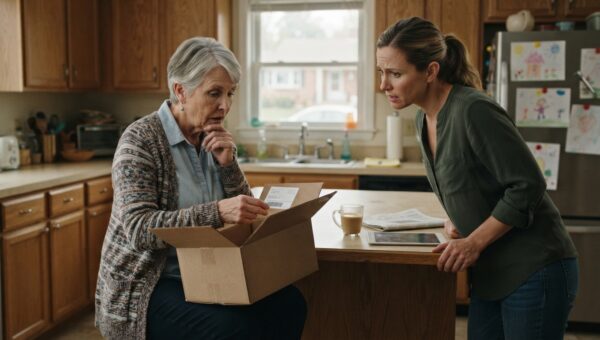
When I finally told Brenda I couldn’t take the kids every single Friday, she looked at me like I was a stranger breaking her heart on purpose. My son Dwayne just stared down at his coffee cup and didn’t say a single word to back me up. That silence hurt worse than her words, because Dwayne knew how bad my knees had gotten over the winter.
I just sat there at my own laminate kitchen table with my hands folded over a damp sponge, wondering how a favor we had started doing out of love had turned into an unwritten contract I couldn’t afford to break.
For the longest time, Brenda and I didn’t keep score. If she needed to stay late at the county records office or if Dwayne had an early shift hauling lumber down past Effingham, I was always right there waiting on the front porch before the school bus even made the turn by the old grain elevator. I adore those children more than my own breath, and having them underfoot with their loud boots and sticky apple-juice cups always made this old house feel full again. But my knees and my own responsibilities have limits, and my body started keeping score even if Brenda wasn’t.
It started creeping up on me when the early morning calls turned into a regular habit instead of an emergency.
Brenda would call right around 6:15 am, her voice already tight and rushing before I had even poured my first cup of chicory coffee. “Ma, can you take the little ones early today? The office changed my rota again.” I would look out the kitchen window at the damp fog rolling off the river, feel that sharp pinch right behind my kneecaps, and say yes anyway. I said yes for weeks, rearranging my grocery trips, my laundry days, and finally my own medical appointments just to keep the peace in their house.
The breaking point came on a Thursday afternoon when Dr. Vance’s receptionist called to confirm I had missed my orthopedic checkup for my right knee joint. I had sat right here in this kitchen waiting for Brenda to drop off seven-year-old Toby because her car wouldn’t start, completely forgetting the three o’clock appointment I had waited two months to get.
My leg had been throbbing all week, and missing that shot meant another month of limping down the steps to check the mail. I felt this hot, heavy wave of frustration settle right behind my ribs, and I knew I couldn’t keep running myself into the ground just to plug the holes in their daily schedule.
So the very next time Brenda stood in my doorway holding her car keys and rattling off the next week’s drop-off times, I took a deep breath and told her the truth. “Brenda, honey, I can’t do every Friday anymore. My knees are just giving out, and I need one day a week to take care of my own appointments and rest up.”
Brenda stopped dead in her tracks, her hand frozen on the door handle. “Every Friday is the only day I have stability at work, Evelyn,” she said, her voice dropping into that sharp, defensive register I had come to dread. “If you won’t watch them, who am I supposed to ask? Are you punishing me because I took the promotion?”
“I’m not punishing anybody, I’m just telling you what I can manage,” I said, my voice shaking a little bit more than I wanted it to.
I looked right at Dwayne, waiting for him to step in and remind her that I was sixty-six years old and had raised my own children thirty years ago. Dwayne just kept his eyes glued to the floorboards by the shoe rack, his jaw set so tight I could see the muscle jumping in his cheek. He didn’t say a word. He just grabbed Brenda’s elbow and muttered something about traffic before they bundled the kids into the station wagon and drove off.
The rest of that weekend was heavy and quiet, the kind of quiet that feels like lead sitting in the corners of every room. When they brought the kids back over on Sunday afternoon for a quick Sunday roast, nobody mentioned Friday at all, but the air between us felt thin enough to crack. Ten-year-old Maya walked straight past the dining room table, didn’t touch my arm the way she usually did, and went straight to the old pine desk in the corner where I keep my spare pencils and drawing paper.
She stayed over there for nearly an hour, her little shoulder blades hunched over the page, her tongue tucked just slightly between her teeth the way Dwayne used to do when he was drawing trucks as a little boy. When she was finished, she folded the paper twice, walked over, and laid it quietly beside my tea saucer without looking up into my face.
“Here, Grandma,” Maya whispered, and then she ran back into the living room to join her brother before I could even ask her about it.
I unfolded the paper with my thumb, smoothing out the cheap notebook sheet against the laminate. It was a crayon drawing of our house, crude and colorful with yellow smoke coming out of the brick chimney and four stick figures lined up neatly in the front yard. But right off to the side, standing completely outside the wooden front door with a little blue circle for a head and no arms to hold onto anything, was a single figure labeled Grandma in Maya’s wobbly second-grade handwriting.
I just stared at that paper for a long time because my brain kind of stopped working for a second. Maya didn’t mean anything cruel by it, because children don’t have the malice for that kind of calculation. She just drew what she felt when she walked into this house over the weekend: tension, division, and an old woman standing on the outside of her own family because she had finally tried to say no.
I didn’t call Brenda that night, and I didn’t wait by the phone for Dwayne to apologize for his silence. I spent Sunday evening sitting on my back porch watching the sun drop behind the pecan trees, letting the ache in my knees remind me that I was a person too, not just an auxiliary engine for someone else’s household. If I didn’t fix this right now, that drawing on my table would become our permanent reality, and nobody in this family was going to survive that kind of quiet exile.
By Tuesday afternoon, I had my thoughts gathered and a small pot of coffee sitting on the stove, and I called Dwayne directly. “Get Brenda and bring the kids over after supper,” I told him when he picked up on the second ring. “We need to clear the air, and I don’t want any excuses about being too tired.”
When they walked through the back door at 6:30 pm, Brenda looked defensive before she even hung up her cardigan coat, her shoulders hiked up toward her ears like she was walking into a courtroom. Dwayne looked worn out, his forehead creased with lines that looked far too deep for forty-two. They sat down at the very same kitchen table where Maya had left her drawing, though I had slipped the paper underneath my small glass-topped recipe box so it wouldn’t be the first thing they threw blows over.
“I know you’re mad at me, Evelyn,” Brenda started right in before I could even pour the coffee, her voice cracking just enough to show the panic underneath her anger. “And I know you think I’m taking advantage, but my boss made it clear last month that if I miss one more morning meeting because of childcare issues, I’m getting demoted back to the front desk. We need the money, Evelyn. We’re barely keeping up with the property taxes as it is.”
I looked at Brenda then, really looked at her, and saw the dark circles under her eyes that no amount of foundation could cover up. She wasn’t a villain trying to grind my old bones down to dust; she was just a terrified mother drowning in a job that didn’t care about family, taking it out on the one person she knew would never slam the door in her face.
“Brenda, honey, why didn’t you just tell me that from the start?” I asked, my voice softening because the anger in me had finally burned down to clear coals. “I can help you, but I can’t be your emergency cushion every single time your boss changes his mind. My knees are failing me, and when I miss my doctor appointments, I end up flat on my back.”
Brenda blinked hard, and I could see the defense armor cracking right down the middle as she looked at my hands resting on the table. “I was just so scared of losing my job that I didn’t want to hear you say no,” she whispered, looking down at her lap.
Then Dwayne finally broke his long, miserable silence, his voice coming out rough and thick like he hadn’t used it all day. “I’m the coward here,” Dwayne said, and he didn’t look at Brenda when he said it. He reached across the table and put his heavy, grease-stained hand right over mine. “I saw how much you were hurting, Ma. I saw you limping around this kitchen last month, and I didn’t say anything to Brenda because I didn’t want to start a fight in our house either. I let you take the whole load so I wouldn’t have to deal with the pressure.”
Nobody said anything for a second after that, and honestly that felt heavier than any argument we could have had.
I reached over and pulled Maya’s drawing out from under the recipe box, laying it flat right in the middle of the table between their coffee cups without a word of scolding. Brenda looked down at it, and I saw her hand go straight up to her mouth as her eyes filled up with hot, sudden tears. Dwayne just stared at the little stick figure standing outside the door, his face going dark with a kind of quiet shame that did more work than any shouting match ever could.
“She draws what she sees, kids,” I said softly, looking back and forth between them. “And we can’t let our stress paint our home like that for them.”
We sat at that table for nearly two hours, talking through things the way we used to do before everyone got so busy running from one obligation to the next. We didn’t solve every financial problem in Ogle County, but we built something that actually worked. Dwayne agreed to shift his early lumber yard hours so he could handle Tuesday and Thursday mornings before school, and Brenda found a reliable neighborhood teenager named Chloe who could take the kids off their hands for two afternoons a week using the extra money from Brenda’s promotion.
We agreed that I would take the grandchildren every Wednesday for a proper supper and overnight stay, and every other Saturday just for fun, but the emergency on-call duty was officially retired. Brenda reached across the table and took my hand, her fingers trembling just a little bit before she squeezed tight. “I’m sorry, Ma,” she said, and I knew she meant every syllable of it. “We won’t take you for granted again.”
Now, on Friday afternoons when the weather is clear, I don’t feel that cold knot of obligation sitting in my stomach when the clock hits three o’clock. I sit out here on my porch swing with a glass of iced tea and a library book, watching the afternoon sun stretch long shadows across the grass while the front door stands wide open behind me, letting the breeze blow straight through the house without a single worry in the world.