The bathroom floor was cold against my bare legs, but the heat of labor was so fierce I didn’t care about anything except getting through the next push. Clifford was right beside me, kneeling on the white linoleum with his shirtsleeves rolled up and sweat dripping off his forehead. He had never delivered anything more complicated than a pizza in his life, and here he was, coaching me through contractions that came back-to-back like waves hitting a seawall.
When our little girl finally slipped out into the world, she didn’t wait to cry. She came out screaming pink, healthy, and loud enough to wake the whole apartment building. Clifford caught her in his palms, his hands shaking so hard I remember thinking he was going to drop her on the tile. He pulled her against his chest, laughing through big ragged breaths while tears spilled right down his nose. Seventeen minutes later, the blue lights flashed against our living room windows and the paramedics burst through the front door with their gear.
The lead paramedic, a steady older man named Dave who I knew from the town council meetings, checked our girl over and handed her back to Clifford like she was made of blown glass. Everything looked good, Dave said, his voice calm and professional. But then he didn’t leave. He glanced down at Clifford’s hands, which were still rattling against the edges of his jacket pockets like dry corn husks in a windstorm.
Dave stepped over to me, lowered his voice so the other EMTs wouldn’t hear, and pulled me toward the hallway archway. Ma’am, I need to tell you something about your husband’s hands, he said. I tried to brush it off with a tired laugh, wiping my forehead with the back of my hand. I told him Clifford was just terrified, that any new father would be shaking after delivering a baby on a bathroom floor. Dave didn’t smile. He slowly shook his head, his eyes fixed on Clifford across the room. No, those weren’t the shakes of fear, he told me quietly. I’ve seen those tremors before. There’s another reason they happen, and I think your husband has been hiding it from you.
The words sat in the air between us, heavy and wrong, while the siren outside whirred down to a low hum. Dave walked back to his team without another word, leaving me standing there with my robe dragging on the linoleum and a cold knot tightening right behind my ribs.
When they wheeled us out to the ambulance ten minutes later, I kept watching Clifford. He carried the diaper bag and the discharge papers, but every time he reached for a latch or a strap, his fingers did that same rhythmic, jerky dance. I told myself Dave was just being an overcautious paramedic. I told myself men get jittery when their wives almost have a baby on the bathroom floor. But the seed was planted, and once you notice something like that, your brain refuses to let it go. By the time we got settled in the maternity ward at the county hospital, the sun was just starting to crest over the tree line outside the window, painting the brick walls a dull, exhausted orange.
Clifford was pacing the small linoleum-floored room, holding a paper cup of ice water that sloshed over the rim every time he took a step.
I watched him from the hospital bed, my legs still heavy and numb from the rush of it all. He caught me looking and forced a tight, tired smile that didn’t reach his eyes. You need some rest, Beth, he said, his voice raspy. You just went through hell. I nodded and told him to sit down, that he looked like he was about to fall over himself. He sat in the stiff plastic chair beside the bassinet where our little girl was sleeping soundly under a pink-striped blanket. I watched him try to set the paper cup down on the rolling tray. His right hand caught the edge, missed by half an inch, and water spilled across the laminate surface. He muttered a quick excuse, grabbed a paper towel, and wiped it up with movements that were far too fast and stiff, like a clockwork toy running down its spring.
The next few hours were a blur of nurses coming in to check vitals, ask questions about feeding, and hand us stacks of paperwork we were too tired to read. Clifford handled every single question with a kind of desperate efficiency, answering before the nurses even finished their sentences. But he never took off his heavy canvas jacket, even though the room was stuffy and warm. He kept his hands jammed deep into the side pockets, pulling them out only when he had to hold the baby, and even then, he cradled her so tightly against his chest that she couldn’t move a muscle. Around noon, a nurse came by and told Clifford he could go down to the cafeteria to grab some real food, that I was going to sleep for a bit. He looked relieved and hesitant all at once. He leaned down, kissed my forehead with lips that felt cold, and walked out the door, leaving his jacket slung over the back of the vinyl armchair.
The room went quiet except for the hum of the wall heater and the soft, steady breathing of the baby in her plastic tub. I lay there for a minute, staring at the ceiling tiles where a water stain looked vaguely like the state of Florida. Dave’s voice kept replaying in my head, flat and certain. There’s another reason they happen. I pushed myself up on my elbows, a sharp ache pulling at my lower back, and swung my legs over the side of the hospital bed. My bare feet touched the cold floor, and I walked the five steps over to Clifford’s jacket. I didn’t plan on searching it. I just wanted to move it out of the way so the cleaning lady wouldn’t trip over it. But when I lifted the canvas by the collar, something heavy and square clinked against the bottom lining, shifting with a dull plastic thud.
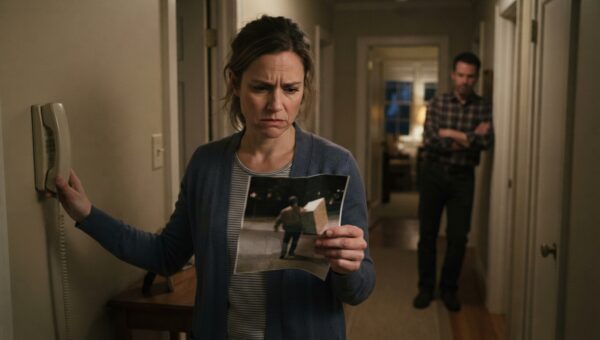
My thumb caught on the brass zipper of the inside pocket, clicking it open with a sharp little sound that felt entirely too loud in the quiet room. Inside was a small orange prescription bottle, the kind they hand out at the downtown pharmacy with the white warning labels wrapped around the middle. My hand was shaking worse than Clifford’s had on the bathroom floor as I pulled it out into the pale light of the window. I turned the bottle over in my palm, squinting at the tiny black print near the barcode. The name on the label wasn’t mine, and it wasn’t an old vitamin refill. It was Clifford’s full name, printed clear as day beneath the name of a neurological clinic over in Huntsville. The drug name didn’t mean much to me at first, but the refill date did. Nine months ago. Right around the time the pregnancy test turned blue and we danced around the kitchen until we both cried.
The door clicked open, and Clifford walked back in carrying a paper sack with a ham sandwich and a Styrofoam cup of coffee. He stopped dead in the doorway when he saw me standing by the chair with the orange bottle in my hand. The color drained right out of his face, leaving him looking gray and hollow under the fluorescent lights. Neither of us said anything for three seconds, and honestly, that felt worse than any shouting match we could have had. Clifford didn’t reach for the bottle. He just let his arms drop to his sides, the paper sack slipping from his fingers and hitting the floor with a dull thud. His jaw worked once, twice, before any sound came out of his throat. You found it, he whispered. His voice sounded smaller than I had ever heard it, like a frightened boy trapped inside a grown man’s frame.
I didn’t yell. I didn’t throw the bottle at him. I just looked at him standing there in the doorway, realizing all at once how many times over the past nine months he had hidden his hands behind his back when we walked down Main Street, how many mornings he had stayed downstairs for an hour before I woke up just to loosen his stiff joints. I have Parkinson’s, Beth, he said, the words tumbling out in a rush now that the dam had broken. Early-onset. The neurologist confirmed it the exact same week we found out you were pregnant. He took a step toward me, his boots scraping softly against the tile. I didn’t want to tell you. You were already worrying about everything, about the bills, about the nursery, about whether we were ready for this. I figured if I could just manage it, if I could keep my hands steady long enough to get us through the delivery, I could carry it alone. I didn’t want you to spend nine months looking at me like I was already half-broken.
He sank down into the chair by the bassinet, burying his face in his hands, and for the first time since we met, I saw him truly shatter. His shoulders shook, not with fear of the delivery, but with the massive, crushing weight of a secret he had carried entirely by himself through every single day of my pregnancy. I walked over and knelt down beside his chair, my knees aching against the hard floor. I reached up and pulled his hands away from his face, holding them in my own palms. They were trembling, cold, and rough from years of chalk dust and woodwork, but they were his. You fool, I whispered, my own voice cracking as tears finally spilled over my lashes. You absolute fool. You don’t have to carry this by yourself. We share the load, Clifford. That’s the whole deal. He looked down at me, his eyes red and wide, searching my face for anger and finding only a deep, stubborn relief that we didn’t have to lie anymore.
We sat there together on the hospital floor for a long time, listening to the hum of the heater and our daughter breathing softly in her sleep. Later that evening, after the nurses had gone home for the night and the hallway outside grew quiet, we stood together beside the clear plastic bassinet. The room was lit only by the pale blue glow of the streetlamp coming through the window panes. We both reached down at the same time, our fingers overlapping over the edge of the striped hospital blanket to make sure she was tucked in tight against the night.