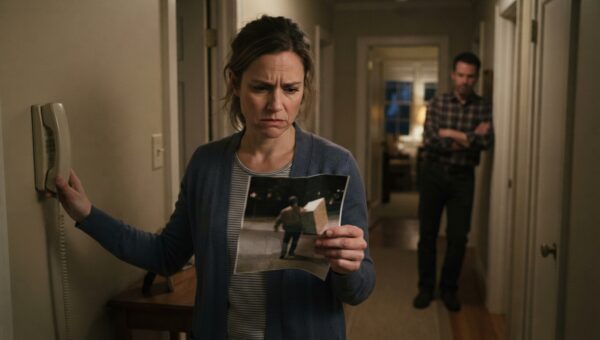
The telephone on the kitchen wall let out that sharp, tinny ring at 4:12 in the morning, vibrating against the drywall in a way that made my teeth ache before my feet even hit the braided rug. I didn’t turn on the overhead light because I already knew what a middle-of-the-night call meant in our family. It meant someone was dead, someone was in jail, or someone had finally hit the absolute bottom of the well.
I picked up the receiver and heard the heavy, familiar static of a long-distance connection, followed by a silence so thick I could hear the refrigerator compressor humming down the hall.
My brother Julian said, “I need your help.”
Not “how are you.” Not “I miss you.” Just five words delivered in that flat, defeated tone I hadn’t heard in six full years.
He didn’t have to explain much more than that. His wife, Evelyn, had finally changed the locks while he was at the hardware store, stacking his three cardboard boxes of clothes on the gravel driveway like trash left out for pickup. He was sitting in the parking lot of a twenty-four-hour diner outside of Flagstaff with a dead phone battery and half a tank of gas, asking if my guest room was still empty.
I said, “Why didn’t you call sooner?”
There was a long pause where the only sound was the heavy draft blowing through his end of the line.
He said, “I was ashamed.”
I told him to drive straight here and not to stop for coffee or gas until he pulled into my driveway.
When he finally got out of his dented sedan at six in the morning, he looked like a ghost who had forgotten how to take up space in the physical world. He was fifty-four years old, but he carried his shoulders hunched up around his ears like a whipped dog afraid of a raised hand.
For the first three months, we lived under the same roof in a state of careful, suspended animation. We didn’t talk about the six years he dropped off the face of the earth. We didn’t talk about why his birthday cards stopped arriving or why he never answered my emails when our father ended up in the hospital. We just existed together in the quiet hallways of my house, moving around each other like ghosts in a museum.
The thing about Julian was that he had developed this terrible, twitchy habit of over-correcting for his own existence.
The first week he stayed in the guest room, I found him scrubbing my kitchen floor on his hands and knees at two in the morning with a toothbrush and a bottle of lemon-scented ammonia.
I stood in the doorway in my flannel pajama pants and asked him what in the world he was doing.
Julian didn’t look up from the grout line. “I’m just cleaning up the mud from my boots.”
“Julian, it’s two in the morning, and the floors were already clean.”
“I don’t want to be a burden,” he muttered, his voice tight and small. “I know how much water costs.”
That was the first real crack in the armor, though I didn’t know it then. Evelyn had spent six years running their marriage like an audited corporate ledger where every favor came with an interest rate and every emotional expression was graded on a curve. If Julian bought her flowers, she weighed whether they cost too much or too little, finding a way to make him feel small either way.
If he visited his family, he paid for it for weeks with silent treatments and icy reminders of how little he prioritized his own household. She had trained him to treat human affection like a dangerous loan that he could never hope to pay back.
He washed his own coffee mug immediately after every single use, drying it with a paper towel and putting it back in the exact same spot on the counter so it wouldn’t leave a ring. He never took the last helping of anything in the refrigerator. If I bought takeout, he insisted on paying me back in exact cash down to the penny, pulling crumpled bills from his pocket and smoothing them flat against the kitchen table with his thumb.
I watched him do it every single day, and every day my chest felt a little tighter.
The turning point didn’t happen during a screaming match or a dramatic late-night confession. It happened on a Tuesday morning in late October, when the frost was just starting to crust the edges of the back porch screen.
The kitchen smelled of burnt toast and chicory coffee because I had gotten distracted watching the crows fight over the birdfeeder. Julian was sitting at the scarred oak table, turning his ceramic mug over and over in his hands, staring down at the little chip in the handle like it held the secrets of the universe.
He looked older than his years. His hair was completely gray at the temples now, and the lines around his eyes were carved deep from years of walking on eggshells in a house that wasn’t a home.
Without looking up, Julian said, “Do you remember when we were kids and you fell out of the old oak treehouse behind the church?”
I paused, holding the butter knife over the counter. I hadn’t thought about that afternoon in forty years. “I remember.”
“You broke your collarbone,” he said softly, tracing the chipped rim of his mug. “You couldn’t even walk. I carried you all the way home on my back through the high weeds because I was terrified if we called an adult, we’d both get whipped for climbing up there.”
“My arm hung down like a wet noodle,” I said, leaning against the counter. “I remember crying so hard I threw up on your sweater.”
Julian finally looked up, his eyes bloodshot and watery behind his wire-rimmed glasses. “I didn’t care about the sweater. I just remember thinking that my little brother was hurt, and it was my job to get him inside where it was safe.”
He swallowed hard, his throat working visibly. “I think I need you to carry me for a while.”
The words hung in the air between us, heavy and fragile all at once. I set down my coffee mug on the formica with a dull thud that made the spoons rattle in the holder.
I looked right across the table at him, straight into those tired, defeated eyes. “I already am.”
For a second, Julian just blinked at me, like he couldn’t quite process a sentence that didn’t come with a hidden condition or a delayed punishment. He opened his mouth to say something, probably to apologize for taking up space or to offer to pay for the coffee, but he stopped. The rigid posture he had maintained for three solid months finally began to sag. His shoulders dropped an inch. Then another.
He let out a long, shuddering breath that sounded like air escaping a punctured tire, and then he put his face in his hands and started to cry. It wasn’t the loud, theatrical sobbing of a man putting on a show; it was the dry, racking cough of someone whose tear ducts hadn’t worked in years and had to relearn how to break down from scratch.
I didn’t say anything else. I walked around the table, pulled out the chair next to him, and sat down. I put my hand on the back of his neck, right where the gray hair met his collar, and I just held him there while the kitchen grew warm around us.
That afternoon, we finally sat down with a legal pad, not to tally up debts or figure out rent, but to look at local apartment listings. Julian didn’t want to stay in my guest room forever, and I knew he needed his own four walls to prove to himself that he could survive outside of a cage. We found a small, clean studio apartment three miles away with a view of the municipal park and a tiny kitchen that smelled faintly of old radiator iron.
He started seeing a counselor on Thursday afternoons, a quiet woman named Dr. Vance who specialized in untangling the kind of psychological knots that six years of emotional starvation leaves behind. He didn’t fix everything overnight. There were still weeks where he tried to apologize for breathing too loud or insisted on buying groceries for the whole house to make up for using the hot water.
Every time he started sliding back into that old, panicked ledger mentality, I didn’t lecture him. I just set my coffee mug down on the table, looked him dead in the eye, and reminded him where we parked our shoes.
Last Saturday, I went over to help him put together a cheap bookshelf he bought at the discount store. We didn’t have any fancy furniture yet, and the walls were still bare white plaster with no pictures hanging. We sat together on two unboxed metal folding chairs in the middle of his living room floor, eating cold chicken salad out of plastic tubs with plastic forks, laughing about something stupid our grandfather used to do down at the auto body shop.
There was no clock ticking down an imaginary debt. There was no scorecard keeping track of who owed whom an apology. For the first time in six years, my brother was just sitting across from me, eating lunch without looking over his shoulder to see if he was allowed to enjoy it.