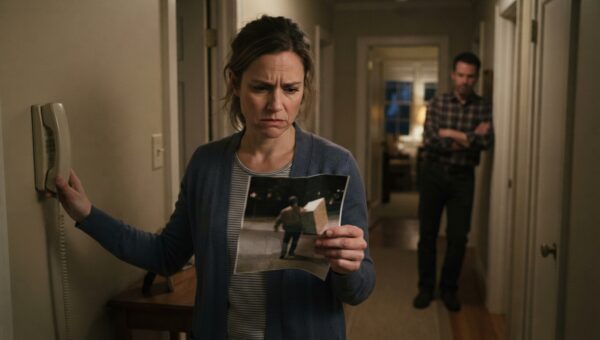
The autumn wind had this sharp, dry rattle against the screen door that afternoon, right around three o’clock, when the bell finally rang. I was standing at the kitchen counter wiping down the linoleum with a damp washcloth, thinking about the half-baked peach cobbler cooling in the oven, when the floorboards groaned under a heavy step. It wasn’t the mail carrier’s slow shuffle.
It was fast, uneven, and heavy, like someone running up the porch steps in a desperate hurry.
I didn’t think about it. I just dropped the rag into the sink and walked down the short hallway, wiping my hands on my apron. My mind was already halfway through wondering if the water bill had gone up again, or if the county was finally going to pave the gravel stretch out past our mailbox.
When I pulled the wooden door open, the wind caught the screen and slammed it sideways against the cedar siding with a loud crack.
Leo was standing right there on the grey concrete stoop. He wasn’t twelve anymore. He wasn’t the skinny kid with scraped knees and a missing front tooth that I had watched vanish down the driveway six years ago. He was eighteen now, standing six-foot-one in a dark canvas jacket that looked too thin for the late October chill, his chest heaving like he had sprinted the last half-mile from the county road.
His face was blotchy, his jaw trembling, and tears were tracking straight down through the dust on his cheeks.
“Hey, Grandma,” he whispered, and before I could even catch my breath, his arms were around my neck and he was burying his face in my shoulder, sobbing so hard his whole frame shook against mine.
I just stood there on the threshold, my arms locked around him, feeling the solid weight of him against me after two thousand one hundred and ninety days of silence. The wind kept howling through the maple trees out front, dropping dead leaves across the porch floor, but I didn’t care about the cold. I pulled him tighter, my own tears starting to spill down my chin, letting out a ragged breath I felt like I’d been holding since the day Evelyn took him.
“You’re home,” I choked out, my fingers tangling in the thick hair at the back of his neck. “Oh, Leo, you’re actually here.”
We stood there on the porch for what felt like hours, wrapped around each other while the world went quiet.
I kept my hand pressed against the back of his jacket, feeling the steady thud of his heart against mine, convincing myself that he wasn’t going to vanish like smoke the second I let go.
Then he pulled back just an inch, wiping his nose with the back of his sleeve, and reached down into the canvas backpack slung over one shoulder.
“I had to wait,” he said, his voice cracking right down the middle. “Every single day for six years, Grandma. I counted.”
He unzipped the main pocket with trembling fingers and pulled out a thick, heavy black binder that looked like it weighed ten pounds. The plastic cover was scuffed at the corners, stuffed so full of loose papers, yellowed sticky notes, and folded legal documents that the metal rings were biting sideways through the spine. Without a word, he lifted it up and placed it right into my hands.
The weight of it almost made me drop my end. My fingers closed over the cold plastic, and the memory of that terrible morning six years ago rushed back into the room like freezing water.
I remembered the white sedan sitting in the driveway. I remembered the tall man in the grey suit standing behind Evelyn, holding a black leather briefcase like he owned the ground under his feet. Evelyn hadn’t even looked at the garden we spent all spring planting. She hadn’t looked at Leo’s boots sitting by the back door. She had just looked me straight in the eye with that cold, flat expression and said, “Thank you for your services. I’ll take it from here.”
Before I could grab my coat, before I could tell Leo to pack his blue dinosaur pillowcase, she took him by the arm and led him down the steps. There wasn’t a court order I could fight on a retired grocery clerk’s pension. She was his mother on paper, and that was all the law cared about. They vanished into thin air that morning, leaving behind a dead phone number and a house that suddenly felt ten times too big.
“What is this, honey?” I asked, looking down at the binder resting between us.
“Everything,” Leo whispered, his eyes red and swollen. “Open it.”
I stepped back, pulling him inside out of the wind, and kicked the front door shut behind us. The sudden quiet of the hallway felt heavy, pressing down on the walls. I set the heavy black binder down on the oak kitchen table, right beside the cooling peach cobbler.
I unclipped the metal rings and opened the first page.
It wasn’t photo albums. It wasn’t report cards from the local high school in Des Moines where she dragged him. It was a grid. Row after row of neatly typed numbers, percentages, and performance scores printed on stiff white bond paper, stamped by a legal firm in Chicago.
“Read the top line, Grandma,” Leo said, standing right beside me, his hands jammed deep into his jacket pockets like he was trying to keep them from shaking.
My eyes scanned the header. *Developmental Compliance Audit. Subject: Leonard James Miller. Custodian: Evelyn Miller.*
Below it was a monthly ledger dating all the way back to November of the year he turned twelve. Every single month of the six years she kept him away from me had been broken down into a corporate spreadsheet. There were weight charts, medical check-up receipts, standardized test percentile rankings, and psychological evaluation summaries written by doctors I had never met.
“I didn’t understand why she enrolled me in four different private schools in three years,” Leo said, his voice dropping to a low, dead flat murmur that scared me worse than his crying. “I thought I was just stupid. I thought I kept messing up. Every time my grades dipped even a little bit, or I gained two pounds outside her approved chart, she’d sit me down at the kitchen table with a red pen.”
I turned the page. Attached to a psychological assessment from when he was fourteen was a handwritten sticky note in Evelyn’s sharp, sloping cursive. *Subject shows excessive emotional attachment to former guardian. Corrective isolation measures increased by thirty percent.*
My stomach twisted into a hard, aching knot. The kitchen around me suddenly felt like it was tilting sideways.
“She didn’t want me, Grandma,” Leo said, and a fresh tear broke loose and rolled down his cheek. “She didn’t come back for me because she missed me. On my twelfth birthday, the trust fund my great-grandfather left for my education activated its main clause. Evelyn found out she couldn’t touch the monthly payout unless she held primary legal custody and proved, every single thirty days, that I was meeting every single corporate and academic metric required by the estate board.”
The pieces started clicking together in my head with a sickening, heavy thud. The expensive lawyer. The sudden, aggressive court filings. The way she didn’t even ask how he was doing when she snatched him off my porch. She hadn’t rescued her son. She had secured an annuity.
“If you gave too little, you were selfish,” Leo murmured, quoting some grim rule she must have beaten into his head every day under her roof. “If you gave too much, you were showing off. And if you gave exactly what someone wanted, they found a way to make you regret knowing them that well.”
“Oh, sweet boy,” I breathed, reaching out to grab his hand, but he shook his head and flipped another page forward in the binder.
“Look at the back,” he said.
I turned past the medical evaluations, past the quarterly growth charts, past the bank deposit slips showing twelve thousand dollars transferred from an estate account into Evelyn’s personal routing number every single month. At the very back of the binder was a fresh, crisp legal document dated from that very morning.
It was a revocation of executorship and a full assignment of trust beneficiary rights, signed in wet blue ink by Leo’s own hand the minute the clock struck midnight and he turned eighteen.
“She called me at eight o’clock this morning,” Leo said, a bitter, humorless smile touching the corners of his mouth. “She walked into my room holding a new compliance form for my college applications. I handed her the signed trust termination papers instead. I told her my eighteen years of being her audit project were officially over.”
“What did she say?” I asked, my breath catching in my throat.
“She didn’t yell,” Leo said quietly. “She just looked at the paper, then looked at me, and asked how we were going to pay the mortgage on her house without the trust check. That’s when I packed my duffel bag, walked out the front door, and took a bus straight here.”
Before I could answer him, the landline telephone mounted on the kitchen wall let out a sharp, shrill ring that made us both jump.
The sound vibrated right through the drywall. We both stared at it.
*Brring.*
It rang again. Then my own cell phone sitting on the counter lit up with an incoming call, the screen flashing Evelyn’s name in bright white letters against the dark glass. The phone buzzed once against the formica counter, rattled for a second, and then went silent as it rolled to voicemail.
Leo reached out, picked up my cell phone with two fingers, and looked at the screen. He didn’t hesitate. He tapped the red decline button, held his finger down until the phone powered completely off with a little digital chime, and laid it face down on the table right next to the heavy black binder.
“She’s done,” Leo said, his voice steady now, clear of all the shaking from earlier. “She doesn’t get another metric. She doesn’t get another report. I’m staying right here.”
I reached out and pulled him back into my arms, resting my cheek against his hair, feeling the warmth of him filling up the cold spaces that had sat empty in this house for six long years. The wind outside was still rattling the screens, and the peach cobbler was growing cold on the counter, but the kitchen felt warmer than it had in a lifetime.
We didn’t talk about the lawyers. We didn’t talk about the money sitting in some bank account in Chicago. We just stood there together by the kitchen table while the sun dipped down below the treeline, turning the Iowa sky a deep, bruised shade of orange.
Later that evening, after the phone had stopped trying to ring and the house had settled into a quiet, steady rhythm, I picked up the heavy black binder with both hands. I carried it down the narrow hallway to the back of the house, opened the door to the hall closet beneath the stairs, and shoved it all the way into the dark corner behind the old winter coats and the spare boxes of canning jars.
I closed the closet door firmly, latching it shut, and walked back to the kitchen where Leo was already sitting at the table with a fork in his hand, waiting for a warm slice of peach cobbler.