The smell of woodsmoke from the neighbor’s outdoor stove always hung low over our gravel road right around sunrise, carrying that dry, sharp scent of seasoned oak that gets deep into your wool coats and stays there.
My kitchen was dead quiet at five minutes before six in the morning. The digital clock on the microwave blinked a steady, amber twelve-o-clock because the power had flickered off during the storm three nights back, and I never did figure out how to set the little red numbers again.
Rilla was asleep in the spare room down the hall, or at least she was lying still under the heavy patchwork quilt I pieced together back when my own eyesight was sharper and my fingers didn’t ache every time the weather turned damp.
She had come to my back door at nine o’clock the evening before, her sneakers soaked right through from the wet clover in the pasture. She didn’t knock three times the way family usually does. She just pushed the screen door open until the little metal spring gave that familiar high-pitched twang, and then she stood on the braided rug with her coat pulled tight across her chest like she was freezing, even though the house was holding seventy degrees from the oil furnace.
I had been sitting at the table mending a dish towel with blue thread when she dropped her school binder. The metal rings popped open a little bit, and three math worksheets fluttered out onto the linoleum.
She didn’t bend down to pick them up. She just pulled out the ladder-back chair across from me, sat down hard, and started tearing the paper napkin from the bread basket into little thin strips. She shredded every single ply until there was just a white pile of lint sitting between her elbows.
She didn’t cry right away. Rilla was sixteen, with her father David’s straight brown hair and those same deep-set eyes that always looked like they were bracing for a reprimand.
“Please, Nana,” she whispered, and her voice sounded thin, like dry grass snapping in winter. “If you tell them, Daddy will put me out like he did Aunt Deb.”
The kitchen had gotten very small just then. The hum of the refrigerator seemed to grow twice as loud, vibrating right up through the floorboards into the soles of my slippers.
I remembered nineteen-ninety-four down to the exact shade of gray the sky had been on the day Deb packed her canvas duffel bag.
David had stood right where Rilla was sitting, only he had been twenty-two then, chest puffed out like a banty rooster, quoting scripture about virtue and house rules until my own mouth felt dry and heavy with a coward’s silence. I had let him push his seventeen-year-old sister out the door because I was tired, because David was the man of the house after his daddy passed, and because it was easier to keep the peace than to cross a boy who wore his righteousness like a suit of iron armor.
Deb had gone to stay with an uncle up near Peoria, and then she had drifted further west over the years, sending postcards with no return addresses until the mail stopped coming entirely in nineteen-ninety-eight. David never said her name at Sunday dinner again. He married Martha two years later, built a prosperous contracting business, and raised his children in a house where grace was something you earned by keeping the lawn mowed and the pew warm.
And now Rilla was sitting in that exact same chair, twisting paper into dust, carrying a secret that would make David lock the front door and point down the highway before the sun hit the top of the silo.
I told her I would think on it overnight. I told her to go wash her face and crawl under the quilt, and I promised I wouldn’t touch the telephone until the sun came up.
I didn’t sleep a wink. I sat in the wingback chair in the front room with a woolen throw over my knees, watching the headlights of the milk trucks sweep across the lace curtains every hour on the hour. I turned things over in my mind until my head throbbed. Stay quiet, and I was the only soul she trusted, a child carrying a child alone in a world that didn’t care about teenage girls who made mistakes in the back of a Ford pickup. Call her parents, and I would break her heart, but David and Martha had a legal right to know about their own home, even if their version of parenting was mostly about elimination rather than mending.
I had three thousand two hundred and forty dollars in a metal lockbox behind the canned peaches in the pantry, saved from selling my hooked rugs at the fall bazaar and a little insurance payout from when the old Buick was totaled. I had a spare room with a good mattress and a window that looked out over the apple trees.
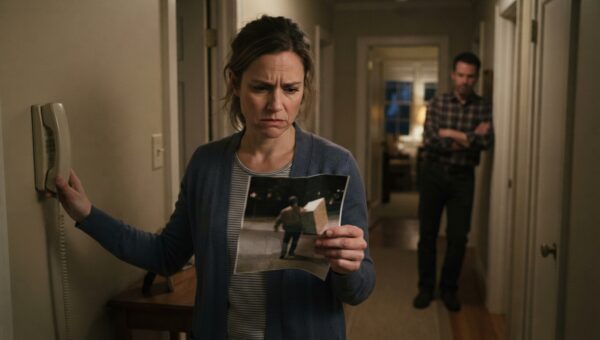
At six in the morning, the house was still holding that cold, predawn blue. I walked out to the kitchen, my joints popping in the quiet, and picked up the black cordless phone off the wall charger.
My thumb hovered over David’s contact. It was right there under the letter D, programmed with a little picture of a tractor he had helped me pick out ten years ago. All I had to do was press green, and within twenty minutes David would pull his white Dodge truck into my drive with his jaw set hard, ready to haul his daughter back to an interrogation under the kitchen chandelier.
Instead, I scrolled down past the church deacons and the plumbing supply store until I found a number I hadn’t dialed in three decades. I had kept it written on the inside cover of my recipe book, right next to the apple crisp instructions, just in case a letter ever found its way back to me.
My hand was shaking so hard the plastic casing clicked against my wedding ring. I pressed call and held the receiver to my ear, listening to the long, hollow distance hum across three states before a woman’s voice answered on the fourth ring.
“Hello?” she said. She sounded tired, like she had already been up for hours tending to something heavy.
“Deb,” I said. My voice cracked right down the middle, and I had to clear my throat twice before the words would come out straight. “Deb, it’s Mama.”
There was a long silence on the line, the kind of heavy, weighted pause where thirty-two years of dust settles between two people who used to live under the same roof. I could hear the faint sound of a dog barking somewhere in the background, out where the air was different from our Illinois bottomlands.
“Mama?” she said, and her voice didn’t sound angry. It sounded small, the way she used to sound when she was six and fell off the porch swing. “Is everything all right?”
“No,” I told her, and the tears finally broke loose down the sides of my nose, hot and sudden. “No, honey, it isn’t. I’m calling because I made a terrible mistake thirty-two years ago, and I am sitting in the exact same kitchen, and your niece is sitting in the exact same chair.”
I didn’t rush. I told her everything while the gray light slowly turned the kitchen windows pale. I told her about Rilla coming through the screen door with her wet sneakers, about the shredded napkin, about David’s hard rules and the three thousand dollars in the lockbox. I didn’t make excuses for myself. I told her how I had stood by the stove back in ninety-four and watched her walk down the gravel drive with her duffel bag because I didn’t have the stomach to fight my own son.
Deb didn’t interrupt me once. When I finally ran out of breath, she let out a long, ragged sigh that sounded like someone letting go of a heavy anchor.
“Is the girl alright?” Deb asked quietly.
“She’s scared,” I said. “She’s sixteen, Deb. She looks just like you did when you sat there holding that blue pillow.”
“Well,” Deb said, and I could hear her shifting the phone to her other ear. “You tell her she’s not walking down that road alone this time. I’ve got a two-bedroom place outside of Springfield, and I’ve been running the books for Dr. Henderson’s clinic for twelve years. I know every specialist within fifty miles, and I know how to keep a roof over a girl’s head without asking a single man for permission.”
We talked for twenty more minutes. We talked about doctors and high school credits and how to handle David when he finally figured out where his girl had gone. Deb didn’t offer cheap comfort, but she gave me something better. She gave me a spine.
By seven-thirty, the smell of coffee was filling the kitchen, dark and rich and roasted with chicory.
Rilla walked out down the hallway wearing one of my old flannel shirts that hung down to her knees. Her hair was still damp from the bathroom sink, and she looked smaller than ever, her bare feet making soft padding sounds on the linoleum.
She stopped by the table, looking down at the pile of paper shreds I hadn’t swept up yet.
“Did you call him?” she asked, and her bottom lip gave a little twitch.
“I didn’t call your daddy,” I said, pouring a splash of cream into her mug. “I called your Aunt Deb.”
Rilla froze mid-step, her eyes going wide. “Aunt Deb? But she lives in Missouri. Dad said she was, “
“Your daddy says a lot of things to keep the world looking simple,” I interrupted, pulling out the chair for her. “She’s coming up this weekend. And you are staying right here in the spare room. We’ve got three thousand dollars and a stack of medical pamphlets coming in the mail, and if your father wants to come over here and preach about house rules, he can talk to his mother and his sister both.”
Rilla let out a breath she must have been holding since the night before, and for the first time in twenty-four hours, the tightness around her mouth let go. She sat down and reached for her mug, her fingers steadying against the ceramic.
David didn’t wait until the weekend.
He pulled his truck into the drive at four-and-forty in the afternoon on Thursday, gravel flying off his rear tires as he slammed the brakes. I saw him through the front window, his shoulders squared up under his flannel work shirt, his heavy work boots hitting the porch steps like a gavel.
I was standing right by the screen door when he yanked it open without knocking.
“Where is she?” David demanded, his voice bouncing off the low ceiling of the entryway. His face was dark red from the wind, and his eyes were fixed on the hallway. “Martha called the school three times today. She wasn’t in her third-period civics class. One of her friends let it slip that she came out here last night.”
He tried to step past me into the house, but I didn’t move an inch. I stood my ground on the braided rug, my hand resting on the wooden frame of the screen door.
“She’s in her room, David,” I said, and my voice didn’t shake. It had the same steady, dry rattle as the oak leaves outside.
“Move aside, Mama,” he said, reaching out to push the door wider. “I am not going to have a stray girl bringing shame under my mother’s roof. We are going to pack her things right now, and we are going to have a talk with the boy responsible before the sun goes down.”
“You aren’t touching her things, and you aren’t taking her anywhere,” I said.
David stopped. He stared down at me like I had lost my mind, his mouth half-open in that familiar look of righteous disbelief he used whenever someone didn’t bend to his blueprint.
“She’s my daughter,” he said, his voice dropping into that low, dangerous register he used when he wanted to remind everyone who held the purse strings in his household. “Under my roof, she obeys my laws. If she wants to live like a sinner, she can do it somewhere else. I won’t have my family name dragged through the mud in this county.”
“Your family name,” I said, and I laughed a little, though there wasn’t any humor in it. “Is that what you called it when you put Deb out in ninety-four? Did you save the family name then, David, while she was sleeping in a bus station in Peoria?”
David went entirely still. The red drained right out of his cheeks, leaving them the color of old parchment.
“That was different,” he muttered, looking away toward the coat rack.
“No, it wasn’t,” I said, stepping closer to him until he had to look down into my eyes. “It was the exact same cowardice dressed up in Sunday clothes. And you’ve been running this family like a little tin dictator ever since because I let you get away with it when you were twenty-two. Well, I am eighty-one years old today, and I am done being quiet to save your pride.”
He opened his mouth to argue, to quote some verse or raise his voice the way he always did when logic failed him, but I cut him off clean.
“Rilla stays here,” I told him, pointing a finger right at the third button of his flannel shirt. “Deb is driving up from Missouri on Saturday to help me get her registered at the clinic in town. You can be part of this girl’s life, or you can walk out that front door right now and never sit at my table again. But I promise you, David, if you try to drag her out of my house, I will call the sheriff, I will call the church elders, and I will tell every soul in this county how my son treats his own flesh and blood when they stumble.”
The kitchen was so quiet you could hear the oil furnace clicking on down in the cellar.
David looked at me for a long, hard minute. His jaw worked back and forth, the muscles in his cheek twitching under his skin. He looked like a man standing at the edge of a frozen pond, testing the ice with his boot and realizing it wouldn’t hold his weight.
“You’ve gone soft in your old age, Mama,” he whispered, but there was no iron left behind it. It sounded like a man admitting defeat to an empty room.
“No, David,” I said softly. “I finally got hard. There’s a difference.”
He didn’t come inside. He backed out onto the porch, his boots crunching on the wooden planks, and climbed back into his white truck without another word. I watched through the warped glass of the front door as he sat behind the steering wheel for three whole minutes, staring out at the empty pasture before he finally threw the gearshift into reverse and kicked up a cloud of dust all the way down to the county road.
When the red taillights finally disappeared behind the copse of walnut trees, I walked back down the hall and pushed open the door to the spare room.
Rilla was sitting at the small wooden desk by the window, where the afternoon sun was catching the dust motes in the air. The shredded napkin was gone from the kitchen, replaced by a fresh, clean notebook she had pulled from her binder, and she was already writing down a list of homework assignments with a blue ballpoint pen while her Aunt Deb talked softly to her through the speakerphone of my cell phone propped up against a stack of old National Geographics.