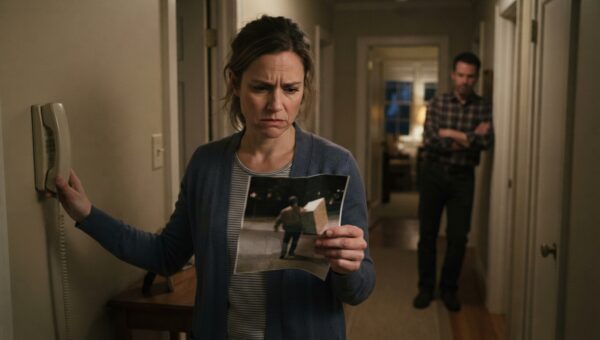
The library telephone always had a dry, tinny ring that made my teeth ache before my hand even reached the cradle.
Mrs. Gable did not waste time with small talk when she picked up on the second Tuesday of last month.
“Martha, you need to come down here right now before I log this in the amnesty pile,” she said, her voice dropping an octave the way it always did when she was holding local gossip.
“I am right in the middle of canning peaches, Helen,” I told her, wiping my palms on my apron while the pot hissed on the back burner.
“It is a book, Martha,” she whispered through the wire. “Checked out March 1970. Fifty-six years overdue.”
The peach on the counter slipped from my fingers and split on the linoleum, orange juice pooling around my bare toes, but I did not look down. My ribs tightened until I could barely pull air into my chest. March 1970 was the exact month Annie Miller’s house went dark over a single weekend, the moving van arriving while the streetlights were still on, her father loading cardboard boxes into the trunk without a wave to any of the neighbors. No goodbye. No forwarding address. Just an empty yard and the heavy, sweet smell of the lilac bushes dropping their dead blooms into the wet dirt.
When I walked through the swinging doors of the town library ten minutes later, the air smelled of stale paper and floor wax. Mrs. Gable was waiting by the front desk with a heavy, cloth-bound volume resting on the scarred oak surface like an artifact pulled from a tomb.
It was a copy of *A Wrinkle in Time*, the cover faded to a dull gray-blue, the library stamp on the flyleaf smudged with purple ink.
“Look at the margins, Martha,” Mrs. Gable murmured, sliding the book toward me with the tip of a yellow pencil.
I leaned over the counter, my fingers shaking as I pried the stiff old pages apart near the middle. Up and down the sides of the paper, written in the faint, stubborn lead of a number two pencil, ran the tiny, precise geometry of the substitution cipher Annie and I had invented in fifth grade behind the old Methodist church. We had spent three solid weeks passing folded notes back and forth during history class, convinced the nuns were going to crack our system.
The letters were small and cramped, but I knew that handwriting better than my own name. It spelled out a sentence letter by letter along the blank border of chapter six.
“MEET ME WHERE THE LILACS BEND,” I read aloud, my voice cracking so badly it sounded like a stranger’s.
“There was a return address on the padded envelope it came in,” Mrs. Gable said, tapping a slip of yellow receipt paper with her fingernail. “A small town about four hours north, right up near the county line where the timber starts getting thick. No name on the sender line, just a zip code and a street.”
I stood there under the fluorescent lights of the library while fifty-six years of quiet grief pressed down on my shoulders. I had spent every single spring of my adult life looking out my kitchen window at the lilac bushes by the fence, wondering if Annie had forgotten the afternoons we spent reading upside down beneath their branches, her dark braids trailing in the grass. I had spent decades assuming her family simply packed up and moved away because they did not care about the kids they were leaving behind.
By three o’clock that afternoon, my daughter Sarah was in the driver’s seat of her sedan, her knuckles tight on the steering wheel as we took the ramp onto the highway heading north.
“Mom, you are awfully quiet back there,” Sarah said about an hour into the drive, glancing at me in the rearview mirror where my face was reflected against the gray glass.
“I just keep thinking about the code,” I said, holding the old library book in my lap like a fragile bird.
“Do you really think it’s her?” Sarah asked, her voice softening as she slowed down for a stretch of road construction where the orange cones cut into the lane.
“It has to be,” I answered, though my stomach felt hollow. “Nobody else on this earth knew that cipher. We made up the substitution rules ourselves when we were ten years old. Even if she is gone and someone else found the book in her things, somebody up there wanted me to see it.”
The miles rolled past in a blur of gray asphalt and endless stands of bare pine trees that looked tired against the March sky. Every time Sarah shifted gears or clicked the turn signal, my mind drifted back to that cold Monday morning in 1970 when I walked past Annie’s house and saw the milk bottles still sitting on the front porch, untouched and frosting over in the early wind. My mother had told me not to go poking around their yard, saying some families just had business to tend to elsewhere, but the silence of it had haunted me every spring since I was a child.
By the time we crossed the county line, the sun was dropping low behind the hills, turning the sky the color of a bruised plum.
“The GPS says we are five minutes away,” Sarah announced, her eyes flicking between the road and the small slip of paper Mrs. Gable had given us. “Number 414 on a dirt road called Miller Creek Lane. Figures.”
My hands were sweating against the blue cloth cover of the library book. The car bounced over a cattle guard, the tires crunching loudly against loose gravel as we turned down a narrow lane overhung with drooping branches. Small, neglected houses sat back from the road behind weathered fences and piles of split firewood.
Then Sarah slowed the car down to a crawl.
“That’s it,” she whispered, pointing toward a small, single-story blue cottage nestled behind an overgrown hedge of ancient lilac bushes.
The paint was peeling from the window trim, and the porch steps looked like they needed a fresh coat of stain, but the yard was quiet and neat. A rusted metal porch swing hung from the rafters, moving slightly in the evening breeze. Standing right by the bottom of the wooden steps, wearing a faded gray cardigan and holding a silver watering can, was an elderly woman with silver hair pulled back into a loose bun.
Sarah cut the engine, and the sudden quiet inside the car felt heavy enough to break.
I pushed the passenger door open, my knees clicking as my feet hit the gravel. The woman by the porch turned her head sharply at the sound of the tires, her hand freezing on the handle of the watering can. She did not look away or shield her eyes from the setting sun. She just stood there, staring across the yard with an expression so raw and disbelieving that my breath caught in my throat.
I took two steps forward, the gravel grinding under my boots.
“Annie?” I asked, my voice barely carrying over the sound of the wind through the pines.
The woman dropped the watering can, the plastic hitting the dirt with a dull thud, and she brought both hands up to cover her mouth. Her shoulders began to shake, and she took a stumbling step down off the porch into the dry grass, her eyes wide and shining with sudden tears.
“You remembered,” she choked out, her voice raspy and thin with age, but carrying the exact same cadence I had heard across a school desk more than half a century ago. “Martha, you actually remembered the code.”
I did not answer her with words because my throat had closed up entirely. I just started walking faster, crossing the patchy grass of the front yard until I reached her at the base of the steps. We didn’t exchange formal greetings or stand on ceremony; we simply collapsed into each other’s arms the way two frightened children do after a storm, holding on so tightly our ribs ached.
“I looked for you,” I managed to whisper against her shoulder, feeling the familiar, frail slope of her back. “Every single spring when the lilacs came in, I looked for you.”
“I know,” Annie sobbed softly, her fingers gripping the fabric of my coat as if she were afraid I would dissolve back into the highway mist. “I am so sorry, Martha. I am so sorry they made us leave like that.”
We sat together on the weathered porch swing as the sun dipped entirely below the tree line, the evening air turning cold enough to frost our breath. Annie told me everything in a quiet, halting voice that stopped every few minutes while she wiped her eyes with the sleeve of her cardigan.
She explained how her father had been a quiet man working down at the county agricultural office who happened to stumble onto a massive, quiet embezzlement scheme involving local officials who held all the mortgage notes in town. One night in March, men in dark suits had arrived at their front door before midnight, telling her parents they had twenty minutes to pack two suitcases each and get into the back of an unmarked sedan. No phone calls allowed. No goodbyes to friends. No warning that they were being tucked away under an informal federal protective umbrella years before the official programs even had names.
“They told my mother that if anyone in town knew where we went, the men who stole the money would find us before morning,” Annie said, staring down at her worn slippers on the wooden boards. “I wasn’t even allowed to bring my schoolbag. I only grabbed *A Wrinkle in Time* because it was tucked inside my winter coat pocket from the library. I kept it all these years, Martha. Every time I moved, that book went into the box first.”
“It’s fifty-six years overdue,” I said, offering a small, shaky laugh that felt half like crying.
Annie reached into the deep pocket of her cardigan and pulled out a small, dried brown object, holding it out on the flat of her palm. It was a pressed lilac blossom, paper-thin and brittle as an autumn leaf, preserved between two pieces of faded wax paper.
“I found it behind the library bushes the day before we left,” she whispered. “I put it on page one so I wouldn’t forget what home looked like.”
I opened the old library book on my lap and turned back the cover, laying her pressed flower back into the exact indent it had left in the paper five decades ago. We sat side by side on the porch swing under the canopy of budding purple lilacs, the shadows stretching long across the gravel drive, reading aloud together from page one as the stars began to punch through the cold northern sky.