The driveway behind my house was baking under an unforgiving Oklahoma sun that made the asphalt smell like hot tar and old dust. It was the kind of dry, heavy Saturday where you could feel the humidity pressing down on your shoulders before you even stepped off the back porch. I had boxes stacked against the garage door, taped up with brown packing tape and labeled with thick black marker, each one holding forty years of living that I simply didn’t have room for in the smaller apartment across town.
My knees ached from bending over tubs all morning, but my back stayed straight because I raised my children to stand up and I wasn’t about to slouch for a yard full of strangers.
Vern had been working the perimeter of the sale since seven o’clock, drifting from table to table with that greasy, predatory glide particular to men who make a living off other people’s clearing out. He smelled strongly of menthol cigarettes and the citrus-scented hand sanitizer he pumped out of a plastic bottle every ten minutes. He wore a damp polo shirt that clung to his ribs and a belt that had given up trying to hold his waist in around five years ago. Vern liked to linger near the older widows in the neighborhood, offering five dollars for things he knew were sterling silver or handing out ten-dollar bills for cast iron pans that had been in families since the Dust Bowl.
He figured old women were tired, forgetful, and eager to make things disappear.
He stopped at the folding table where I had laid out the linens. The heat had baked the scent of old cedar and sun-dried cotton into the air around us, a clean, dry smell that cut right through his cigarette smoke. Vern reached out and picked up Mama’s wedding quilt with two fingers, holding it away from his shirt like it might be catching. He gave it a little shake, his mouth curled into that practiced, pitying grimace antique dealers wear when they want to make you feel like your history is a burden they are doing you a favor to haul off.
“These old utility quilts, sweetheart,” Vern said, tossing his head back with a little huff of laughter. “People want farmhouse-look now, not farmhouse-smell.”
The quilt in his hand wasn’t just old cloth. It was a Depression-era double wedding ring masterpiece, hand-pieced from feed sacks with tiny, invisible stitches that ran eight to the inch.
My grandmother spent the winter of 1934 piecing it by kerosene lamp while the wind whistled through the floorboards of the farmhouse outside of Enid. Every single arc of colored cotton, the faded madder pinks, the flour-sack indigos, the pale buttermilk yellows, was stitched by a woman who could make a garden grow out of gravel. In the lower right corner, tucked inside the border lattice, Mama had stitched her own initials in double-strand embroidery floss: E.M.W. 1934. I had judged textile entries at the Oklahoma State Fair for thirty consecutive years. I knew the exact count of a feed-sack weave by touch alone, and I knew what an heirloom looked like when I saw one.
Vern gave the edge of the quilt another dismissive flick, letting it sag in his damp fingers. “I’ll give you five dollars for it. Maybe ten if I’m feeling charitable and have to pay to get the musty smell out at the laundromat.”
I didn’t yell. When you spend three decades telling farm wives and 4-H girls why their seams didn’t hold up under a magnifying glass, you learn that raising your voice just lets the other person know they’ve rattled you. I looked right at Vern, at the thin greasy ring around the collar of his polo shirt, and I smiled. It wasn’t a sweet smile. It was the smile I gave eighteen-year-old boys who thought they could glue lace to muslin and fool a state fair judge.
“It’s not for sale, Vern,” I said, my voice as flat and dry as the Oklahoma wind.
He let out a wet, raspy chuckle, shifting his weight to his other hip and pulling out a battered leather checkbook that looked like it had survived a tractor fire. “Everything’s got a price tag, darlin’. Ten dollars is my final offer. Take it or keep the mothballs.”
He pulled a ballpoint pen from his shirt pocket and started scribbling numbers on the back of one of his dirty business cards, leaning over the folding table with the heavy, unearned confidence of a man who thought he was the smartest fox in the henhouse. “I’ll write this down in case you get realistic after I clear out,” he muttered, not even looking up at me.
I didn’t answer him. I turned my back, walked across the hot gravel of the driveway, and stepped into the cool, dark shade of the kitchen. The screen door banged shut behind me with a sharp, familiar rattle that had punctuated every summer of my childhood. The kitchen was quiet, smelling faintly of stale coffee and the lemon furniture polish I’d used on the table the day before. My heart was beating a little faster than usual, not from fear, but from that cold, sharp clarity that comes right before you drop an anvil on someone’s foot.
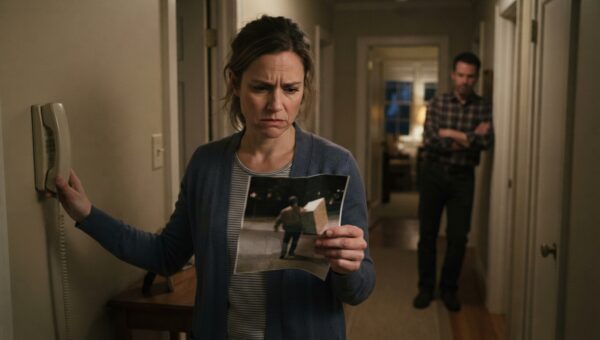
I picked up the wall phone, the heavy cream-colored rotary model that had hung by the refrigerator since 1978, and dialed a number I hadn’t had to use in ten years but still kept written down in the back of my address book in fading blue ink. I didn’t even have to look it up. Arthur Pendelton’s office in Tulsa. Arthur was the kind of man who wore tweed jackets in ninety-degree weather and spoke about calico and batting the way preachers talk about scripture. He had been chasing Mama’s double wedding ring quilt since the regional exhibition in 1984, back when Arthur was just a junior appraiser with ink-stained fingers and I was half my age. Every five years or so, he’d send a polite letter asking if the family was ready to let it go into the state historical archive. Every five years, I had told him no.
The phone rang twice before a crisp, dry voice answered. “Pendelton and Associates, historical textiles. Arthur speaking.”
“Arthur,” I said, leaning my hip against the cool formica counter. “It’s Clara Vance down in Garfield County. You still looking for E.M.W.’s wedding ring?”
There was a sharp intake of breath on the other end of the line, followed by the sound of papers being shoved aside with a sudden, clattering urgency. “Clara? Good Lord. Is the quilt intact? Tell me it hasn’t been laundered in a machine.”
“It’s sitting on a folding table in my driveway in the sun,” I told him, keeping my voice entirely even. “And a man named Vern is currently trying to buy it for ten dollars because he thinks it’s a smelly utility rag.”
Arthur made a sound like a dog choking on a bone. “Vern? Vern from the salvage barn? Clara, put the phone down, lock your doors, and do not let that man touch another square inch of cotton. That piece is documented in the 1986 Oklahoma Folk Art Registry. The State Historical Society has had a $40,000 acquisition rider on it since the museum wing opened in Oklahoma City. If you are selling, I am in my car right now. I have my portable appraisal kit and my checkbook in the glove box. Give me two hours and forty minutes down the Turner Turnpike. Do not let him touch it.”
“I won’t,” I said. “Drive safe, Arthur.”
I hung up the phone and stood there for three seconds, listening to the hum of the refrigerator. Then I walked back out through the screen door, letting it slap shut behind me with a dry thwack that made Vern look up from his card.
He was still standing by the linen table, looking well pleased with himself, holding out the business card with his scribbled ten-dollar figure like he was handing down the tablets from the mountain. He had a smug little grin plastered across his face, the kind of look men get when they think they’ve just robbed a blind man at a church bazaar.
“Decided to be reasonable?” Vern asked, tapping the card against his knuckle.
I didn’t take the card from his hand. Instead, I reached out, plucked the cheap plastic ballpoint pen right out of his shirt pocket, and pulled the card toward me across the folding table. Vern blinked, his grin faltering just a fraction as he watched my hand move across the heavy cardstock. I didn’t write ten dollars. I didn’t write twenty. I wrote forty-five thousand dollars, and I added two zeros and a decimal point just to be thorough, pressing down hard enough that the ballpoint tore a little groove right through the cardboard. Then I slid the card back across the laminate surface until it hit the knuckle of his thumb.
Vern looked down at the numbers. The color drained out of his face so fast he looked like he’d just bit into a green persimmon. His eyes darted from the ink to my face, then down to the quilt, and then back to the card like he was trying to do math he hadn’t learned in school.
“Forty-five…” Vern choked out, his voice cracking on the syllable. “Lady, you’ve lost your mind. That’s an old blanket. Nobody pays forty-five thousand dollars for an old blanket. That’s museum nonsense. That’s, “
“That’s a documented 1934 Depression-era folk art masterwork hand-stitched by Eleanor Mae Wilson, my grandmother, complete with her initials in the bottom right corner,” I said, my voice dropping into that cool, level register I used when a 4-H contestant tried to pass off machine-sewn polyester as homespun wool. “The same quilt Arthur Pendelton from the state auction house in Tulsa has been trying to acquire for forty years. He’s on his way down the turnpike right now.”
Vern opened his mouth, but nothing came out except a dry clicking sound, like a grasshopper trapped in a jar. He looked around the driveway suddenly, as if noticing for the first time that Mrs. Gable from three houses down was standing by my hydrangea bushes with a box of Mason jars in her arms, staring right at him with her mouth pursed into a hard, narrow line. Mrs. Gable had known Mama. She knew what those quilts looked like, and she knew what kind of men like Vern spent their Saturdays hunting for in widows’ yards.
“Now, Clara,” Vern stammered, taking a clumsy half-step backward and nearly tripping over a crate of old paperback books. “I was just… you know how it is in the resale business. You start low, you negotiate. It’s just a joke between us, right? Neighbors having a little fun at a Saturday sale.”
“You weren’t joking when you told Mrs. Gable over there that her depression glass was chipped and worth fifty cents,” I said, not raising my voice an inch, just letting every word drop like a lead sinker into deep water. “And you weren’t joking when you tried to buy Mrs. Henderson’s cedar chest for a five-dollar bill. You’re a vulture, Vern, and you picked the wrong yard today.”
A low murmur went through the three or four neighbors who had drifted over to watch the spectacle. Mrs. Gable crossed her arms over her floral apron and gave Vern a look so cold it could have frozen coffee in a tin cup. Vern’s face went from pale to a dull, mottled red that crept up into the roots of his thinning hair. He looked down at the business card still sitting on the table, snatched it up like it was burning his fingers, and shoved it deep into his pocket.
“You’re crazy,” Vern muttered, his voice trembling with a mixture of humiliation and sudden, greasy panic. “Both of you are out of your minds.”
He didn’t try to buy anything else. He turned around so fast he kicked over an empty plastic crate, muttered a curse under his breath, and practically ran across the gravel toward his rusted-out Ford pickup truck. The transmission whined with a loud, grinding shriek as he threw it into reverse, backed halfway into my neighbor’s ditch, and tore out of the driveway in a cloud of white dust and blue exhaust fumes that smelled of burnt oil.
Nobody said anything for a second after he left, and honestly, that felt better than any speech I could have made. The hot Oklahoma wind just stirred the dust in the driveway, settling it back down over the gravel and the cardboard boxes.
Two hours and thirty-eight minutes later, a dusty black sedan with Tulsa plates pulled up behind my station wagon, and Arthur Pendelton stepped out of the driver’s side wearing a rumpled brown tweed jacket despite the July heat. He had sweat rings under his arms and a leather briefcase tucked under his arm like a Bible, his glasses sliding down his nose as he hurried up the driveway toward the back porch.
“Clara,” Arthur breathed, pulling off his spectacles and wiping them on his tie as he stopped in front of the folding table. “Tell me it’s still here. Tell me Vern didn’t get his greasy hands on it.”
I pointed down to the table. The double wedding ring quilt was still lying right where I had left it, the faded pinks and indigos catching the flat afternoon sunlight, looking like a garden that had somehow survived thirty years of drought. Arthur walked over slowly, like a man approaching an altar, and crouched down until his nose was six inches from the bottom corner. With trembling, careful fingers, he traced the tiny, perfect stitches of the initials E.M.W. 1934 that Mama had left behind in the border.
“My word,” Arthur whispered, his voice dropping into that quiet, reverent tone he used every time he found something that mattered in a state full of things people had forgotten. “It’s even better than the catalog records from eighty-four. Look at the dye consistency in the feed sacks. You can still see the flour mill stamp faintly on the backing if you catch the light just right.”
He stood up, reached into his leather briefcase, and pulled out a thick stack of official museum consignment papers and a golden Parker pen. He didn’t even ask about the price. We both knew what Mama’s work was worth, and we both knew it was never going to end up in a box on a dealer’s floor.
By four o’clock, the quilt was folded into acid-free archival tissue paper and resting securely in the back of Arthur’s sedan, headed for the climate-controlled vaults of the state historical museum in Oklahoma City where it would sit under clear archival lighting with Mama’s full name on the brass plaque. The yard sale wrapped up around five, and by six, the driveway was entirely empty except for the cicadas starting up their dry, rhythmic rattle in the elm trees across the road.
I sat on the back porch with a glass of iced tea, watching the sun drop low behind the water tower down on Fourth Street. The tea was cold and sharp against my tongue, and my knees finally stopped aching for a minute. On the kitchen counter inside, right next to the telephone, I left the scrap of paper where I’d written out the figures for the day. Vern’s ten-dollar offer was crossed out with three firm, angry lines, but underneath it, bold and black and clear enough for anyone to read, was the number forty-five thousand. And beneath that, in Mama’s honor, I had written the only thing that mattered anyway. E.M.W. 1934. Some things don’t lose their value just because the people holding them don’t know how to read the stitches.