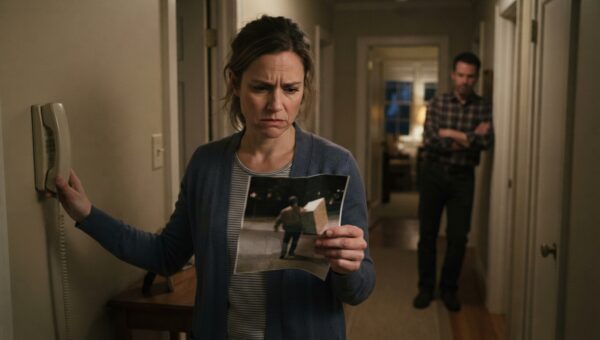
The key to Bernard’s study had a small notch filed into the brass head so he could tell it apart from the cellar key in the dark. For twenty-eight years, that key stayed on his heavy key ring, right beside his truck ignition, and that ring never left the hook by the back door unless it was in his trouser pocket.
March was always the month he turned inward. He would bring home a heavy expandable accordion folder from the post office, stuff it with W-2s and 1099s from his hardware supply accounts, and disappear behind that heavy oak door for three weekends straight. Nobody went in. Not our boys when they were small and wanted to show him a broken bicycle chain, and certainly not me. He always said taxes were a private business between a man and the federal government, and since I handled the grocery money and the electric bills, I never had any reason to argue with him.
The change happened slowly over the winter, like frost creeping up a windowpane. By late February, Bernard could no longer hold his coffee mug without spilling half of it onto the oilcloth table runner, and his handwriting had turned into a shaky, jagged line that looked like barbed wire.
“I can’t grip the pen, Martha,” he told me one morning, staring down at his right hand as if it belonged to a stranger. “You’ll have to take the folder down to Mrs. Gable at the tax service. Tell her to run it just like always.”
I didn’t think twice about it. The snow was just starting to melt off the back pasture, turning the red clay into grease, and I was glad to get out of the house for an hour. Mrs. Gable’s office smelled like stale peppermints and old carbon paper, just like it had when my mother used to bring her farm ledgers in. She took the green folder from my hands, slid her wire-rimmed glasses down her nose, and started tapping at her old desktop computer with two fingers.
I sat in the vinyl chair by the radiator, watching the sleet hit the frosted glass outside.
After about ten minutes, Mrs. Gable stopped typing. She didn’t look up right away, but I noticed her shoulders stiffen under her gray cardigan.
She clicked the mouse twice, very deliberately, and then turned the heavy gray monitor around so it was facing me across the desk.
“A daughter. Is this your daughter?” she asked.
All the air left the small office. My lungs just stopped working. The screen showed a standard federal schedule, but my eyes locked onto the dependent section near the top. There was a name I had never heard in my life, followed by a birth year that made my blood run cold.
“We only have boys,” I said, and my own voice sounded small and thin, like someone else talking from across the room. “Bernard and I only had Richard and Thomas.”
Mrs. Gable didn’t say anything for a long moment. She just watched my face, her eyes filled with that terrible, quiet pity that small-town people reserve for public tragedies.
“Well,” she murmured, tapping the edge of the screen with a fingernail. “There’s been a line item here every single year since nineteen ninety-six.
Three hundred dollars a month, drawn from your joint checking account, routed through an escrow service down in Knoxville. And Martha, look at the address listed for the recipient.”
She reached into the paper tray, pulled out a small dot-matrix printout, and slid it across the blotter toward me.
The address was on a gravel road about four miles outside of Clinton, tucked right against the ridge where the creek bends. It was my mother’s old place. It was the farmhouse where I grew up, the house my younger sister Clara had stayed in after the rest of us moved away, long before she stopped answering my letters and before the property tax notices stopped coming in my family’s name.
The world didn’t spin, and my heart didn’t shatter into a million pieces like something in a storybook. Instead, the kitchen table at home, the way Bernard used to sit staring out the window during the winter of ninety-six, and the long weeks he spent away on that supposed hardware supply trip to Memphis all snapped together with a heavy, sickening click.
“Do you know who lives there now?” Mrs. Gable asked gently, almost whispering.
“My sister Clara lived there,” I managed to say. “At least she did until she went off the grid. But Clara didn’t have a child. Not then. Not ever.”
“Well, someone did,” Mrs. Gable said, and she started gathering up the tax forms, slipping them back into Bernard’s green folder with a soft, sliding rustle. “And whoever she is, she’s twenty-eight years old now. And Bernard has been paying her way through every April fifteenth since she drew her first breath.”
The drive back home took twice as long as it should have. The tires of my old Buick crunched over the gravel in our driveway at precisely 11:14 in the morning, the sound echoing off the metal siding of the machine shed.
When I walked through the back door, the house was dead quiet except for the grandfather clock in the hall wheezing before its strike. Bernard was sitting at the kitchen table, wearing his gray cardigan with the frayed elbows, trying to scrape a piece of dried egg off his plate with a dull butter knife. His hands were shaking so badly the silverware sounded like a tambourine.
“Did Mrs. Gable get the forms?” he asked without looking up. His voice had that flat, careful tone he always used when he was bracing himself for a bad crop or a broken tractor axle.
I didn’t take off my coat. I laid the green folder right in the middle of the oilcloth table runner, square on top of his plate, and then I laid the printed address sheet right beside it.
“Open it, Bernard,” I said.
He didn’t move. His hand stayed frozen on the butter knife, the knuckles swollen and red with arthritis. For a long, terrible minute, the only sound in the kitchen was the refrigerator motor kicking on with a low, vibrating hum.
“Martha,” he started, but his voice cracked right down the middle, like dry pine snapping under a boot.
“Open the folder,” I said again, and this time my voice didn’t shake at all. It felt like cold iron.
He reached out with those trembling fingers, the fingers I had trusted for nearly three decades, and pulled back the flap of the manila folder. He looked down at the top page, then at the small white slip with the address on the creek road, and all the color drained right out of his face until he looked like something carved out of old tallow.
“You went down there,” he whispered.
“I had to take your taxes because your hands don’t work anymore,” I said, leaning down so my face was level with his. “And Mrs. Gable wanted to know why we were claiming a daughter we never had. A daughter living in the house where my sister used to farm.”
Bernard closed his eyes. He didn’t try to pull the papers away, and he didn’t try to lie. He just slumped back in his wooden chair, looking smaller and older than I had ever seen him, like the wind had finally knocked the last bit of starch out of his frame.
“It wasn’t an affair, Martha,” he said, and the words came out rough and ragged, as if they had been sitting in his throat for thirty years waiting to choke him. “I swear to God on everything holy, it wasn’t that.”
“Then whose child is sitting in my family’s old house on three hundred dollars a month?”
“It was Clara’s,” he said, and a tear finally broke loose from the corner of his eye, tracking slow and dirty down the deep wrinkle beside his nose. “Your sister Clara. That winter you and I were nearly split down the middle, when you took the boys and went to stay with your mother in Knoxville for three months… Clara was down at the home place. She was mixed up with some shiftless boy from over in Campbell County who cleared out the minute he found out she was carrying. She was eighteen, terrified, and too ashamed to tell you or your folks.”
The kitchen seemed to shrink around us, the walls closing in until I could smell the dust on the top of the pantry shelves. I remembered that winter with a sudden, painful clarity. The endless grey snow, the silence between Bernard and me that felt heavier than lead, and the month Bernard claimed he had to drive down to the Tri-Cities to settle a lumber dispute for the hardware store.
“She called me at the store,” Bernard whispered, his head bowed down toward the table. “She was hiding in the root cellar. She said she was going to give the baby up to the state, or worse, because she didn’t have a dime for salt, let alone a doctor. She made me promise on my mother’s grave that I wouldn’t tell you, because she knew you and she already had that bad blood between you over the farm division. She said she’d rather die than have you look down on her.”
“And you just took it on?” I asked, my voice dropping to a harsh rasp. “You played the secret benefactor for twenty-eight years behind my back?”
“I couldn’t let your sister’s child go to strangers, Martha,” he said, looking up at me with those old, watery blue eyes that used to make me feel safe in the middle of a thunderstorm. “And I couldn’t tell you back then because you would have packed up the boys and left me for good if you thought I was spending our grocery money on your sister’s secret baby. So I set up the escrow through an accountant friend in Knoxville. I paid the taxes on the home place. I sent the three hundred every month like clockwork. And when the girl grew up, she stayed on the property. She keeps bees down by the creek. She doesn’t even know where the money came from; she just thought the old land trust was still paying out from your grandfather’s estate.”
I stood there by the table, looking down at the man I had shared a bed with for nearly three decades. All those years I thought he was locking his study to hide tax receipts or worry over farm debt, he was really just guarding a ledger of secret kindnesses and lies that kept my own blood alive in the dark.
“She’s my niece,” I said, and the realization hit me like cold well water splashing across my face. “Clara’s girl. My own blood, living four miles down the road, and I drove past that gate a hundred times and never knew.”
“She looks just like your mother around the jaw,” Bernard whispered, staring down at his useless, shaking hands. “I have the pictures in the bottom drawer of the desk. In the biscuit tin.”
I didn’t answer him right away. I walked over to the back door, reached up to the wooden peg where the heavy key ring always hung, and lifted it off the hook. The brass ring felt cold and heavy in my palm.
I carried it down the narrow hall to the locked study, pushed the notched key into the brass lock, and turned it. The latch gave a dry, metallic click that sounded louder than a gunshot in the quiet house.
Inside, the room smelled of old paper, machine oil, and stale pipe tobacco. The metal filing cabinet stood against the wall, its drawers jammed with twenty-eight years of canceled checks, carbon copies, and handwritten letters from Clara that had never seen the light of day. On the corner of the oak desk sat a rusted round tin that once held shortbread cookies.
I didn’t turn on the overhead light. I just walked over to the desk, set the heavy key ring right in the center of the green blotter, and left the study door wide open behind me as I walked back out to the kitchen to call my niece.