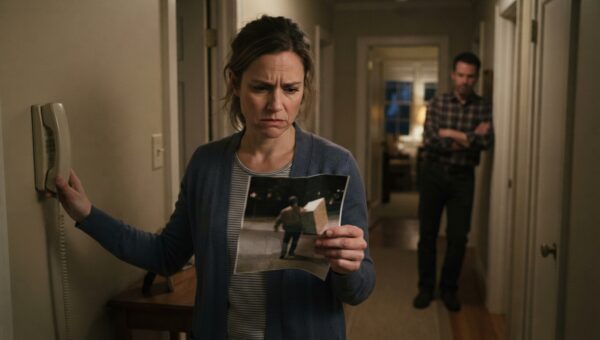
The laminated card sitting on the corner of the kitchen counter had the number for the outpatient lab printed in blue ink right above my own handwriting.
I looked at those eight digits every morning while the coffee brewed, the exact same way I had looked at them every single day since Arthur and I came home from the clinic three weeks ago.
The rain outside was tapping against the kitchen window with a steady, dull rhythm that felt less like weather and more like someone keeping time with a metronome.
When my affair blew up our lives eighteen years ago, I spent the first six months waiting for Arthur to pack his bags or throw mine down the front steps.
Instead, he did something far worse.
He stayed.
He didn’t scream, he didn’t throw plates against the wall, and he certainly didn’t look at me with hate.
He simply erased me from every part of his life while letting me stay in the house.
From that day forward, my husband never touched me again.
No morning hugs, no lingering hand on the small of my back when we passed each other in the narrow hallway, and not a single argument to clear the air.
We became two strangers who happened to share a mortgage, grocery bills, and a set of matching armchairs in the living room.
I told myself his cold politeness was a penance I had earned.
Every time he passed the coffee pot without pouring me a cup, I swallowed the lump in my throat and told myself I deserved it.
Maybe it was mercy compared to the absolute devastation I caused when I wrecked our marriage over a foolish summer mistake that ended almost as soon as it began.
The silence between us became so thick over the years that we could sit across the dining table eating roast beef without saying a single word for forty-five minutes, and neither of us would even blink.
We raised our son, Julian, inside that quiet house, careful to keep the peace for his sake, though Julian was grown now, living two hours away in the city with a job in logistics and a golden retriever.
I thought we had settled into a permanent, frozen truce until the day we turned sixty-five and went in for our routine post-retirement physical exams at the clinic on 4th Street.
The exam room smelled like rubbing alcohol and old linoleum, that particular pale green shade that seems to exist only in doctors’ offices.
Dr. Harrison was an old family practitioner who had known us since Julian was cutting his first teeth, and he usually spent the first ten minutes of any visit asking about our garden or Julian’s latest promotion.
This time, though, he didn’t look up from the thick manila folder resting on his metal rolling tray.
He just turned the pages back and forth with a slow, deliberate thumb, his glasses sliding slightly down the bridge of his nose.
Arthur was sitting straight up on the examination table, his hands resting flat on his knees in that quiet, military posture he always kept.
Dr. Harrison stopped on a full-page lab printout, squinted at the row of small blue numbers near the bottom, and let out a short, confused breath.
He looked right past me and stared straight at Arthur with a furrowed brow.
“Arthur,” the doctor said, his voice dropping into that careful, professional register that doctors use when they are trying to figure out how to phrase bad news. “I am looking at your comprehensive hormone panel and your post-retirement urology workup from last week.”
Arthur didn’t blink. He just watched the doctor with those steady, gray eyes that had stopped looking at me with any kind of warmth nearly two decades ago.
“And?” Arthur asked. His voice was flat, level, and entirely devoid of panic.
Dr. Harrison tapped his pen against the edge of the metal tray once, twice.
“Sir… according to these results, you could never have fathered children.”
My blood turned to ice water in my veins, right there under the fluorescent lights.
My knees gave a sudden, violent lurch, and I had to grab the back of a plastic waiting chair to keep from hitting the floor.
Because in that exact, blinding second, the entire architecture of my life collapsed inward.
Julian was twenty-four years old.
Julian had Arthur’s quiet, stubborn walk, the exact same slight dip in his left shoulder when he was tired, and the same way of holding a coffee mug with both hands.
If Arthur was sterile, and had always been sterile, then the math didn’t just fail.
It destroyed everything.
I couldn’t breathe.
The room felt like it was shrinking, the green walls pressing in until the air turned thick and sour.
Dr. Harrison looked up, finally noticing the way I was swaying on my feet, and started to say something about consulting a specialist to double-check the lab work.
I didn’t hear the rest of it.
I just remember the sound of my own boots clicking against the hallway tile as I walked out of that office before Arthur could even stand up.
The drive home was a blur of gray asphalt and wiper blades, the rain coming down harder now as it battered the windshield of our old Buick.
Arthur drove with his hands placed neatly at ten and two on the steering wheel, his jaw set in a hard, unyielding line.
Not a single word passed between us during those twenty-two minutes on the highway.
When we pulled into the gravel driveway, he killed the engine, got out into the pouring rain without grabbing an umbrella, and walked straight into the garage.
I sat in the passenger seat for five full minutes, staring at the small water droplets racing down the glass, trying to gather enough courage to walk through our front door.
When I finally stepped inside, the house smelled of old wool and floor wax, the familiar scent of a home where nothing ever changed.
Arthur was already standing in his small study at the end of the hall, the door pushed open just enough to let a thin strip of yellow light fall across the hardwood floor.
I walked down the hallway, my heart hammering against my ribs like a trapped bird, and stopped right at the threshold.
He wasn’t sitting at his mahogany desk.
He was standing by the tall bookshelf, holding a worn blue photo album that had been sitting on the bottom shelf since Julian was a toddler.
“You knew,” I whispered.
My voice sounded small, thin, and brittle, like dry twigs snapping underfoot.
Arthur didn’t turn around right away.
He slowly ran his thumb across the edge of the leather cover, his head bowed slightly toward the floor.
“I knew,” he said.
The two words dropped into the quiet room with the heavy finality of a deadbolt sliding home.
He finally turned to face me, and for the first time in eighteen years, I saw something in his eyes that wasn’t just cold indifference.
It was exhaustion.
A deep, bone-weary tiredness that had been carried in secret for more than two decades.
“When?” I asked, and my voice cracked right down the middle, the tears finally spilling over my lashes. “Arthur, tell me when you knew.”
He walked over to the desk, set the photo album down with agonizing slowness, and looked me dead in the eye.
“The day you confessed,” he said evenly. “The day you sat right there in that armchair and told me about him.”
My breath caught in my throat, choking me.
“That afternoon,” he continued, his voice dropping into a low, steady hum, “I went back to Dr. Evans downtown.
The same doctor who ran my post-mumps workup when I was twenty-one years old. I asked him to pull my old file out of the archive. I needed him to look me in the eye and tell me if there was any chance, any medical miracle at all, that I could have made a child.”
He paused, looking down at his own calloused hands.
“He looked at the chart, patted my shoulder, and told me what he told me back then. Zero sperm count. Permanent, irreversible sterility from a bad case of mumps I caught the year before we met.”
I felt like someone had punched me squarely in the chest.
“And you came home,” I whispered, the horror of that long-ago day washing over me in a freezing wave. “You came home to me and Julian, and you didn’t say a word.”
“What was I supposed to do?” Arthur asked, his voice rising just a fraction, the first sign of strain breaking through his armor. “Destroy a six-year-old boy’s entire world?
Walk out the door and let some stranger’s name be whispered in his ear for the rest of his life? Hand him a broken home because of your mistake?”
“You could have divorced me,” I cried out, the guilt tearing through my chest like jagged glass. “You could have thrown me out on the street where I belonged!”
“And risk losing Julian?” Arthur shook his head slowly, stepping closer to the desk. “I didn’t care about the marriage contract anymore. The moment you slept with him, that part of us was dead. But Julian wasn’t. Julian was my boy. I taught him how to throw a baseball in that backyard. I sat up with him for three nights when he had croup. I paid for his braces. Blood doesn’t make a father, Martha. Being there does.”
He looked at me with such fierce, quiet conviction that I had to look away.
“I loved him,” Arthur said softly, his voice softening around the edges. “I loved him enough to swallow my pride, put my anger in a box, and stay in this house every single day so he could grow up safe, loved, and whole. And I did it.”
I sank down onto the small wooden chair by the door, burying my face in my hands as the full, crushing weight of his sacrifice finally broke over me.
For eighteen years, I had lived in a self-pitying fog, complaining about the coldness of my marriage, thinking I was the victim of a cruel, unyielding husband.
In reality, I was living inside a fortress built entirely out of his mercy.
He had taken my betrayal, locked it away in the dark, and spent two decades protecting our son while keeping the roof over our heads.
The silence wasn’t a punishment.
It was the price he paid to keep our family intact without having to look at the woman who tore it apart.
“I’m sorry,” I choked out, the words feeling utterly useless, like trying to bail out an ocean with a teaspoon. “Arthur, God, I am so, so sorry.”
“I know,” he said quietly.
The house fell completely still again, but this time the silence didn’t feel heavy or suffocating.
It felt clean, like the air right after a violent summer storm finally clears out the humidity.
Later that evening, around 7:00 PM, my phone rang on the kitchen island.
It was Julian, calling from his apartment in the city to ask if we wanted to drive up for Sunday pot roast this weekend.
I handed the phone to Arthur without a word, watching him take it with his usual steady grip.
“Hey, kid,” Arthur said into the receiver, a small, genuine warmth creeping into his voice that I hadn’t heard in years. “Yeah, your mother and I would love to come up. Sunday works just fine.”
He listened for a moment, laughed at something Julian said about his dog digging up the landlord’s flower bed, and then hung up the phone.
He set the cell phone back on the counter, right beside the laminated lab card, and looked out the window at the clearing sky.
The rain had stopped.
We didn’t talk about the medical charts anymore that night, and we didn’t need to.
The next afternoon, when the sun finally broke through the gray clouds and dried the wet grass on the lawn, Arthur carried two ceramic mugs of hot tea out to the back patio.
He handed me one without a word, his fingers brushing briefly against mine for the first time since the previous century.
The touch was light, almost accidental, but it stayed there in the air between us.
We sat together on the weathered wooden bench, looking out over the damp garden, two old partners who had finally laid down the heavy, unbearable burdens we carried for half a lifetime.