The envelope arrived on a Tuesday afternoon while Brenda was out at the hardware store. It sat right on top of the pile of junk mail and utility bills, looking entirely ordinary except for the way the postage stamp was licked crooked. I picked it up by instinct, expecting another donation request from the veterans’ charity we give to every fall, but my thumb caught the texture of the paper before I even flipped it over.
Heavy cardstock. Cream-colored, with a deckled edge that cost extra at whatever print shop handled the local high school orders up north.
Thirty years of mail from that address had all been typed on peel-and-stick labels or written in the sharp, sloping hand of my late mother-in-law. Helen had kept us at arm’s length for three decades, sending stiff Christmas letters that detailed every grade David made and every football game he started, never letting me forget that I was the man who packed her grandson up in a Ford station wagon and dropped him off on her front porch like an overdue library book. But Helen passed three years ago. The stroke took her in her sleep, and after that, the holiday cards stopped coming entirely. I figured that was the end of it. I figured the line had gone dead for good.
I turned the envelope over on the laminate counter. My own name and address were written across the front in blue ballpoint ink, pressed down hard enough to leave deep grooves in the paper.
I knew those loops and angles before I even registered who had sent it. It was David’s hand. Not the sloppy, rushed printing of a fourteen-year-old boy stuffing his sneakers into a gym bag, but the steady, deliberate script of a forty-four-year-old man who rarely wrote anything by hand anymore.
I used a butter knife to slice the top open because I didn’t want to tear the edge. Inside was a formal invitation with an embossed gold seal on the cover, announcing that Ethan James Miller would graduate from Oak Creek High School on the morning of May twenty-second. Folded inside the flap was a small square of plain lined paper torn from a legal pad. Four words written in that same heavy blue ink.
He asked for you.
That was all. No signature. No “hope you’re doing well.” Just those four words sitting there in the middle of the kitchen while the refrigerator hummed its low, steady background noise.
I stood there with the card between my fingers, and the thirty years between 1995 and today just kind of folded up like an accordion.
I remember the exact shade of blue the station wagon was when we made that drive north. A dull, faded navy that looked gray in the dust. David sat in the passenger seat with his arms crossed so tight his knuckles looked like peeled garlic, staring straight out the windshield and refusing to look at me when I tried to explain why it had to be this way. Brenda had cried in the kitchen before we left, telling me she couldn’t breathe in the house anymore with the two of us constantly circling each other like stray dogs. She wasn’t a cruel woman. She just had a quiet way of making her misery known, walking through the rooms with her shoulders hunched and her lips pressed into a thin, white line until I felt like I was suffocating under low rafters.
So I chose the quiet house. I told myself it was for his own good. I said it to Brenda when we got back from dropping him off, and I said it to myself in the bathroom mirror every time I shaved, whispering it until I half believed that sending a boy away to be raised by grandparents who barely tolerated me was somehow an act of parental mercy.
The front door clicked open and Brenda walked in carrying a brown paper bag from the hardware store with two new faucet washers sticking out the top. She set it on the counter, kicked off her gardening clogs, and looked at me before she even took off her cardigan.
“You look like you just saw a ghost,” she said. Her voice hasn’t changed much in all these years. Still has that slight raspy edge from thirty years of menthol cigarettes she finally quit back when we turned sixty.
I didn’t say anything right away. I just slid the card across the laminate toward her.
She picked it up, her reading glasses dangling from the cord around her neck. She looked at the printed invitation first, then down at the small slip of legal pad paper. I watched her eyes move across those four words. She read them once, then she read them again, very slowly, the way people read things when they are trying to figure out if there’s a hidden joke underneath.
“David wrote this?” she asked.
“The envelope too,” I said. My voice sounded thin, like dry paper tearing.
Brenda set the card back down right on top of the utility bills. She reached up and touched the frame of her glasses, a little nervous habit she has when things get complicated. “Well,” she said softly. “I suppose that’s the boy.”
“Ethan,” I said. “His son. The one graduating.”
“You haven’t seen him since he was what, two?”
“Three,” I corrected her. “We went up for his third birthday. Helen wouldn’t let me inside the living room until David came out and told her to stop being difficult on the boy’s account. We sat on the porch for twenty minutes and ate dry sheet cake while the kid played with a red plastic tractor in the dirt.”
Brenda looked out the kitchen window toward the backyard where the tomato cages were standing empty in the dirt. “Thirty years is a long time to stay away, Hoot.”
She called me Hoot sometimes when she was feeling soft, an old nickname from back when we worked the lumber yard together in the seventies. It hadn’t sounded right in a long time.
“I didn’t stay away,” I muttered, feeling that old, familiar defensiveness crawl up the back of my neck like an ant. “They didn’t want me around. Every time I called, Helen answered and made it clear I was interrupting whatever peace they’d built.”
“You sent him away, Hoot,” she said, and she didn’t say it meanly. She just said it the way you read a weather report out loud when it’s already pouring rain outside. “You can’t pack a boy up and drop him forty miles north and then act surprised when his grandmother doesn’t bake you a pie every time you drive up the gravel.”
I didn’t argue with her. I couldn’t. Because for thirty years I had used Helen’s coldness as a shield, hiding behind those polite holiday cards and the annual Christmas check sent through the mail like a tax payment for my absence. I had bought my peace cheap, and now the bill had finally come due in blue ink on a scrap of legal pad paper.
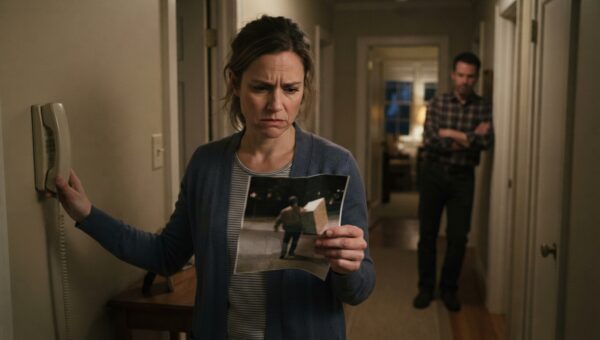
That night I didn’t sleep much. I lay there listening to Brenda breathing softly beside me in the dark, watching the headlights of the occasional logging truck sweep across the ceiling as it took the curve on Route 4. My mind kept looping back to that boy with the red plastic tractor. I wondered what he looked like now. David had my chin and his mother’s heavy brow, but what about this new one? What did an eighteen-year-old kid in Oak Creek see when he looked at a photograph of a grandfather he’d only ever seen twice in a family album?
He asked for you.
Those four words kept tapping against the back of my skull. Not David. David had spent thirty years learning how to live without me, building a life in that northern town with people who remembered his mother before she got sick. It was the boy. Ethan. He must have found some old shoebox of pictures in the back of a closet or an attic, looked at the stranger standing on the porch in the 1995 windbreaker, and decided he wanted that man sitting in the folding chairs behind the gymnasium on a Thursday morning.
By morning my mind was made up, though my stomach felt like I’d swallowed a handful of gravel.
“Where are you going in your good shirt?” Brenda asked from the kitchen table when she came down at seven and saw me buttoning my gray plaid button-down.
“I’m going to drive up there,” I said.
She stopped pouring her coffee, the pot hovering an inch above the mug. “Today? The graduation isn’t until Thursday.”
“I know,” I said, pulling my car keys off the hook by the pantry. “I need to talk to him before the crowd gets there. I’m not walking into a gymnasium full of three hundred strangers without knowing if he’s even going to let me through the door.”
Brenda set the coffee pot down, wiped a drop off the counter with a paper towel, and looked at me for a long, quiet second. “Take the Buick,” she said. “The heater’s acting up in your truck, and forty miles is a long way to drive with cold feet.”
The drive north hasn’t changed much since 1995. The state put in a new bypass back around 2008 that shaved off five minutes, but the old two-lane highway still winds past the same dairy farms and the same rusted-out tractor dealerships where the paint has peeled off to bare red primer. I kept the radio off the whole way. I just listened to the hum of the tires on the asphalt and watched the mileage markers tick down by tens. Thirty miles. Twenty miles. Ten miles.
When I pulled into the gravel parking lot behind Oak Creek High School, my hands were shaking so bad I had to sit with my palms pressed against the steering wheel for two minutes before I could turn the ignition off. The lot was already half full of pickup trucks and compact sedans with bumper stickers from half a dozen local community colleges. A group of kids in black graduation gowns were standing near the side entrance smoking cigarettes behind a utility shed, laughing too loud the way teenagers do when they think nobody important is watching.
I got out of the Buick and walked toward the gymnasium doors. My boots crunched on the gravel, a sound that felt entirely too loud in the morning air.
I didn’t have to look for David very long. He was leaning against the side brick wall of the gymnasium, holding a large cardboard box full of extra folding programs under one arm. He looked older, naturally, with gray creeping into the sides of his close-cropped brown hair and lines around his eyes that weren’t there when I saw him last at his mother’s funeral ten years ago, but the way he stood, weight shifted onto his left foot, right hand tucked into his pocket, was identical to the way I stood every time I waited for the lumber truck to back into the yard.
He saw me coming about twenty feet away. He didn’t drop the box, and he didn’t run. He just stopped moving and waited, his eyes fixed on my face with a flat, careful look that told me he’d spent a lot of years figuring out how to keep his distance.
I stopped about six feet away from him. The wind kicked up a little bit of dust from the parking lot, blowing a dry oak leaf across the toe of my boot.
“David,” I said. My voice came out rough, like I needed to clear my throat.
“Hoot,” he said. He didn’t call me Dad. He hadn’t called me that since the day we drove up in the navy station wagon. But he didn’t tell me to turn around and go home either.
“I got the invitation,” I said, gesturing vaguely toward my shirt pocket where the four-word note was folded up.
David looked down at the concrete for a second, then back up at me. “Ethan found an album in the top of the cedar chest last month,” he said, his voice completely level. “Pictures from before we moved up here. He asked who the man in the blue windbreaker was.”
“What did you tell him?”
“I told him the truth,” David said. “I told him you were my father, and that you lived forty miles south, and that we didn’t have much to say to each other after I was fourteen.”
I felt that old weight settle right behind my ribs, heavy and hot. “He didn’t have to invite me, David. I know I didn’t earn a seat in that gym.”
David shifted the cardboard box to his other arm. He looked at me for a long time, studying my face the way I had studied his envelope the day before.
“He didn’t ask for a grandfather who sent me away,” David said quietly, and every word was like a small, clean cut. “He asked for the man whose picture was in the book. He’s eighteen. He thinks people can change their minds if you give them half a chance.”
He reached into his pocket, pulled out a heavy brass key on a split metal ring, and held it out toward me. The metal was worn smooth around the edges where it had rubbed against his pocketknife for years.
“My truck’s in the side lot,” David said, his voice dropping a little softer. “Drive it back to your house, pack a bag, and come back on Sunday. Use the front door this time. It’s unlocked at five.”
I took the key from his hand. His fingers brushed mine for a second, calloused and warm, the exact same skin I used to carry around the hardware store on my shoulders when he was small enough to fit inside a single arm.