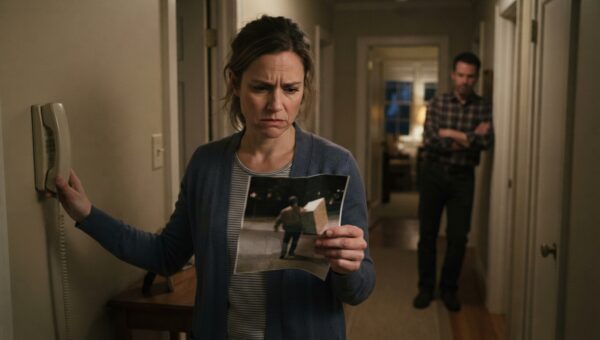
“Your brother isn’t the only one on that payroll. The fifth name is your…”
The sentence hung in the heavy, yellowed air of my mother’s dining room like a drop of grease hitting a hot burner. The roast chicken on the platter between us was already cooling, the skin turning gray around the edges. Nobody moved. Marcus kept his fork pressed flat against the white ceramic of his plate, his knuckles showing white underneath the kitchen light.
Brenda didn’t even look up from her lap, her fingers worrying the hem of her napkin until the linen frayed.
For twenty-two years, Marcus ran the family restaurant. He was the golden boy who stayed behind to keep our father’s name alive on the marquee while I built a life two states away. We pulled in $1.2 million a year at our peak. When Marcus finally handed me the keys and the binder of retirement papers six months ago, he told me the market had dried up and the post-pandemic years had bled us dry. He showed me the ledger with $340,000 in outstanding supplier debt and told me it was my turn to carry the family weight. I spent my savings taking over the title because I believed in the bloodline. I believed the restaurant was just an old, tired engine that needed a new mechanic.
Then Karen showed up at my front door on a Tuesday morning with a heavy cardboard box.
Karen had been our head bookkeeper for fourteen years until Marcus fired her over a disagreement about supply invoicing.
She didn’t look like a whistleblower. She looked like a tired woman who had spent too much time under fluorescent lights. She didn’t waste time with pleasantries when I opened the screen door. She just set the box on my porch and opened the top flap.
“Your brother fired me because I found something,” Karen told me, her voice flat and steady. “And you need to look at these before you sign another line of credit for that building.”
She had pulled unredacted banking logs and master payroll schedules spanning eleven years. The restaurant had run four ghost employees, names of people who never flipped a burger, never wiped a table, never clocked a single hour. Every two weeks, checks went out to them like clockwork. Over eleven years, those four phantom workers pulled out $780,000. And every single cent of it landed in a joint checking account belonging to Marcus and his wife, Brenda.
I didn’t sleep for three days after Karen left. I cross-referenced the tax filings with the state portal. I sat at my kitchen island with a red pen until my hand cramped, tracing the math of a restaurant that supposedly went under while siphoning nearly a million dollars into personal accounts. By the time Sunday rolled around, I wasn’t just angry. I was cold. I drove over to my mother’s house with the printouts tucked inside a black leather folder on the passenger seat, ready to blow the roof off the whole operation.
Dinner started with the usual suffocating politeness. My mother, Evelyn, ladled out gravy with the slow, deliberate care of a woman who believed her kitchen was a sovereign state. Marcus talked about his golf game. Brenda talked about her hydrangeas. I sat there watching them, waiting for the right moment to drop the folder on the mahogany table.
I didn’t wait until dessert. Midway through the meal, when Marcus reached for the salt, I slid the payroll records across the wood. They stopped right next to his water glass.
“Eleven years of ghost employees, Marcus,” I said, my voice barely louder than the hum of the refrigerator. “Four names pulling down seventy grand a year apiece straight into Brenda’s account. The business didn’t fail. You drained it.”
Marcus put his fork down with a sharp clink. The silence that followed was heavy and absolute.
“The business was failing,” Marcus muttered, not meeting my eyes.
“With $780,000 in ghost payroll?” I shot back. “You didn’t just mismanage the books. You robbed the register for over a decade and then handed me the remaining $340,000 debt like a parting gift.”
Brenda kept her head down, staring at her napkin. That was when my mother, Evelyn, stepped in. She didn’t blink. She didn’t look surprised. She just took a slow sip of her water, set the glass down with a faint click, and told me to leave it alone.
I turned on her then, because the look in her eyes wasn’t shock. It was management.
“You knew?” I asked.
And that was when she dropped the sentence that stopped the room. “Your brother isn’t the only one on that payroll. The fifth name is your…”
My mother stopped right there, letting the silence finish the thought for her. She didn’t have to say the last word. My brain supplied it before the air even settled.
I stood up so fast my chair tipped back and hit the drywall with a dull thud. “My what? Say it.”
Marcus finally looked up, his face flushed and greasy under the kitchen lights. “Sit down, Leo. You don’t know what you’re talking about.”
“Try me,” I said, leaning over the table so my hands flat-palmed the polished mahogany. “Who is the fifth name? Because I have eleven years of bank routing numbers right here, and I am calling the state police tonight if I don’t get an answer in the next ten seconds.”
My mother didn’t flinch. She picked up her cloth napkin, folded it twice with maddening precision, and laid it beside her plate. She looked old in that light, but she also looked like she had been holding a heavy stone for twenty-two years and was almost relieved to finally let it drop.
“Your father didn’t walk out on us to Florida, Leo,” Evelyn said softly. “He didn’t leave us stranded when you were twelve.”
The words felt like someone had dumped a bucket of ice water down my spine. For two decades, the story in our family was simple. Arthur, our father, packed a suitcase one Tuesday morning in October, cleaned out the joint savings account, and caught a bus south because he couldn’t handle the pressure of opening the restaurant. It was the founding myth of our household. It was the reason Marcus was pushed into the kitchen at eighteen and why my mother became the iron matriarch of the family.
“What are you talking about?” I whispered. The anger in my chest suddenly turned into something hollow and cold. “He sent postcards for two years.”
“He sent them from a post office box in Toledo because I told him to,” Evelyn said, her voice terrifyingly calm. “When we started the restaurant, your father partnered with a silent backer who turned out to be mixed up in some very bad local loans. When the debts came due, they weren’t business debts. They were mob-connected. If we didn’t pay them off, they were going to take the building, the house, and everything we owned.”
Marcus rubbed his face with both hands, smearing sweat across his forehead. “Mom had to buy him out quietly to keep the lien off the property. Dad took the blame and left town so the creditors wouldn’t come after the family. But he didn’t disappear. He needed housing, medical care, and a living allowance every month for the rest of his life.”
“So you put him on the restaurant’s books?” I said, my voice shaking as the pieces started clicking into a pattern I never wanted to see. “For eleven years?”
“For twenty-two years,” Evelyn corrected. “Marcus just found a way to keep funding it after the cash flow slowed down. The first four names were dummy accounts to hide the transfers from the corporate auditors. The fifth name, the main account that received the bulk of it every month, belonged to Arthur. Your father.”
I looked from my mother to my brother. The room seemed to tilt slightly on its axis. All those years I spent working summer shifts while going to college, all those times Marcus told me we had to tighten our belts and skip bonuses, all of it was funding a ghost living in a cheap apartment three states away while my mother played the betrayed widow.
“You sank the business,” I said, pointing down at the manila folder. “You ran it into the ground with three hundred and forty thousand dollars of fresh debt just to keep paying off a man you told me was dead to us.”
“We didn’t have a choice,” Brenda finally spoke up, her voice small and tight. “If those old debts came to light, the courts would have seized everything, including this house. Your mother’s name was on the original predatory loans. She would have lost her home at seventy-eight years old.”
I looked at Brenda, then down at the papers on the table. The anger didn’t come back. Just a heavy, suffocating exhaustion. They had built a fortress out of lies, and when the walls finally cracked, they handed the rubble to me.
“You’re not putting this on my credit,” I said quietly, backing away from the table. “I am not paying off three hundred and forty thousand dollars of supplier debt while you people protect a forty-year-old secret.”
“Leo, wait,” Marcus started, standing up from his chair.
“Don’t,” I said, holding up a hand. “I’m calling the corporate lawyer in the morning. We are auditing every single asset, including this house. If those debts are tied to the restaurant corporation, we liquidate everything to clear them. Every last piece.”
My mother looked at me then, her eyes hard and unyielding, the matriarch to the very end. “You do that, and you drag your father’s grave into the open. The whole town will know.”
“Let them,” I said.
I left the folder right where it was on the table, walked out the front door into the humid evening air, and didn’t look back once.
It took four months of forensic accounting, three angry meetings with our family attorney, and the threat of criminal fraud charges before Marcus and Brenda finally cracked. They were forced to liquidate their personal investments, drain their retirement accounts, and sign over the deed to a rental property they owned to cover the $340,000 supplier debt. My mother’s financial control over the family was permanently severed, her bank accounts audited and stripped of any lingering corporate ties.
The restaurant didn’t survive. There was no grand reopening, no triumphant turnaround. The building was sold off to a commercial developer who planned to tear it down for a parking lot.
On the final day before the handover, I drove down to the empty property alone. The dining room was dark, the tables stripped of their red-checkered cloths, the kitchen silent except for the low hum of the pilot lights in the old stoves. I walked across the scuffed linoleum floor where my brother and I had spent half our lives shouting orders across the pass-through window.
I unlocked the heavy glass front door, stepped outside into the glaring afternoon sun, and pulled the deadbolt shut from the outside. I slid the metal key ring into the brass slot of the drop-box by the frame, letting it fall with a sharp, final clatter against the metal bottom. I stood there on the empty sidewalk for a long moment, watching the traffic roll by on the highway, before turning around and walking to my car for the last time.