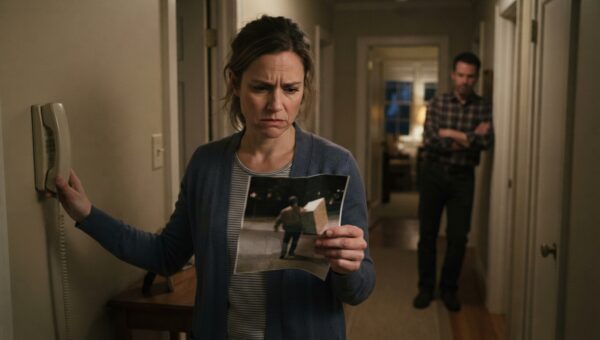
Five years. Three nights a week. The exact same highway exit, the same sliding glass doors, the same smell of commercial carpet cleaner and stale lobby coffee.
My husband, Freddie, told me the logistics coordinating job required him to stay over in Syracuse three nights a week to manage the overnight freight transfers at the regional terminal. He had a gold Marriott Bonvoy card and a preferred room preference, high floor, away from the ice machine.
I never had a reason to doubt him because he brought home a steady paycheck, kissed me on the top of my head every Monday morning before the sun cleared the garage roof, and smelled faintly of Old Spice and cold diesel exhaust.
The fracture started on a Tuesday afternoon at 2:14 in the kitchen while I was wiping down the laminate counters with a damp sponge. Our twentieth wedding anniversary was coming up on Friday, and I wanted to surprise him by driving up, checking into his hotel under our shared account, and waiting for him with a bottle of the Cabernet he liked. I dialed the toll-free number from memory, gave the clerk his name and our member number, and asked to be placed in the room next door or upgraded if possible.
There was a long click on the line, followed by the dry rustle of hotel software keys tapping against a plastic keyboard.
The desk clerk, a young woman whose voice sounded entirely too bored for what she was about to drop into my lap, paused for three seconds.
“Which reservation would you like me to look at, ma’am? He has two rooms booked for this week.”
I stopped wiping the counter. My hand stayed pressed against the green sponge, water soaking through the corner onto my thumb.
“Two rooms,” I said. It wasn’t a question, though it came out sounding thin and stupid. “He travels alone. Why would he have two rooms?”
“I’m sorry, I shouldn’t have said anything about the secondary block,” she stammered, the professional script slipping instantly. “Mr. Vance maintains a corporate tier suite and a secondary executive workspace under a corporate subsidiary account. That’s all I see on the manifest.”
“What is the number of the secondary room?” I asked. My voice didn’t sound like mine. It sounded like an old radio tuned between two stations.
“Ma’am, I really am not authorized to, “
“Give me the number,” I said, and the tone in my own throat scared me enough that the clerk sighed and gave it up without another fight.
“Room 314. But he checked in an hour ago.”
I hung up the phone. I didn’t scream, and I didn’t throw the sponge.
I just walked out to the garage, got into my Buick, and drove seventy-two miles north with my knuckles welded to the steering wheel until my fingers turned the color of lard.
When I pulled into the Marriott parking lot, the asphalt was greasy from a light afternoon mist. I didn’t go inside the lobby. I sat in my car for two hours with the engine idling and the heater ticking, watching the third-floor windows on the eastern corner of the building. Nothing moved except the gray clouds hanging low over the interstate overpass.
At 4:42, a housekeeping cart rattled out of the side service exit, pushed by an older woman in a navy smock with gray hair pinned up in a messy bun. I killed the engine, got out, and intercepted her near the dumpster enclosures where the smell of wet cardboard and old coffee grounds hung heavy in the damp air.
“Excuse me,” I said, stepping into her path. She stopped the cart, her eyes narrowing with the defensive weariness of someone who had dealt with too many hotel guests missing dry cleaning. “I need to talk to you about room 314.”
The woman froze, her hand still resting on the metal handle of the supply cart. Her jaw tightened, and she looked past my shoulder toward the lobby doors as if checking to see if a supervisor was watching.
“I’m not supposed to talk about guests,” she said, her voice raspy from years of inhaling bleach and carpet powder. “Management has strict rules about privacy.”
“My name is Arlene Vance,” I said, pulling out my driver’s license and holding it flat against my palm. “That’s my husband’s room up there. Or one of them. Talk to me before I walk through those front doors and make a scene that gets you both called into the manager’s office.”
The maid, whose nametag said Elena, stared at the plastic card for three long seconds. She let out a short, bitter puff of air that formed a white cloud in the chilly air.
“Room 314,” Elena muttered, shaking her head. “Every single week. He checks in at four. A woman checks in twenty minutes after him using a different keycard. She always parks her sedan around the back by the emergency exit so the cameras don’t catch her plate.”
My stomach didn’t drop. It felt like it filled up with molten lead, heavy and burning. “A woman.”
“Every week for three years,” Elena said, leaning closer to the cart. “And she tips me a hundred-dollar bill every Friday morning when I come in to service the room. Wants fresh linens every single day, twice a day sometimes. Do you have any idea how much twenty-four hundred dollars in cash looks like over five years? Well, more like twenty-six thousand total counting the holiday bonuses she handed out.”
“Twenty-six thousand dollars in tips,” I whispered.
“That’s what she paid me to keep my mouth shut and change the sheets without asking questions,” Elena said, reaching into the deep pocket of her navy smock. “She thought I was stupid. Thought I didn’t notice what was going on in there. But people leave things behind when they’re rushing to sneak out before checkout time.”
Elena pulled out a cracked smartphone, tapped the screen twice with a thumb calloused by dish soap, and held it out toward me.
“Last month, she left her leather folio under the armchair cushion by the window,” Elena said. “I opened it to find an ID to put in lost and found, but I looked at the picture first.”
I squinted down at the glowing screen. It wasn’t a jewelry receipt, and it wasn’t a romantic card. It was a heavy plastic ID card hanging from a silver ball chain, bearing the gold seal of the state government. The bold black letters across the top read *OFFICE OF THE DISTRICT ATTORNEY, SPECIAL INVESTIGATIONS DIVISION*. The name beneath it was Agent Sarah Miller.
My husband was a corporate logistics coordinator for a mid-sized freight broker in Syracuse. He moved palletized paper and industrial fasteners. He didn’t know anyone in law enforcement. He didn’t even have a parking ticket on his record.
“My husband is currently under investigation for what?” I asked, my voice shaking so hard the words barely came out.
“I don’t know the criminal part,” Elena said, pulling her phone back and slipping it into her pocket. “All I know is that woman spends four hours in room 314 with him every Tuesday afternoon, and they aren’t sleeping. They’ve got file boxes stacked halfway up the curtains.”
I left Elena by the dumpster, walked through the automatic sliding doors of the Marriott, and took the elevator to the third floor. My boots made no sound on the industrial red hallway carpet.
Room 314 had a “Do Not Disturb” sign hanging from the brass knob, but when I pressed my palm against the wood, the latch gave a soft, loose click. Freddie hadn’t seated the deadbolt properly.
I pushed the door open four inches and stopped breathing.
The room didn’t smell like hotel lavender or cheap room spray. It smelled like toner ink, hot electronics, and old paper. The king-sized bed had been pushed entirely against the far wall to make room for two folding tables covered in black wirebound binders, three laptop computers plugged into a multi-port surge protector, and a gray encrypted server box with blinking amber lights.
“I told you the side deadbolt needs to be thrown every time we close the log,” a woman’s voice said from the small bathroom alcove.
I stepped inside, my foot crunching on a discarded zip-tie wrapper.
Agent Sarah Miller stepped out of the bathroom holding a plastic cup of tap water. She wore a sharp charcoal blazer over a silk blouse, her dark hair pulled back into a severe clip. She froze halfway across the carpet, her eyes dropping from my face down to my wedding ring, then back up. She didn’t reach for a gun. She just let out a long, slow sigh that sounded like someone who had been waiting for an inevitable wreck to finally happen.
“You must be Arlene,” she said quietly.
Before I could answer, the connecting door from room 312 clicked open, and Freddie walked through carrying a stack of yellow manila folders. He looked older than he had on Monday morning. His hair was grayer at the temples, and the skin around his eyes had the permanent, pinched look of a man who hadn’t slept a full night since the first Bush administration.
Freddie saw me standing by the door. The manila folders slid out of his hands, hitting the commercial carpet with a heavy, muffled thud that scattered paper clips across the floorboards.
“Arlene,” he whispered. His hands came up empty, palms forward, like he was facing an animal he didn’t want to startle. “How did you find this place?”
“You have two rooms,” I said, and the words felt small and ridiculous in a room full of federal surveillance gear. “You told me you were managing freight transfers. You’ve been spending twenty-six thousand dollars in cash on hotel tips for five years.”
“That was state asset recovery funds, Mrs. Vance,” Agent Miller said, stepping smoothly between us without raising her voice. “Every cent of the tip money was accounted for in the quarterly audit logs. Though I admit we should have told the housekeeping staff to keep their mouths shut.”
“Tell me what my husband is doing in a hotel room with the District Attorney’s office,” I said, looking straight at Freddie. “Right now. Or I walk out this door, call the county sheriff myself, and let them sort out what kind of cartel you’re running.”
Freddie looked at Sarah Miller. The investigator gave a single, microscopic nod.
“Sit down, Arlene,” Freddie said, his voice cracking on my name. He pulled out one of the metal folding chairs from beneath the stack of binders. “Please. Just sit down and let me show you the paperwork before you call anyone.”
I didn’t sit. I stood by the door with my arms crossed over my chest, staring at the gray server box blinking against the wall.
“Two years ago,” Freddie began, his hands trembling as he picked up one of the scattered manila folders and laid it flat on the table. “Our company, NorthStar Logistics, wasn’t just moving paper. The executive board set up a multi-million-dollar kickback and freight-skimming ring. They were billing federal shipping contracts for phantom loads and siphoning the difference into offshore accounts in the Caymans.”
“You coordinate freight,” I said. “You don’t run the board.”
“I was the one who signed off on the manifest adjustments,” he said, and his voice dropped to a flat, dead register that sounded like a confession read at a funeral. “When the state auditors flagged the discrepancies two years ago, they came to my office at four in the morning. They had every routing slip I’d signed since 2019. They gave me a choice, Arlene. Ten years in federal prison for wire fraud and corporate conspiracy, or wear a wire, turn over every internal ledger, and help them build a RICO case against the executive suite.”
I stared at him. The gray temples, the tired eyes, the Monday morning goodbyes.
“You turned informant,” I said.
“If I didn’t, they would have seized our house, our retirement accounts, and everything we spent thirty years building,” Freddie said, his voice breaking. “Agent Miller set up this room under a secure operational alias so we could review the wiretaps and financial logs away from the corporate office. The company hired private security firms to sweep our home office twice a year. We couldn’t meet at my desk. We couldn’t meet at her office downtown without setting off alarms. This Marriott was the only neutral ground with secure high-speed fiber lines.”
“And the second room?” I asked, pointing toward the connecting door.
“Room 312 is where I sleep when the document transfers run past midnight,” Freddie said quietly. “I haven’t been sleeping at home three nights a week, Arlene. I’ve been sitting here with a forensic accountant tracing fifty million dollars in stolen state infrastructure funds so my family doesn’t lose everything.”
Agent Miller walked over to a locked aluminum briefcase sitting on the edge of the desk, popped the combination locks with two sharp clicks, and pulled out a thick document bound in blue cardstock. She laid it across the table beneath the fluorescent light.
“Here is the federal cooperation agreement signed by the United States Attorney for the Northern District of New York,” Sarah said evenly, turning the page to show a series of red wax stamps and signatures. “Your husband has been working as a primary cooperating witness for twenty-four months. The final indictments against the executive officers of NorthStar Logistics are scheduled to drop next Tuesday morning at 9:00 AM.”
I walked over to the table. I picked up the document, my eyes scanning the dense legal paragraphs until I saw Freddie’s signature at the bottom, written in his familiar, sloping cursive. It was real. The immunity clause was stamped in red ink across the final page.
“Next Tuesday,” I repeated.
“Once the indictments are filed, my undercover role is terminated,” Freddie said, standing up and taking a step toward me. His shoulders were finally down, the rigid posture of a man carrying a secret boulder for two years giving way to something fragile and hollow. “The company will be seized by federal receivers. My employment there ends the moment the marshals serve the warrants. But we keep our home. We keep our pensions. And I am finally done lying to you.”
I looked from Freddie to Agent Miller, then back to the gray server box blinking rhythmically against the Marriott wallpaper.
“If I find out there’s another lie,” I said, my voice cold enough to freeze water, “I won’t just call the sheriff. I’ll pack the Buick tonight and you can explain your federal immunity to an empty house.”
“There are no more lies, Mrs. Vance,” Sarah Miller said, closing the aluminum briefcase with a solid, definitive snap. “The operation concludes on Tuesday.”
We drove home in separate cars. Freddie followed behind my Buick all the way down Interstate 81, his headlights cutting a steady, yellow path through the drizzle.
That evening, after we sat in the kitchen in a silence so thick you could have sliced it with a butter knife, Freddie walked over to the hallway table and emptied his pockets. He set his secondary encrypted laptop, the corporate badge, and the brass hotel key card for Room 314 down on the wooden surface next to the mail holder. The metal key made a small, dry clinking sound against the wood, quiet and final in the empty house.
He didn’t say anything. He just looked at me across the kitchen table, waiting for whatever came next.