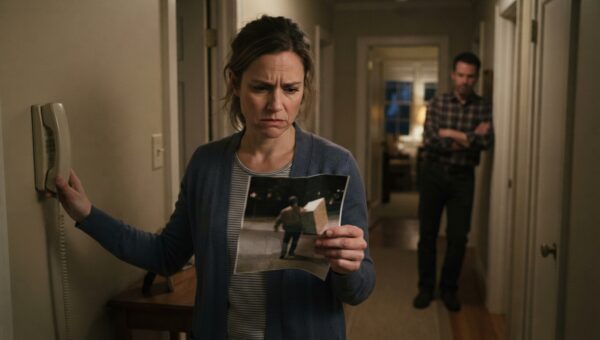
The autumn morning air always smelled of damp oak leaves and old exhaust pipes by the time I pulled my sedan up to the curb outside the primary school. My daughter Sonia was swinging her small canvas lunchbox back and forth against her knee, humming some tune she had learned in music class, completely unaware of the sudden silence that had dropped over the front seat.
I stared straight ahead at the brick facade of the building, my hands locked hard against the steering wheel.
“Dad, who is that man who always touches Mom’s body with a red cloth every time you sleep?”
She asked it just like that. No hesitation, no lowering of her voice, just a simple observation tossed out between two bites of an apple. I froze the moment I heard those words. My foot slipped half an inch off the brake pedal before I caught myself. The car jerked slightly against the transmission.
“Sonia, what are you saying? Where did you hear such nonsense?” I asked, my voice coming out tighter and louder than I intended.
“Dad, it happens every night when you’re sleeping in Mom’s room with you,” she said matter-of-factly, as if she were telling me about a stray cat she saw by the fence. “And Mom doesn’t say anything. She just closes her eyes.”
“Stop! Don’t ever say that again!” I warned her.
We rode the rest of the way in heavy silence until we reached the school drop-off lane. I watched her unclip her seatbelt and hop out onto the pavement, offering a little wave before she joined the line of kids shuffling toward the double doors. I pulled away from the curb, but the engine hum felt muffled, as if my ears had suddenly filled with water. A cold, heavy knot formed right behind my ribs.
I did not drive straight to the warehouse. Instead, I turned the car around and headed back toward our quiet street, my mind racing through every impossible scenario. Elena and I had been married for twelve years. We had built our life on steady, predictable routines, working opposite shifts so one of us was always home with Sonia. The thought of someone else entering our house in the dark, moving through our bedroom while I lay dead to the world from sheer exhaustion, made my stomach turn over.
When I unlocked the front door, the house was completely still. The morning sun was just starting to slant across the worn hardwood floors of the hallway. I walked straight back to our bedroom, my boots clicking softly against the planks. The bed was made, the heavy quilt pulled tight across the mattress. Everything looked normal. Too normal.
I knelt down beside the nightstand and began checking the lower shelves, then moved to the guest room across the hall. At the bottom of the linen cupboard, shoved far back behind a stack of scratchy wool blankets we never used, my fingers brushed against something cold and foreign. I pulled it out into the light. It was a heavy plastic medical tube with prescription labels peeled halfway off, alongside a thick pad of heavy-duty thermal wraps. The chemical smell of wintergreen and strong medicinal camphor hit the air instantly.
My chest tightened until it hurt. I sat back on my heels on the floorboards, turning the tube over in my palm.
The name printed on the faded label was Elena’s, but the prescribing doctor was out of a neurological clinic three towns over, a specialist we certainly never had the spare money to visit.
I spent the next several hours pacing the kitchen, staring out the window at the empty backyard. When Elena came home from her afternoon shift at the community library, she looked as composed as ever, though her shoulders were dropped just a fraction lower than usual. She managed that same soft, tired smile she always gave me when I walked through the door.
“You’re home early,” she said, setting her canvas bag on the counter. “Is everything all right at the yard?”
“I didn’t go in,” I said, keeping my voice as flat as I could manage. “Sonia talked to me this morning in the car.”
Elena paused, her hand hovering over the strap of her bag. The color seemed to drain from her cheeks in a single steady pulse, though she tried to keep her chin up. “What did she say?”
“She told me about the man who comes into our bedroom at night with a red cloth.”
The kitchen grew so quiet I could hear the hum of the refrigerator motor from down the hall. Elena did not deny it. She closed her eyes for three long seconds, and when she opened them, the defiance had completely gone out of her face, leaving behind only an exhausted, brittle sort of shame.
“I didn’t want you to know,” she whispered.
“You didn’t want me to know that a stranger is in our house while we sleep?” I raised my voice then, the panic finally breaking through the shell of my control. “Elena, what is going on here? Who has been coming into our room?”
“Not a stranger,” she said, her voice shaking as she sank into one of the wooden kitchen chairs. “It’s David. David Miller.”
I stared at her, trying to connect the name. David was a quiet, unassuming man who had run a small physical therapy clinic down by the river for years. He had known Elena’s father back when the old man was still alive.
“David?” I repeated, shaking my head. “Why would David be in our room at two in the morning?”
“Because I couldn’t walk, Gordon,” she said, and her voice broke on the last word.
She rolled up the sleeve of her cardigan, revealing a forearm mottled with faint, dark bruising along the muscle line. Then she reached down and pulled off her left shoe and sock. Her ankle and the lower part of her calf were swollen, the skin pulled tight and glossy over inflamed tissue.
“Four months ago, the spasms started,” she said, staring down at her lap. “Severe neuropathy and nerve inflammation in the spine. By midnight, my legs just… lock up. The pain is like fire, Gordon. I can’t move them, and I can’t sleep. If I scream out, it wakes you up, and you’re already working sixty hours a week trying to keep us afloat. I couldn’t bear the thought of you carrying my body on top of everything else.”
The anger that had been burning in my chest sputtered out, replaced by a cold, heavy wave of grief. I pulled out the chair opposite her and sat down, resting my elbows on the table.
“So you called David?”
“He does palliative home therapy,” she whispered. “He’s certified in specialized infrared heat compression. He comes in through the side porch door so he doesn’t wake the house. He uses those heated red wool flannel wraps soaked in herbal salves to force the muscles to release. It takes forty minutes of agonizing pressure every single night just so I can straighten my legs by morning.”
“And you just suffered through it in the dark?” I asked. “Month after month?”
“I kept my eyes closed because if I looked at you sleeping there, knowing how hard you were working for us, I wouldn’t have been able to stay quiet,” she said, a tear finally spilling over her lashes and tracking down her cheek. “I am so sorry I kept it from you. I was just so scared of being broken.”
That evening, the dinner table felt different. Sonia sat between us, chattering happily about her spelling test while Elena buttered her toast with fingers that trembled only slightly. I watched Elena closely, noticing for the first time the way she subtly shifted her weight to ease the strain in her lower back, a habit I had mistaken for ordinary tiredness for months.
After we put Sonia to bed and the house settled into its usual nighttime quiet, I did not go straight to sleep. I lay awake beside Elena in the dark, listening to the steady rhythm of her breathing. The grandfather clock in the hall struck 1:30, then 1:45.
At precisely 2:00 AM, the floorboards near the side porch gave a soft, familiar creak.
I slipped out from under the covers without waking Elena, moving quietly down the dim hallway. A sliver of light cut across the floor of the sitting room. David stood by the side of our bed, holding a steaming, thick red wool wrap in his hands, his face tight with professional concentration as he prepared to lower it onto Elena’s trembling lower spine.
I stepped into the doorway and flicked the wall switch.
The lamp flared, casting a sharp yellow light across the room. David froze, the red cloth held half an inch above Elena’s skin. Elena gasped, pulling the sheet up to her chin, her eyes wide with terror.
“Gordon,” David said, his voice low and steady, hands remaining entirely open and visible at his sides. “I’m sorry. I told Elena we should have told you from the start.”
I walked across the room, my boots making no sound on the rug, and placed my hand firmly over the top of the steaming red flannel wrap, stopping him. David looked up at me, his eyes tired and kind, showing no guilt, only the heavy burden of a professional helping a friend in secret.
“It stops tonight, David,” I said, keeping my voice level, though my throat felt thick. “I appreciate what you’ve done for her. More than you know. But she isn’t doing this alone anymore.”
David looked from me to Elena, then slowly nodded. He folded the red cloth, placed it carefully into his insulated thermal bag, and zipped it shut. “The clinic bills can be scheduled through regular daytime hours, Gordon. You don’t have to carry the whole weight of this world by yourself either.”
After David let himself out through the side door and the latch clicked shut into the frame, the room felt lighter than it had in months. Elena was crying softly into her pillow, her shoulders shaking with the release of four months of accumulated fear.
I sat down on the edge of the mattress, slid my arms under her, and pulled her against my chest. She buried her face in my shoulder, her hands gripping my shirt the way a drowning person grabs a lifeline.
“We are going to handle this together,” I told her, my voice rough against her hair. “Every single part of it. No more secrets in the dark.”
The next morning, the sunlight streamed bright and clear through the kitchen windows, filling every corner of the room with a warm, steady gold. Sonia sat at the small pine table, kicking her legs back and forth while she waited for her breakfast.
I stood by the stove, flipping a golden pancake on the griddle, while Elena sat comfortably at the table with a red fleece blanket draped softly across her shoulders. Sonia looked over at her mother, tilting her head with a child’s pure, uncomplicated curiosity.
“How are your legs today, Mom?” Sonia asked.
Elena smiled, reaching out to squeeze our daughter’s hand across the table, her eyes bright and clear without a single shadow left between us. “They’re doing just fine, sweetie,” Elena said, her voice steady and strong. “Daddy’s going to help me take care of them from now on.”