The green crayon had a waxy smudge right on the tip where Maya pressed too hard, leaving a smear of forest pigment across the kitchen island. She was only five years old back then, and her world was supposed to be simple, bounded by our small backyard fence and the gravel drive that led out toward the county road.
I was wiping down the laminate counters with a damp cloth when she slid the construction paper across the wood toward me.
Her little fingers left a faint smear of peanut butter near the bottom edge.
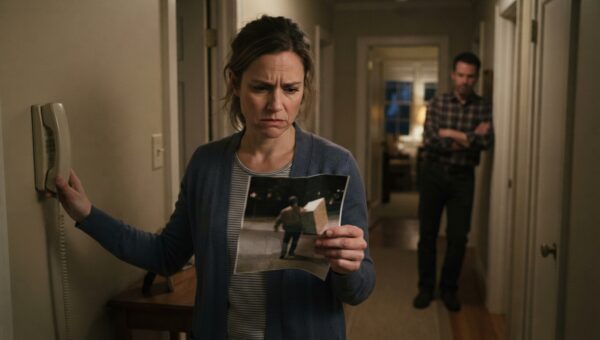
She pointed a small, ink-stained finger at a row of six stick figures drawn with thick outlines. We were a family of three, or so I had spent the last six years believing, yet the paper crowded itself with extra heads and scribbled arms.
“Sweetie, who are the extra people?” I asked, laughing a little because kids invented imaginary playmates all the time, or so I told myself to keep my breathing steady.
She did not hesitate at all. “That’s Daddy’s other mommy. And Emma. And baby Lucas?”
The cloth in my hand went stiff. I looked down at the stick figures, noting the crude circle representing a woman with long yellow hair standing right beside Greg.
Later that evening when Greg walked through the back door smelling of damp wool and cold engine oil, I showed him the paper while he pulled off his boots.
He just chuckled, tossing his keys into the ceramic bowl by the pantry with a heavy clatter.
“Kids imagine things, honey,” he said, kissing the top of my head without even looking twice at the paper before walking down the hall to wash up.
That dismissal should have settled it, but it did the exact opposite. I spent the next six hours staring at the ceiling while Greg breathed softly beside me in the dark, wondering why a child who had never heard those names would invent them with such casual certainty.
The next morning at 8:14, long before the first delivery trucks rattled their pallets against the asphalt behind the hardware store, I called Mrs. Gable at the primary school.
Her voice came through the receiver with that careful, professional calm teachers use when they are bracing for a complaint. “Your husband came for Career Day last month,” she told me, her words clipping the morning silence. “He brought two other children. Introduced them as his. He donated $500 under your last name.”
I gripped the edge of the kitchen counter so hard my knuckles turned gray. “A girl, maybe 7? A boy, maybe 3?”
“That sounds right about their ages,” Mrs. Gable replied gently.
I did not wait for the end of the school day. I drove home with my hands locked onto the steering wheel of my sedan, reviewing every late-night conference call and every weekend hardware run that had kept Greg away from our dinner table over the last three years.
The digital numbers on the stove clock read 5:42 when I finally unlocked our front door and stepped onto the linoleum. Greg was standing by the stove making pork chops, whistling an old tune under his breath while the grease popped quietly in the skillet.
I walked right up to him and stopped just short of the counter. “Who is Emma?”
His hand stopped dead on the metal spatula. He did not turn around for three long seconds.
Then he set the spatula down beside the iron pan and looked over his shoulder toward the living room where Maya was sitting on the rug, busy coloring the margins of a new book.
He looked back at me with a face that had suddenly lost every trace of its usual easy charm. “Emma is your sister.”
The kitchen seemed to shrink until the walls felt like they were pressing straight against my shoulders. Greg tried to talk fast then, his hands moving in tight, nervous circles as he explained Kendra, the apartment twenty miles away in the neighboring county, and the four years he had split down the middle.
He claimed he had tried to leave Kendra before we got married, but she came back into his life three years ago with a toddler and nowhere to turn, and he felt obligated to keep them afloat with money from our joint accounts.
He told me he brought them to the school Career Day because Kendra was fighting an uphill custody battle against her ex and needed proof of local community ties to keep her kids in the district.
I did not yell. I did not throw the cast-iron pan or let the tears spill over, though my throat felt like it was lined with dry glass. I just listened to him try to rationalize his double life as an impossible moral burden he simply had to carry.
“You didn’t have to carry it alone,” I said, my voice sounding stranger and colder than I ever knew it could. “You chose to build a second life with someone else while eating dinner at my table every single night.”
I spent the next three hours pulling up digital banking records on the old laptop while Greg sat at the kitchen table with his head in his hands. The screen flickered under the dim light, showing recurring bi-weekly transfers, utility bills for an address I had never seen, and grocery store receipts from towns I only ever drove through on the way to my mother’s place.
Thousands of dollars routed right out of our future and into a domestic arrangement built on lies.
When the bank statements were printed and stacked neatly beside the school donation receipt, I handed Greg a black leather suitcase from the top shelf of the hall closet.
“You need to be gone before Maya finishes her coloring book,” I told him, standing squarely in the hallway so he could not sidestep me. “I am not having her watch you pack your things.”
He tried to plead then, his voice cracking as he reached out a hand toward my shoulder, but I stepped back into the doorway of the kitchen and let my arms cross tight across my chest.
“Don’t,” I said.
He left before dusk, his tires crunching down the gravel drive with a sound that felt like the final period at the end of a very long, very bad sentence. I watched him go from the front window, feeling a cold, heavy emptiness that settled deep behind my ribs.
The next morning, I sat across from a family lawyer in a small office that smelled faintly of old carpet and floor wax, sliding the printed bank statements and the school receipt across his oak desk.
By the end of the week, the joint accounts were frozen, the assets were locked down pending audit, and the preliminary custody filings were drafted with strict, unyielding boundaries that kept Greg at arm’s length for Maya’s sake.
It took weeks for the house to stop feeling like a stage where a play had just ended, leaving only the bare boards and the ghosts of lines we never should have spoken.
Now, the kitchen is quiet again, save for the hum of the refrigerator and the scratching of crayons against fresh paper.
Maya and I sit together at the sunlit kitchen table, placing a fresh sheet of clean white paper right over the old drawing with its crowded, confusing lines.
She presses a green crayon into my hand, looking up at me with clear, trusting eyes as we draw just the two of us under a sturdy roof.