Two million nine hundred ninety-nine thousand dollars is a very strange number to see printed on a piece of heavy cream paper from the state commission. It makes your eyes blur just trying to count the zeros. I found it tucked right inside an old Montgomery Ward catalog on my kitchen counter back in October, wedged between a page of thermal underwear and a garden hose attachment I never bought.
My late friend Laura always told me that money doesn’t change people, it just pulls the wrapper off them so you can see what was underneath the whole time. Laura passed away three winters ago in the back bedroom of her daughter’s house in Xenia, smelling faintly of peppermint and menthol rubs, and I used to think she was just being cynical. She spent forty years working the register at the hardware store, so she saw folks at their absolute worst when their credit cards got declined for a box of galvanized nails.
I sat there at that oilcloth-covered table for three hours after reading that paper, watching the light move across the linoleum until it hit the leg of the electric stove. My husband Arthur had been gone six years by then, and the quiet in the house had turned into something that felt heavy, like wet wool left in a basket.
My children, Daniel and Brenda, hadn’t called me since the second Tuesday of August. Brenda was always too busy with her real estate listings down in Cincinnati, and Daniel had his hands full with his landscaping business and his mortgage payments on that big split-level out in Beavercreek.
I didn’t tell them. Not a single word. If I had called them up and said I won the kind of money that could buy a small county, they would have been over on my porch before I could set the kettle down. They would have brought casseroles in disposable foil pans and patted my hand and talked about trust funds for Ethan and college accounts for Brenda’s girls.
Instead, I decided to test them. It was a cruel thing to do, I know that now. A mother shouldn’t have to test the people she brought into this world with a handful of cheap tricks.
But the loneliness had been wearing down my patience for months, and I needed to know if there was anything real left under all those polite Thanksgiving visits and birthday cards bought at the grocery store check-out lane.
On a rainy Thursday afternoon when the sky was the color of a galvanized bucket, I picked up the telephone with my hand shaking so hard the receiver rattled against the plastic cradle. I dialed Daniel’s number. It rang four times before he picked up, and I could hear the faint sound of a leaf blower running in the background.
“Mom? Can this wait? I’m in the middle of an estimate,” he said, and his voice sounded thin and impatient, like he was standing too close to the highway.
“Daniel, I need a little help,” I said, keeping my voice small on purpose. “My blood pressure prescription went up again this month.
The pharmacist says it’s thirty-four dollars I don’t have until my social security hits next week.”
He let out a long, heavy breath that sounded like a sigh of pure annoyance. “Mom, you budget that money every month. You need to figure it out. I can’t keep bailing you out over thirty bucks.”
“I just thought maybe you could spot me until, “
“I gotta go, Brenda’s calling on the other line,” he interrupted. “Just figure it out.”
The line didn’t just go dead with a click. It went silent in a way that felt entirely different. When I looked down at the screen of my old cordless phone, the little red light was flashing, and a small notification told me my number had been blocked. Just like that. Thirty-four dollars for heart pills, and my only son decided he was done dealing with the inconvenience of an old woman.
Something inside my chest went very quiet. It was the same hollow feeling I had standing by Laura’s hospital bed when the machine started making that long, steady beep. I didn’t cry. I just walked over to the kitchen sink and stared out at the backyard where the tomato cages were leaning sideways in the mud. Laura’s voice came back to me as clear as if she were standing right beside the toaster. *They’ll show you who they are when the well runs dry, Clara. Don’t ever doubt it.*
I spent the rest of that afternoon sitting in the dark living room with my hands folded in my lap. The house felt colder than it should have for October. I didn’t turn on the lamps because I didn’t want to see the dust motes hanging in the air.
It was almost eight o’clock when the front door didn’t ring so much as rattle in its frame. Our front deadbolt has a loose pin that makes a distinct two-part clack if you push it too hard. I got up slowly, my knees clicking like dry kindling, and flipped the porch light on.
Ethan was standing there on the braided rug outside the screen door. He was seventeen then, all elbows and long legs, wearing his gray high school track hoodie with the sleeves pushed up past his wrists. His face was red from the wind, and he was breathing through his mouth like he had run all the way from the bus stop down on Maple Street.
“Grandma?” he said, his voice cracking slightly on the second syllable. He wasn’t supposed to be over on a Thursday; he had track practice until six and then algebra tutoring.
I pushed the screen door open a couple of inches. “Ethan? What are you doing out in this damp? Your mother knows you’re supposed to be home by, “
He didn’t answer my question. Instead, he reached deep into the front pocket of his hoodie and pulled out a small, crumpled wad of green bills held together by a rubber band. He held it out toward me like it was something fragile that might break if he squeezed too hard.
“Dad called me,” Ethan said, and his eyes stayed fixed on the floorboards between us. “He said you were crying about your medicine and that you were acting impossible again. He said he couldn’t deal with it tonight.”
I just looked at the money in his hand. It was five hundred dollars. I knew that because I knew what his part-time job at the muffler shop paid him on Saturdays, and I knew every single bill he had saved from mowing Mr. Henderson’s lawn all summer. That envelope was everything he had in the world. His gas money, his Friday night pizza money, his savings for a used truck he talked about every time he came over to help me haul firewood.
“Ethan, put this away right now,” I said, and my throat felt suddenly tight. “Where did you get this?”
“It’s mine,” he said, and he pushed the bills further into my hand, his fingers cold against my palm. “Just take it, Grandma. Get your pills. And buy some groceries so you don’t have to call him again. I’ve got enough for gas to get to school tomorrow. Just take it.”
He didn’t ask me why I didn’t have thirty-four dollars. He didn’t ask why Daniel wouldn’t help. He just stood there on the porch in the cold drizzle, giving away his last five hundred dollars because he thought his grandmother was starving and sick.
That broke me right down to the marrow more than Daniel ever could. I pulled that tall, awkward boy into the hallway and held onto the back of his cheap cotton hoodie until my shoulders shook. He smelled like damp wool and laundry detergent, and for the first time in six years, the house didn’t feel quite so empty.
Three days later, I called the family meeting.
I didn’t tell them why. I just left a message on Daniel’s machine and sent a sharp text to Brenda telling them both to be at my kitchen table by two o’clock on Sunday afternoon or don’t ever bother showing up for Christmas turkey again. They showed up at one-fifty-five, both of them looking like they were attending a hearing with a municipal tax board.
Daniel brought his wife, Sarah, who sat down at my table without taking off her leather coat and immediately checked her phone for text messages. Brenda brought a plastic container of store-bought sugar cookies she’d clearly picked up at the Kroger bakery on her way down the highway. Ethan sat quietly in the corner by the flour bin, wearing his old blue button-down shirt that was getting a little short in the sleeves.
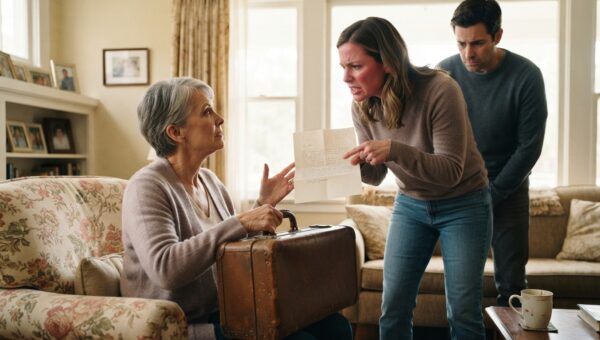
“Well, Mother, what’s this about?” Daniel asked, crossing his arms over his chest and looking around my kitchen like he was already calculating how much he could get for the copper plumbing if I ever went into a home. “Brenda has an open house at three in Mason, so we can’t stay all afternoon.”
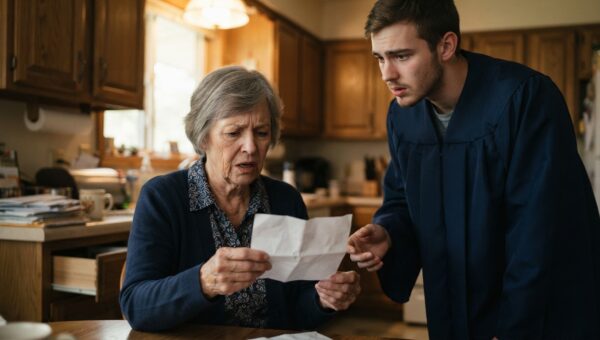
I didn’t answer right away. I reached into the drawer beneath the telephone and pulled out two things. First, the official cream-colored commission paper with the two million nine hundred ninety-宁nine thousand dollar figure stamped in purple ink at the top. Second, a small, clean white envelope containing Ethan’s untouched five hundred dollars, exactly as he had handed it to me in the rain.
I laid the paper right in the middle of the oilcloth table, right over where Sarah had set her car keys.
“What is that?” Brenda asked, leaning forward and squinting her eyes behind her tortoiseshell glasses. She reached out a manicured fingernail and touched the corner of the paper. “Clara, is this… is this a state lottery check stub?”
“It’s the verification from the commission office downtown,” I said, and my voice was steadier than it had been all week. “I won it back in September. Two million nine hundred ninety-nine thousand dollars.”
The kitchen went dead quiet. You could hear the old refrigerator in the corner giving its little shudder before the compressor kicked on. Sarah dropped her phone on the table. The screen cracked right across the corner against the salt shaker.
Daniel’s face didn’t go pale all at once; it sort of shifted, like dough settling in a pan. His eyes went wide, and he reached out a hand, his fingers twitching twice before he touched the edge of the paper.
“You… you won three million dollars?” Daniel whispered, and his voice went up half an octave. “Mom, you won three million dollars and you didn’t tell us?”
“I told one person,” I said, and I looked straight across the table at him. “Last Thursday, I called you and told you I couldn’t afford thirty-four dollars for my heart pills. Do you remember what you told me, Daniel?”
Daniel blinked, his mouth opening slightly. “Mom, that was… I was busy. I had a crew waiting on a site in Springboro. You know how those commercial landscaping jobs are, “
“You told me to figure it out,” I said, my voice dropping down to a flat, hard whisper. “And then you blocked my number so I couldn’t bother you again. Brenda, I called you twice that same afternoon. You let it go straight to voicemail and texted me that you were with clients.”
Brenda flushed a bright, angry red right up to the roots of her blonde highlights. “Mother, we didn’t know! If you had told us about the lottery, “
“That’s the point,” I interrupted. “I shouldn’t have had to win the lottery for you to care if I could buy my medicine. A stranger on the street would have given thirty dollars if they thought an old woman’s heart was giving out. But my own children decided I was an expense they couldn’t afford.”
Sarah found her voice then, and she leaned across the table with her eyes narrowed into hard little slits. “So what? You called us to gloat? You sat on three million dollars while we’ve been killing ourselves trying to keep up with property taxes and private school tuition for the girls?”
“I didn’t call you to gloat,” I said. I picked up the small white envelope with Ethan’s money inside and slid it across the table toward Daniel. “I called you here to tell you how the will is being rewritten as of Monday morning.”
Daniel looked down at the envelope like it was a coiled snake. “What is that?”
“That’s five hundred dollars,” I said softly. “It’s Ethan’s last five dollars from his savings account at the credit union. He walked through the rain last Thursday night to give it to me because he thought I couldn’t buy food. He didn’t know about the lottery. He didn’t know there was a single cent coming his way. He just knew his grandmother was alone.”
Ethan shifted in his chair, looking down at his sneakers like he wanted the linoleum to open up and swallow him whole.
“So,” I continued, looking around the table at my two adult children whose faces had gone from greedy shock to a cold, hard panic. “The lawyers are drawing up the papers tomorrow. Every single cent of that two million nine hundred ninety-nine thousand dollars is going into a trust managed by the bank in Dayton, with Ethan as the primary beneficiary and sole executor once he turns twenty-one. You won’t see a dime of it. Not for your mortgages, not for your trucks, not for your college funds.”
Daniel stood up so fast his metal folding chair screeched against the floor, tipping back and hitting the refrigerator with a loud *thud*.
“You’re out of your mind!” he shouted, his face turning dark and swollen with rage. “You’re cutting off your own family for a stupid test? You set us up! That’s manipulation, Mom! That’s elder abuse or whatever they call it!”
“Get out of my house, Daniel,” I said, and I didn’t raise my voice an inch.
Brenda was shaking her head, her eyes bright with angry tears as she grabbed her purse off the back of her chair. “You’re going to regret this, Clara. When you’re old and frail and you need someone to change your sheets in that nursing home, don’t expect us to answer your calls.”
“I won’t have to,” I said. “I’ve got someone who knows how to answer a door.”
They didn’t say another word. Daniel kicked the fallen chair out of his way with his boot, slamming the front door hard enough to rattle the glass in the china cabinet. Brenda followed right behind him, her heels clicking fast down the concrete steps. The screen door gave that familiar two-part clack, and then there was nothing left except the sound of their tires spinning gravel out in the drive before the engine noise faded away down the road.
The house settled back into itself almost immediately.
The silence that came after wasn’t heavy anymore. It felt clean, like the way the kitchen smells after you’ve scrubbed the grease off the stove with a lemon wedge and hot water.
Ethan was still sitting in the corner by the flour bin, looking a little stunned, with his hands jammed deep into his pockets.
“Grandma?” he asked quietly. “Are you… are you serious about all that?”
I stood up from the table and walked over to the counter, picking up the white envelope he had brought me three nights ago. I pulled the five-hundred-dollar bill out, smoothed it flat with my thumb, and laid it right beside a fresh ceramic mug of tea.
“I’m entirely serious, Ethan,” I said, and I finally let myself smile for the first time in six years. “Now go out to the garage and tell me if you still want to look at that red pickup truck down at the dealership on Route 4, because I think we’ve got some shopping to do.”