The cedar floorboards in the hallway always had this way of settling right around dusk, a dry, familiar creak that I used to mistake for safety. When Raymond walked out that Tuesday evening, he didn’t use the back door where our boots piled up. He took the heavy oak front door, the one we had sanded and stained together during our second summer in the house, and he pulled it shut behind his leather weekender bag with a sharp, final click.
Twelve years. Twelve winters of scraping ice off the windshield of his old sedan before he got his promotion to regional director. Twelve years of eating pasta three nights a week so we could put forty dollars into the savings account every Friday without fail. I thought we were building something from the ground up, brick by heavy brick. I thought the blisters on my palms from painting the baseboards were part of the same foundation he was standing on.
He stood on the front porch for a second, adjusting the strap of his bag, refusing to look at the hydrangea bushes I had spent three weeks nursing back to life after the late frost. I stepped toward him, my hand halfway out to touch his sleeve, but he took half a step back. That was the moment I knew the distance between us wasn’t just physical.
He looked me up and down, his eyes cold and flat like river stones in winter, and said the words that stayed in my head like a low-frequency hum for months. “I climbed the ladder, Lucille. You stayed a nobody. I need better.”
Then he got into a car that wasn’t ours, and he drove away.
I didn’t cry right then. I just stood on the porch until the taillights turned the corner past the mailbox. My hands felt empty, so I went back inside and washed the two coffee mugs we had used that morning, scrubbing the rims until the porcelain squeaked. That was my life for the next four months. Quiet. Too quiet. The house felt bigger, like the walls had slowly drifted apart while I wasn’t looking. I kept working my shifts at the county records office, filing deeds and sorting property taxes, coming home to an empty kitchen where the refrigerator hummed a little louder than it used to.
People from the office tried to check on me, especially Colleen, who brought over a casserole in a foil pan that sat in my fridge until the edges turned green.
But I didn’t want talking. I wanted the silence. I wanted to figure out how twelve years of my youth could vanish because some twenty-four-year-old marketing coordinator with bleached hair and a laugh like a dry fan belt told Raymond he was brilliant.
Four months. That was all the time he got on the upper rung of his ladder.
The phone call came on a rainy Thursday morning at 6:42. It wasn’t Raymond. It was a doctor from St. Jude’s pulmonary unit who didn’t waste time with gentle introductions. He told me Raymond had been admitted forty-eight hours earlier with an aggressive, rapid-onset infection that had compromised his lungs. He told me Raymond was listed as his emergency contact because nobody else had updated their paperwork.
“He’s asking for you,” the doctor said, his voice flat through the static of the line. “Or at least, he’s not saying anyone else’s name.”
I sat at my kitchen table for twenty minutes looking at a water ring on the wood grain.
I thought about the ladder. I thought about the way he looked at my worn cardigan before he walked out. I thought about the savings account he had cleaned out three days before he left, leaving me with ninety-four dollars and a mortgage in both our names.
Then I grabbed my coat. Because spite is a heavy thing to carry, but decency is heavier, and I had spent thirty-eight years learning how to lift the heavy things without dropping them.
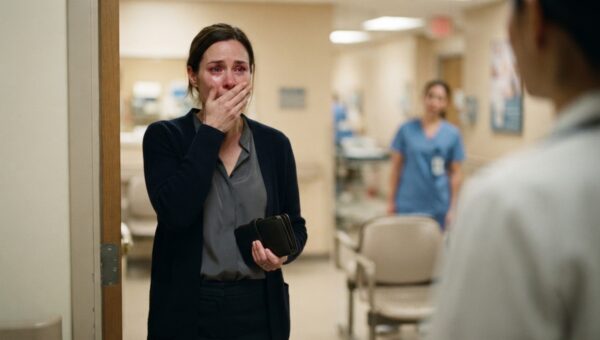
When I walked into room 412, Raymond looked like a skeleton shoved into a hospital gown. The broad shoulders he had spent five years working on at the corporate gym were gone, melted away by a fever that wouldn’t break. The room smelled of rubbing alcohol and old lemon-scented floor wax. There was no sign of Chloe. Her designer coat wasn’t draped over the vinyl chair. Her expensive handbag wasn’t sitting on the tray table. The nurse told me she had dropped him off at the emergency doors, asked the triage clerk if his health policy covered private recovery suites, and when she found out it didn’t, she walked out into the rain and didn’t come back.
Raymond turned his head on the pillow, his skin the color of skim milk. His lips were dry and cracked, bleeding a little at the corner.
“Lucille,” he whispered. It sounded like dry leaves scraping across concrete.
“Don’t talk,” I said, pulling the straight-backed chair right up beside the metal rail of the bed. “Save your breath.”
“She left,” he said, and a single tear tracked down into his temple, disappearing into his graying hairline. “The minute the doctor said it was bad… she called an Uber from the lobby.”
“I know,” I said, reaching out to adjust his blanket. My fingers brushed his wrist, and he flinched, not from pain, but from the sheer weight of his own shame. “Close your eyes, Raymond. Rest.”
I stayed in that room for three weeks. I spooned broth into his mouth when he could swallow. I sponged his forehead when the fever spiked at midnight. I listened to the steady, rhythmic hiss of the oxygen machine until it became the only sound in the world. Colleen covered my shifts at the county office, dropping off clean clothes every Tuesday without asking questions. She didn’t lecture me. She just left a bag of peppermint drops on the side table and squeezed my shoulder before she went back down the hallway.
In his final days, Raymond couldn’t talk much. He just gripped my hand with a desperate, trembling strength that surprised me. Two days before the end, he managed to cough out a few broken syllables.
“I’m sorry,” he rasped, his eyes wide and wet. “I was a fool.”
“Everybody’s a fool sometimes,” I told him, looking out the narrow window at the gray parking lot below. “Some people just take longer to figure it out.”
He passed away just as the morning sun hit the top of the brick wall across the street, right around 7:15. The room went very quiet, that heavy, absolute quiet that only comes when a machine stops fighting. I didn’t call for a nurse right away. I just sat there holding his cold hand, my thumb rubbing the knuckles where our wedding ring used to be, and whispered that he wasn’t alone.
I thought the hard part was over. I thought grief was just a matter of showing up, signing the papers with the county mortuary, and putting him in the ground without making a scene.
The funeral was small. Just me, Colleen, and a few middle-management guys from Raymond’s office who stood awkwardly near the back with their hands in their pockets, checking their watches every two minutes to see if they could make it back for the afternoon board meeting. The preacher said a few nice things about Raymond’s dedication to his work, which felt hollow enough to echo off the marble headstones, but I didn’t mind. The dead don’t care about a good review.
Then I saw her.
She was standing near the wrought-iron gate by the old elm tree, looking like she had stepped out of a fashion magazine and wandered into a graveyard by mistake. Chloe was wearing an ivory trench coat that cost more than my first car, sunglasses the size of dinner plates, and a pair of black stiletto heels that were already sinking into the damp spring mud. She wasn’t crying. She looked irritated, like she had been waiting ten minutes for a taxi that wasn’t coming.
The service ended, and the men started folding up the green canvas chairs. I stood by the polished mahogany casket resting on the lowering straps, pulling my black wool gloves off one finger at a time. Colleen stayed a few paces back, watching the gate with her jaw set tight.
Chloe clicked her heels across the gravel path, the sound sharp and intrusive against the quiet hum of traffic from the highway. She stopped three feet away from me, crossing her arms over her chest and pushing her sunglasses down the bridge of her nose just enough to glare at me with those hard, youthful eyes.
“You’re Lucille, right?” she asked, her voice high and thin, carrying right across the grass. “We need to talk about the estate paperwork.”
I didn’t blink. I just tucked my gloves into my coat pocket and looked at her shoes, noticing how the expensive leather was already ruined by the cemetery mud. “There isn’t much to talk about, Chloe. Raymond left an apartment full of overdue bills and a used sedan with a slipping transmission.”
She let out a sharp, incredulous laugh that made one of the office guys turn around from the parking lot. “Don’t play games with me. Three weeks before he got sick, Raymond told me about the corporate policy. The secondary beneficiary rider. Two hundred and fifty thousand dollars. He said he hadn’t gotten around to filing the final change-of-address forms yet, which means under state law, it defaults to his partner of record. And that was me.”
She said it with such absolute, unearned certainty that almost felt sorry for her. Almost. She stood there shivering slightly in her thin trench coat, convinced that death was just another transaction she could close if she pushed hard enough.
Before I could answer, heavy footsteps crunched on the gravel behind us. It was Mr. Harrison, the attorney Raymond had hired back when we bought the house on Maple Street, the same lawyer who had drawn up the separation papers twelve years ago. He was holding a thick manila envelope sealed with red wax string.
“Actually, Miss Miller,” Mr. Harrison said, his voice dry and steady like old paper. “That is entirely incorrect.”
Chloe whipped around, her face tightening. “Who are you?”
“I am the executor of Raymond’s final estate,” Mr. Harrison said, stopping right beside me and giving my arm a brief, reassuring pat. He looked down at Chloe over his half-moon reading glasses. “Mr. Vance amended his primary beneficiary declarations six weeks ago while he was recovering at St. Jude’s. He executed a new will in my presence, revoking all previous riders and naming his legal spouse, Lucille Vance, as sole executor and sole beneficiary of everything he owned.”
Chloe stared at him, her mouth slightly open, the bright confidence draining out of her face until she looked ten years older than she was. “That’s impossible. He was… he was out of it. He was sick. He didn’t know what he was doing.”
“He was lucid for two hours every afternoon,” Mr. Harrison replied calmly, tapping the corner of the manila envelope against his palm. “And his signature was witnessed by two independent staff physicians. The paperwork is ironclad. As for the corporate policy you’re referring to, Raymond canceled it the day after you moved out of his apartment. He used the payout to pay off the back taxes on this woman’s house.”
I didn’t say a word. I didn’t have to. The silence between us was heavier than any speech Raymond had ever given me about climbing ladders.
Chloe looked from the lawyer to me, her chest heaving under the expensive ivory coat. She opened her mouth to say something sharp, something about being young, something about wasted years, but nothing came out. The anger died right there in her throat, replaced by the bitter, cold realization that she had bet everything on a man who had already cashed his chips in elsewhere.
Without another word, she turned on her heel. Her stiletto caught deep in the soft turf near the plot marker, and for a second she almost lost her balance, stumbling forward before she yanked her foot free, leaving the ruined shoe half-buried in the dirt. She didn’t look back to get it. She just hurried down the gravel path toward the iron gate, her heels clicking unevenly against the stones until the sound faded into the distance.
Mr. Harrison handed me the envelope with a soft sigh. “You didn’t have to nurse him, Lucille. You know that, right?”
“I know,” I said, taking the heavy paper from his hand. “I didn’t do it for him.”
He nodded, tipping his hat before walking back toward his car. Colleen came up beside me, looking down at the single black shoe lying in the mud near the elm tree.
“Well,” Colleen said, blowing out a long breath through her teeth. “That’s certainly one way to clear out the closet.”
I looked down at the envelope in my hands, then out past the wrought-iron gates where the morning traffic was finally starting to thin out. The sun had broken fully through the gray haze, warming the top of my shoulders through my wool coat.
I pulled my gloves back out of my pocket, dropped them into the muddy hole where Chloe’s shoe had been, and turned my back on the graveside.