The rain up here in the Hudson Valley has a heavy, stubborn way of settling into your bones, and I was standing right at the edge of the sodden grass when Chloe stepped out from behind the trunk of a weeping willow. Her heels were sinking an inch deep into the mud, though she was trying hard to pretend she didn’t notice.
Twelve years. Twelve whole years of my life went into building a brick-and-mortar foundation so Julian could finally get his partnership at the firm. I worked the late shifts at the county records office while he finished his classes, eating cold soup out of a tin and telling myself that the struggle had an expiration date.
The morning he packed his bags, the sun was hitting the kitchen linoleum in a sharp, bright square. He didn’t even look up from zipping his leather folio when he dropped those words on me like lead weight.
“I climbed the ladder,” Julian said, his voice as flat and empty as a polished stone. “You stayed a nobody. I need someone better.”
I didn’t scream. I didn’t throw his coffee mug against the wall, though my hand was twitching for the weight of it. I just stood by the sink and watched him walk down the front steps to a car that belonged to a twenty-four-year-old marketing assistant named Chloe.
Four months went by. Four months of a quiet house that smelled only of my own coffee and the lavender soap I used to scrub his side of the closet until it didn’t smell like him anymore. I thought that was the end of the story. I figured he had won his game and I was left to pick up the board pieces.
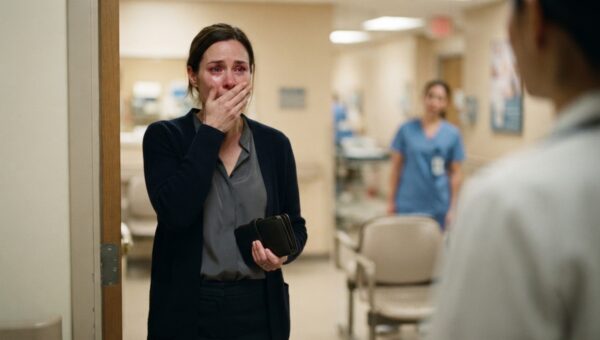
Then came a Tuesday afternoon in November when the front doorbell rang in that frantic, uneven way that usually meant someone was hurt. I opened it to find Julian standing on my porch, but the man who looked back at me wasn’t the arrogant partner who had walked out the door. His cheeks were hollow, his skin had that gray, translucent look of old parchment, and he was leaning so hard against the doorframe his knuckles were white.
“She left,” he whispered, and the sound was so thin it barely cleared the porch screen. “When the diagnosis came down… she just packed her bags.”
The doctors had found a mass near his pancreas, and the prognosis wasn’t a matter of years anymore.
It was weeks. Chloe had taken one look at the hospital paperwork, calculated the cost of long-term care versus an inheritance that was rapidly evaporating into medical debt, and vanished without leaving a forwarding address.
Martha, my neighbor who had watched Julian leave me back in the spring, dropped by that evening with a casserole she didn’t expect me to eat. She stood in my kitchen with her arms crossed over her plaid jacket, shaking her head until her silver earrings tapped against her collar.
“You aren’t seriously thinking about letting him back in that spare room, Clara,” Martha said, her voice dropping into that sharp register she used when she thought I was being a fool.
“I have to, Martha,” I told her, wiping down the counter with a damp rag that was already clean. “If I turn him away now, there is literally nobody else in this county who will pick up the phone when the hospice nurse calls.”
“He called you a nobody,” Martha reminded me, and the word hung in the quiet kitchen like a bad smell.
“I know what he called me,” I said. “But I know who I am.”
The next six weeks were a blur of oxygen tanks, rattling breath, and the steady, mechanical beep of the heart monitor we managed to squeeze into the guest room.
I bathed him when he was too weak to lift his arms. I spooned broth past lips that had once curled into that cruel, dismissive smile. He didn’t say much during those weeks, but sometimes in the middle of the night, when the house settled and the only sound was his ragged breathing, his hand would move feebly across the quilt like he was searching for something he had dropped years ago.
He passed away just as the sky was turning the color of a wet slate roof at 5:22 in the morning. I was sitting right beside the bed with my thumb pressed against his wrist, feeling the pulse slow down until it simply stopped.
“You aren’t alone, Julian,” I whispered into the dim room, and for the first time in twelve years, I didn’t feel any bitterness behind the words. Just a heavy, profound quiet.
Which brings me back to the graveyard under the weeping willow.
I thought the chapter was finished. I had handled the paperwork, paid the modest funeral home fees out of my own savings, and arranged for a simple marker because there simply wasn’t anything left to buy a monument with. Martha was standing beside me under a black umbrella, her hand tucked firmly into the crook of my elbow to keep me steady against the damp wind.
Then Chloe appeared.
She looked entirely out of place among the damp dirt and the sparse handful of people from the office who had bothered to show up. Her wool coat was a shade of camel so light it looked expensive just existing near the mud, and her blonde hair was pulled back into a neat, glossy twist that defied the drizzle.
She waited until the few remaining colleagues muttered their condolences and walked back toward the gravel parking lot. Then she stepped forward, her heels making a wet squelching sound in the turf, and stopped two feet from the polished stone.
“Clara,” she said, her voice dripping with a practiced, thin sorrow that didn’t reach her eyes. “It’s just… so tragic. I wanted to be here to pay my respects.”
I didn’t move. I kept my eyes fixed on the single white rose resting on the dark earth. Martha shifted beside me, her breath hissing softly through her teeth.
“You picked a fine time for mourning, Chloe,” Martha said, not bothering to keep the acid out of her tone. “He’s been gone six weeks total if you count the time he was sick at Clara’s.”
Chloe ignored Martha entirely, her gaze darting past my shoulder toward the modest hearse idling near the cemetery gates. Her eyes had that calculating, restless flicker I recognized from the way Julian used to look at a balance sheet before a hostile buyout.
“I know things were complicated at the end,” Chloe said, lowering her voice into a confidential whisper as she took another half-step closer. “And I know Julian was proud. But with his position at the firm, and the investments he told me about… I assume there’s a policy. Or an account set aside. We should probably sit down and go over the paperwork together. Since we both cared about him.”
The sheer audacity of it hung in the cold air between us like a physical object. She wasn’t here to say goodbye. She was here to collect a dividend on a man she had abandoned the second his balance sheet dropped to zero.
“Investments?” I asked, and my voice sounded surprisingly steady, even to me.
“Well, of course,” Chloe said, her lips tightening into a thin, anxious line. “A man in his position doesn’t just leave nothing. There has to be a payout. A survivor’s benefit, at least.”
I turned my head slowly and looked her dead in the eye, taking in the panic hiding just beneath her expensive makeup and the way her gloved fingers were twisting the strap of her leather purse into tight little knots.
“Julian didn’t leave a payout, Chloe,” I said plainly. “He left fifteen thousand dollars in medical debt, two suits that don’t fit anymore, and a set of golf clubs I’m giving to the high school team.”
Her face went completely rigid, the carefully constructed mask of grief slipping away to reveal the cold, hard disappointment underneath.
“That’s impossible,” she muttered, taking half a step back as if the words themselves were contagious. “He made partner. He was supposed to, “
“He was supposed to be a lot of things,” I interrupted, my voice dropping an octave until it cut through the sound of the rain. “And he told me I was a nobody because I stayed behind while he chased after what he thought looked like success. But let me tell you something about nobodies, Chloe. We are the ones who stay when the bills come due. We are the ones who don’t run away when the room gets cold.”
Chloe stared at me for three long seconds, her mouth opening slightly as her brain tried to calculate a loss she hadn’t anticipated. Then she looked down at her ruined designer heels, covered in thick gray Hudson Valley mud, and realized there was nothing left here for her to take.
She didn’t say another word. She turned on her heel, her coat whipping around her knees, and practically half-jogged back toward the gravel lot without looking back once.
Martha watched her go until the car door slammed shut with a dull, hollow thud in the distance. Then she let out a long, whistling breath and shook her head.
“Well,” Martha muttered, adjusting her collar against the drizzle. “I suppose that’s the last of her.”
“I suppose it is,” I said.
I looked down at the dark, freshly turned earth and the single white rose I had placed there with my own hands. The morning fog was finally starting to lift off the distant ridge, burning away under a thin, pale slice of sunlight that cut right across the valley floor.
My hands were empty, my pockets weren’t full of anything except the keys to a house I had built with my own labor, and for the first time in twelve years, I didn’t feel like I was holding onto anything that wasn’t real. I turned my back on the stone, took Martha by the arm, and we walked out of the gate together into the open road.