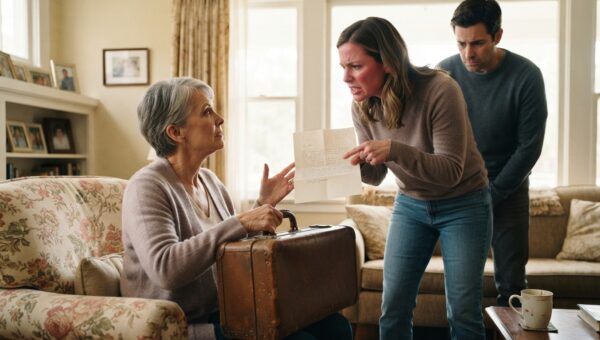
“Yes? Can I Help You?” the young woman asked as she opened the door. I took a deep breath and met her eyes. “I think you can,” I said calmly. “I’m Jake’s wife.” The color drained from her face. “His… wife?” she whispered. “That’s right. Martha. The woman paying the bills. The woman helping him Dream Farm.” For a moment, neither of us spoke.
Then she crossed her arms defensively. “Why are you here? To call me names? To tell me to stay away?”
I shook my head. “No. I just want the truth.” Her expression shifted. “What truth?” I stepped forward. “Who are you to my husband? And why did he come here instead of going to walnut industry business meeting he claimed he had?”
The silence that followed felt endless. Finally, she looked away and exhaled slowly. “I’m the woman he’s…” She stopped mid-sentence, as if realizing something. Then her eyes narrowed. “Wait….. He told me you already knew about me.” My heart stopped, and cold dread hit me right in the chest. Because in that moment, I realized Jake had been telling two very different stories, and neither of us had been given the truth.
For three years, my life had been measured out in wire transfers and quarterly loan installments.
Jake was a man of big ideas and quiet charm, the kind of person who could make thirty-year mortgages sound like poetry. When he pitched the Dream Farm project down in Mahaska County, I didn’t hesitate to help him liquidate our savings certificate. He packed a brown leather briefcase every Tuesday and Thursday, kissed my cheek at the screen door, and drove two hours south to inspect soil pH levels and negotiate tractor leases. I kept the books, balanced the ledger down to the penny, and trusted the man I had built a twenty-year marriage with.
The farmhouse kitchen smelled faintly of cedar shavings and black coffee. Elena stood by the enamel sink, her hands still damp from whatever work she had been doing in the adjoining barn. She wasn’t the corporate investor Jake had described to me over evening dinners, nor was she the casual acquaintance he had brushed off when I asked about local suppliers.
She was a woman who wore frayed flannel shirts and work boots with dried mud caked into the treads, someone whose calloused palms told a story of genuine physical labor.
“Sit down,” she said quietly, pulling out a wooden chair with a scraped leg that screeched against the pine floorboards. “If what you’re saying is true, and you’re really his wife, then we both need to sit down right now.”
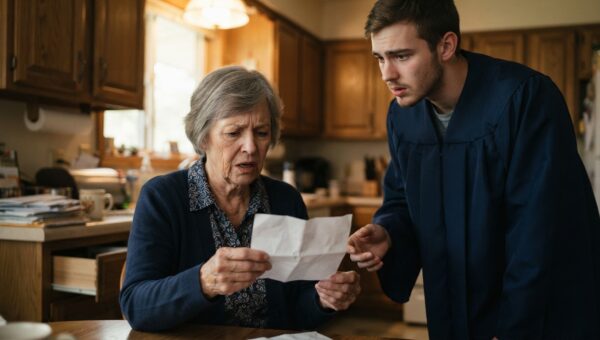
We sat across from each other at the scarred kitchen table. The distance between us felt smaller than the width of the wood. She pushed a ceramic mug of hot water toward me, though neither of us touched it. I reached into my canvas handbag and pulled out the manila folder I had brought along, the one containing three years of cancelled checks, bank statements, and the specific calendar schedule Jake had left open on his desk.
“He told me you were an estranged partner,” Elena said, her voice dropping into a register that sounded dangerously fragile. “He said your marriage ended ten years ago on paper, but you stayed legally tethered because of joint business holdings.
He told me you didn’t care about anything except your quarterly dividends.”
I let out a harsh, dry sound that wasn’t quite a laugh. “Divorced? We share a bedroom fifteen miles north of here. I cooked his breakfast at six this morning before he put on his gray suit and told me he had an all-day board meeting in Des Moines.”
“He told me he bought this place with his own inheritance,” she whispered, her fingers tracing the edge of the table. “He said my family’s homestead was going to be foreclosed on by the bank, and that he stepped in to save it because he believed in my woodworking business. He said he was putting fifty thousand dollars of his own cash into the barn upgrades every single month.”
I opened the manila folder and slid a printed bank ledger across the grain of the wood. The numbers stared up at us under the harsh light of the pendant lamp. “Fifty thousand dollars didn’t come from an inheritance, Elena. It came from our home equity line of credit and my mother’s small retirement trust. He’s been draining my accounts to pay your property taxes while telling you he’s a generous benefactor.”
For a long time, the only sound in the room was the heavy ticking of an old wall clock shaped like an oak leaf. Elena didn’t look angry at me anymore. The defensive posture dissolved, leaving behind the stark, hollow look of someone whose foundation had just been kicked out from under them. She turned the ledger pages with fingers that trembled slightly, reading the dates, the routing numbers, and the memo lines where Jake had written fraudulent business expense codes.
“Every time he came down here,” she murmured, half to herself, “he talked about how hard it was to deal with you. He said you were cold, that you only valued money, that you watched his every move like a hawk.”
“And every time he went home,” I said, my voice steady despite the trembling in my hands, “he talked about how difficult the soil was, how stubborn the local contractors were, how much the dream of this farm was costing us in blood and sweat.”
We spent the next hour laying out the pieces. It was like watching two halves of a cracked bowl finally fit together, revealing a pattern neither of us wanted to see. Jake had engineered a masterpiece of compartmentalization. To me, he was the devoted husband sacrificing his weekends to build our retirement haven. To Elena, he was the independent investor rescuing a struggling local artisan from financial ruin. He collected my sympathy and my capital on one end, and he collected her gratitude and her physical labor on the other. He played both sides with the practiced ease of a man who didn’t view people as human beings at all, but as resources to be managed.
“He’s supposed to be back here by four this afternoon,” Elena said, looking up from the bank statement with a cold, clear light in her eyes. “He said he had to finalize the timber harvesting contracts before the weekend.”
I looked down at my watch. It was 2:14 in the afternoon. “Good,” I said. “Let’s make sure we’re ready for him.”
We didn’t yell, and we didn’t plan an elaborate theatrical ambush. We simply cleared the table of everything except the core documents, pulled our chairs side by side, and waited. The rain picked up outside, drumming a steady, heavy rhythm against the old tin roof of the farmhouse. Every minute that ticked past felt heavier than the last, but the nervous flutter in my stomach had completely vanished, replaced by a cold, steady resolve that felt like iron.
At precisely 4:12 PM, the crunch of gravel sounded outside the front window. A sleek black sedan pulled up beside the weathered red barn, its headlights cutting through the gray afternoon mist. Car doors slammed shut. Heavy footsteps echoed on the porch boards, followed by the familiar jingle of keys in the brass lock.
The door swung open, and Jake stepped into the entryway, shaking the raindrops from the shoulders of his gray suit jacket. He started to smile, a practiced, warm expression designed to greet the woman he expected to find here, but the smile froze dead on his face the second he stepped past the mudroom and saw both of us sitting together at the kitchen table.
“Martha?” he said, his voice pitching upward in an unnatural way. “What… what are you doing here? I thought you had that doctor’s appointment in town.”
I didn’t stand up. I just looked at him across the span of the kitchen, watching the color drain out of his face until he looked almost gray in the dim light. “The appointment was at ten, Jake. I had plenty of time to drive down and see how the crops were growing.”
He took a half-step backward, his eyes darting between Elena and me like a trapped animal looking for an exit. “Look, I can explain. It’s not what it looks like. There’s a lot of complicated financial structuring going on with this property and…”
“Stop talking, Jake,” Elena said. Her voice was remarkably calm, carrying the quiet authority of someone who had spent her entire life repairing things with her own two hands. She stood up from her chair and walked over to the kitchen counter, picking up a thick manila envelope containing the land deeds and local tax filings. “You told me you bought this farm outright. You told me my name was going on the secondary deed by the end of the month.”
“Elena, honey, listen to me, “
“Don’t you ever call me that again,” she said crisply, sliding the envelope across the oak table toward me. “Your wife and I have spent the last two hours comparing receipts. We know about the home equity loan. We know about my grandfather’s historical lien that you never paid off. And we know that every single cent you put into this place came out of joint accounts behind her back.”
Jake’s charm vanished instantly, replaced by a flash of genuine panic and an ugly flicker of temper. He stepped forward, his jaw clenching. “You have no idea what you’re messing with. If you pull out now, the whole investment collapses. You’ll both lose everything.”
“No, Jake,” I said, standing up slowly and smoothing down the front of my cardigan. “We’re not losing anything else. Because as of forty minutes ago, my attorney filed a temporary restraining order and a full asset freeze on every joint account bearing my name. Your corporate credit cards are already declined.”
He stared at me, his mouth opening slightly as the reality of his situation finally began to sink through the layers of his carefully constructed lies. He reached out a hand, his fingers twitching toward the briefcase he still held in his left hand. “Martha, please. We can talk about this at home. We’ve built twenty years, “
“There is no home left to go back to, Jake,” I said quietly. “Your suitcase is currently sitting on the front porch in the rain where you left it this morning.”
Elena walked to the front door and pulled it open wide, letting the damp autumn wind sweep through the warm kitchen. She didn’t shout, and she didn’t point. She simply stood beside the open latch and looked at him with absolute, unvarnished contempt.
“Get off this property, Jake,” she said. “If you’re still within five miles of this county line by sundown, the county sheriff will be serving you with fraud papers instead of a trespass notice.”
For a second, I thought he might try to argue, might try one more slick phrase or half-baked excuse. But he looked at our faces, looked at the matched stack of bank statements on the table, and realized that the arithmetic of his double life no longer added up. He turned on his heel without another word, his leather shoes crunching hard against the gravel drive as he hurried back toward his car.
I stood on the sunlit porch of the farmhouse, watching the dust settle behind Jake’s departing car as I handed Elena a clean, newly printed folder of verified property documents, leaving the gravel driveway quiet and entirely clear.