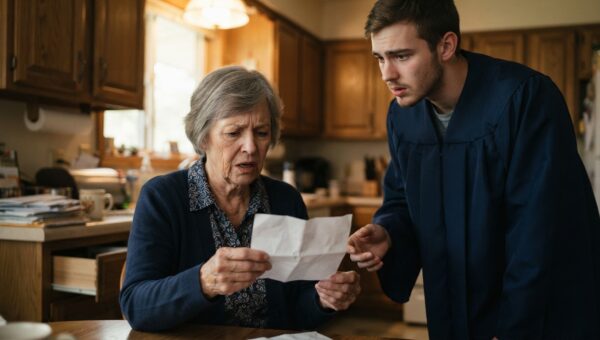
The dry cleaner on Maple Street always smelled like hot steam and heavy starch, a flat chemical scent that had stayed the same for the twenty years Ross and I lived in this county. I was standing at the counter waiting for the girl to fish out his charcoal work suit when my thumb brushed against something stiff tucked inside the breast pocket.
I pulled it out expecting a stray receipt or an old business card. It was a boarding pass stub made out to Ross Miller, dated two weeks prior, with a single destination printed in bold black letters. Phoenix.
He had kissed me goodbye on a Monday morning in the front hallway, his briefcase in one hand and his travel garment bag over his shoulder, telling me he was flying out to Seattle for a regional hardware convention. Seattle was three hours north by plane. Phoenix was a four-hour flight south into the desert. I didn’t drop the suit, and I didn’t let out a gasp that would make the teenage girl behind the counter look up from her phone. I just folded the blue-and-white strip of paper in half, slid it deep into my denim pocket, and paid for the cleaning with exact change.
I drove home slowly, keeping my hands at ten and two on the steering wheel, watching the gray Iowa cornfields blur past the windshield.
My mind wasn’t racing with wild accusations of another woman because Ross wasn’t that kind of man, or at least he never had been. He was predictable to a fault, a man who ate his toast with the crusts cut off and kept a ledger for every penny we spent on home repairs. But a man who lies about the direction of his plane ticket isn’t making a simple scheduling error. He is building a wall, brick by quiet brick, and I needed to know how high it went.
Back in the quiet of our kitchen, I sat down at the heavy oak desk where Ross kept his laptop. I didn’t need to guess his password for the airline’s frequent flyer portal because he used the exact same combination for everything that required numbers. Our wedding anniversary. September fourteenth, nineteen-ninety-eight. I typed the four digits into the login box, hit enter, and watched the screen refresh with his complete digital ledger.
Phoenix. Six times in the past twelve months. Always midweek. Always leaving on a Monday or Tuesday and returning thirty-six hours later.
I pulled out the spiral wall calendar we kept hanging beside the pantry, the one where I marked my dentist visits, the monthly bridge club nights, and the three-day weekend trips I took down to see my mother in Dubuque after her hip replacement. I took a red ballpoint pen and started matching the dates. Every single flight to Phoenix corresponded precisely to a day I was scheduled to be out of the house. When I had my annual physical last November, he was in Arizona. When I drove down to help my mother settle into her assisted living apartment in March, he was in Arizona. When I spent a rainy weekend at the lake with my college roommates, he was in Arizona.
The coincidence stopped being a coincidence somewhere around flight number four. It looked less like an accident and more like a carefully scheduled disappearance.
I didn’t yell at the empty kitchen walls. I didn’t throw my coffee mug against the backsplash. I felt a cold, hard clarity settle into my ribs, the kind of stillness you get right before a thunderstorm hits the prairie and the cows bunch up together in the corner of the pasture. I plugged our old HP printer into the USB port and hit print on his entire travel history, watching the pages slide out one by one with a rhythmic, mechanical click.
When the printout finished, I folded the sheets into a standard business envelope. I took a black felt-tip marker and wrote two words across the front in my normal, neat handwriting. Frequent Flyer. I carried the envelope upstairs, walked into our master bedroom, and placed it squarely in the middle of his side of the bed, right on top of his feather pillow. Then I went down to the kitchen, poured myself a cup of decaf, and sat at the kitchen table to wait.
The front door clicked open at six o’clock. Ross dropped his keys into the wooden bowl by the entryway just like he always did, his footsteps heavy and familiar on the hardwood floor as he unbuttoned his coat.
“Trudy?” he called out, his voice carrying that faint, practiced exhaustion he brought home from the warehouse every evening. “You home?”
“In the kitchen,” I said, not raising my voice.
I heard him pause in the hallway. I heard the faint rustle of his jacket hitting the coat rack. He didn’t come straight back to the kitchen, which told me he had already walked past the master bedroom and seen the envelope waiting on his pillow. The house went dead silent for a long time, the only sound being the low hum of the refrigerator motor kicking on in the corner. Ten minutes passed. Then twenty. Upstairs, the floorboards creaked as he started pacing back and forth above my head, a slow, heavy rhythm that went on for an hour, then two.
When he finally came down the stairs at eight-fifteen, his shoulders were slumped and the color had drained out from under his tan. He didn’t look like a man defending a secret; he looked like a man who had finally run out of road. He walked into the kitchen, his fingers clutching the printed airline records, and pulled out the chair opposite me without asking.
“How long have you known?” he asked. His voice was cracked, barely louder than a whisper.
“I found the boarding pass at the cleaner’s this afternoon,” I told him, keeping my eyes fixed on the rim of my coffee mug. “Then I checked your account. Six trips, Ross. Always when I was busy elsewhere.”
He rubbed a hand across his forehead, his knuckles white against his skin. “I didn’t want to bring it home to you. I wanted to keep it separate.”
“Keep what separate?” I asked. “Are you running another life down in the desert?”
“No,” he said, shaking his head sharply, finally looking me in the eye. “God, no, Trudy. It’s not another woman. It’s my brother, Arthur.”
I frowned, the name hitting the quiet room like a stray stone. Arthur was Ross’s younger brother, a man we hadn’t spoken to in over a decade after a bitter family falling-out over land inheritance following his father’s death. Arthur had packed up a battered Ford pickup truck and driven west in nineteen-ninety-five, vanishing into the sprawl of Phoenix without leaving a forwarding address.
“Arthur?” I repeated, my skepticism hanging heavy between us. “You haven’t spoken to Arthur since your father’s funeral.”
“He got sick, Trudy,” Ross said, his voice dropping an octave as he looked down at the table. “Liver failure, mostly from years of hard drinking, combined with congestive heart failure. He tracked down my work number about a year ago. He was living in a cheap motel off Interstate 17, broke and losing his mind, and he didn’t have anyone else to call.”
“And you just got on a plane?” I asked, feeling a cold knot twist in my stomach. “You flew down there behind my back six times instead of telling me?”
“How could I tell you?” Ross shot back, his voice rising just a fraction before he caught himself. “After the way he treated you? After the things he said about our family when we sold the farm? I knew you’d tell me it wasn’t our problem, or worse, you’d insist on getting involved and spending our retirement savings to bail him out. I wanted to handle it myself.”
“So you lied to my face,” I said quietly. “You looked at me while I packed your suitcase for a fake conference in Seattle, and you lied because you think I’m incapable of handling family mess.”
“I thought I was protecting our peace,” he whispered, staring hard at the printed pages in his hands. “I thought if I kept it quarantined in a forty-eight-hour window once every couple of months, it wouldn’t bleed into our life here.”
“A marriage isn’t a quarantine ward, Ross,” I said, leaning forward across the table so he could see the absolute finality in my eyes. “When you decide what I can and cannot handle, you aren’t protecting our partnership. You’re destroying it. You’re treating me like a stranger who has to be managed.”
He didn’t answer. He just sat there in the harsh overhead light of the kitchen, looking small and defeated in his work shirt, the man I had shared a bed with for twenty-seven years reduced to a pile of airline receipts and half-baked excuses.
“Is he still alive?” I asked after a long, grinding silence.
Ross nodded slowly. “Barely. Hospice care now. That’s why I went down two weeks ago. To sign the paperwork.”
“Then here is how this works,” I said, my voice dropping into that flat, steady register that meant there was no room left for negotiation. “We are not doing this in secret anymore. If your brother is dying, we bring him up here or we handle his affairs together out in the open. But the lying stops tonight. If you ever book a flight behind my back again, you won’t need to come home to an envelope on your pillow, because I won’t be here when you get back.”
He swallowed hard, his Adam’s apple bobbing in his throat, and for the first time all evening, he nodded. “I understand.”
Morning came with a pale, washed-out winter sun cutting through the kitchen windowpanes. The “Frequent Flyer” envelope, now torn open and flattened out, lay on the kitchen island between two cups of untouched morning coffee, right beneath a newly purchased wall calendar with every future date written in ink so dark it could be read from across the room.