My fingers were locked around the cold plastic visitor badge when the nurse walked in. I was fourteen days deep into a hospital room that smelled permanently of bleach and instant coffee, watching the rhythmic rise and fall of Richard’s chest on the monitor. The bills had already crossed $150,000, sitting in a neat, terrifying stack right on the bedside tray where the overnight discharge papers usually went.
I had spent two weeks convincing myself that the panic in my chest was just exhaustion, just the natural weight of a wife watching the man she built a twenty-year life with hover somewhere between here and gone.
Richard had been in the rollover accident on Route 65 just outside Springfield, his sedan crushed against a concrete bridge abutment at 2:14 in the morning. The state trooper had called my landline at dawn, his voice flat and practiced. I had dropped my coffee mug right there on the kitchen floor, the ceramic shattering into three jagged pieces that still sat under the counter because I hadn’t had the heart to sweep them up before driving straight to the trauma ward. For fourteen days, I slept sitting up in a chair that bit into my lower back, eating stale crackers from the vending machine, keeping watch over a man who didn’t even know I was holding his hand.
On the fifteenth morning, my shoulders felt like lead and my throat burned from the dry air, so I dragged myself down to the cafeteria for a styrofoam cup of black coffee. The trip took seven minutes by the wall clock. When I pushed open the door to Room 314, a young relief nurse with a name tag that read Chloe was standing by the IV pole, checking the drip rate with quiet efficiency. She looked up and offered a soft, sympathetic smile that didn’t quite reach her eyes.
“His other wife just left,” she said casually, tapping the screen of the infusion pump. “She brought his favorite blanket.”
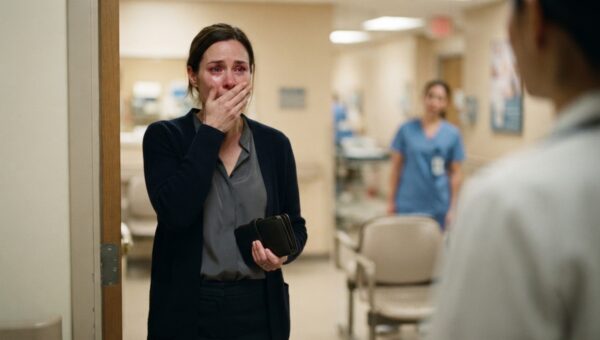
My knees buckled so fast I didn’t even have time to catch myself against the frame. The hot coffee sloshed over the rim of the cup, burning the back of my hand, but I didn’t feel it. I caught the edge of the rolling tray, sending a box of sterile wipes clattering to the floor.
“What other wife?” I demanded. My voice came out cracked and harsh, vibrating off the tile walls.
The nurse’s face went completely pale. She stared at me, her eyes widening as she processed the terror in my tone. She realized her mistake in an instant, her mouth opening and closing like a fish out of water. She didn’t say another word, just backed slowly out of the room and let the heavy door swing shut behind her.
I stood there shaking, the silence rushing back in to fill the space where my breath used to be. On the foot of Richard’s bed, folded neatly over the scratchy institutional quilt, sat a navy blue wool blanket with frayed edges. I knew that blanket. It was the one he always claimed he left in the trunk of his company car during his quarterly inventory trips to Kansas City and St. Louis. Except it was here, in this room, brought by someone else.
I spun around and grabbed Richard’s personal items bag from the metal locker by the sink. I hauled the zipper open with a violent jerk and fished out his leather-bound phone case. The screen was black, locked with a six-digit passcode I had never needed to know because he always said he kept his work matters strictly separate from home. I stabbed my own birthday into the keypad. Incorrect. I tried our anniversary. Incorrect. Three tries left.
I didn’t waste the last ones. I dropped the phone back into the bag and marched out into the hallway, my sneakers squeaking against the linoleum. I headed straight for the nurse’s station where the charge nurse was tapping away at a desktop computer.
“I need the visitor log for Room 314,” I said, leaning over the counter so hard my wrists ached. “Right now.”
The nurse, an older woman with iron-gray hair pinned back in a tight bun, looked up with a frown. “Ma’am, visitor logs are confidential unless, “
“I am his wife,” I snapped, and the sheer ugliness in my voice made her stop. “The legal one. Give me the book.”
She hesitated for two seconds, took one look at my face, and slid the heavy leather-bound binder across the laminate desk. I flipped the pages back through the last two weeks, my finger scanning the columns of signatures, dates, and relationship checkboxes. On Tuesday of last week, while I had gone home to shower and change clothes for the first time in a week, there it was. A neat, looping script in black ink. Clara Vance. Relationship written down in the margin: Spouse.
I stood there in the middle of the hallway, the hospital hum fading into a dull roar in my ears. Clara Vance. Not a client. Not a coworker. A second signature, appearing every single Tuesday and Thursday afternoon during the exact window when Richard supposedly had regional sales meetings across the state line.
I took the visitor log back into Room 314 and dropped it onto the tray table next to the stack of $150,000 medical bills. Richard lay there motionless, his chest rising and falling to the steady beep of the machine, looking entirely innocent and terribly fragile. For a long, stupid minute, I wanted to reach down and shake him until his eyes flew open and he explained away the ink on that page. I wanted him to tell me it was a clerical error, a bad joke, a ghost story.
Instead, I opened the black binder containing his intake paperwork and insurance documentation from the night of the crash. Tucked inside the clear plastic pocket was the emergency contact slip filled out by the hospital intake clerk who took his wallet at the scene. Under next of kin, written in his own familiar, sloping handwriting, was a different address in a subdivision thirty miles north of our town, paired with a phone number I had never dialed in my life.
The pieces didn’t click into place slowly; they slammed together like iron gates. The late nights at the regional office, the weekend inventory audits that always required him to pack a duffel bag, the sudden phone calls he had to take out on the back porch in the dead of winter. He hadn’t been traveling for the firm. He had been maintaining an entire domestic setup two towns over, complete with a woman who apparently thought she was the only one waiting at home.
The door clicked open softly. I looked up.
A woman stood in the doorway holding a small plastic bag from the hospital gift shop containing a toothbrush and a fresh change of clothes. She was in her late thirties, wearing a beige trench coat with the belt tied loosely around her waist, her hair pulled back into a neat clip. She froze the second she saw me standing by the bed with the hospital binder open in my hands.
“Who are you?” she asked, her voice dropping into a defensive register. She took a step into the room, her eyes darting from me to the monitor, and then down to the blue blanket folded neatly on the foot of the bed. “What are you doing with his things?”
“That’s a very good question,” I said, my voice terrifyingly calm. I reached down, picked up the visitor log, and held it out toward her so she could see her own handwriting staring back at her from the page. “I’m his wife. Who the hell are you?”
Clara stepped back as if I had thrown something at her. The color drained from her cheeks until her face matched the stark white of the hospital walls. “No. That’s not… we’ve been married for three years. We had a ceremony in Eureka Springs. He told me his first wife passed away.”
The lie hung in the sterile air between us, ugly and small. I let out a dry, humorless sound that didn’t feel like a laugh at all.
“Passed away,” I repeated. “That’s rich. He’s been sleeping in my bed every Sunday night for the last thirty-six months when he wasn’t pretending to inspect warehouses in Joplin.”
Clara dropped her gift shop bag. It hit the floor with a dull thud, a small plastic tube of toothpaste rolling out across the tiles and stopping near my shoe. She didn’t reach for it. She just stared at Richard’s unmoving face on the pillow, her hands trembling as she brought them up to cover her mouth.
“He said… he said he traveled for work,” she whispered, her voice cracking right down the middle. “He had a key to the house. We share a bank account.”
“We share a mortgage,” I shot back, the anger finally breaking through the numbness. “We share twenty years of tax returns and a joint savings account that he’s been bleeding dry to fund whatever life he built with you.”
We stood there on opposite sides of the hospital bed, two strangers bound together by the same lying man who couldn’t even manage his deceptions well enough to survive a Wednesday morning commute. For a few seconds, neither of us moved. The monitor kept beeping, steady and indifferent, counting off seconds that neither of us could get back.
“He’s got no short-term memory right now,” she whispered, her voice hollowed out. “The doctors said if he wakes up, he might not even know who we are.”
“Then he won’t have to worry about choosing between us,” I said.
I didn’t stay to argue about insurance policies or legal precedents. I walked out of Room 314 and headed straight down the corridor to the hospital administration office on the ground floor.
The billing supervisor looked up from her desk, her expression polite and tired. I laid my driver’s license and our joint marriage certificate on the polished wood surface, alongside the printed summary of the $150,000 balance currently accruing under my name as the primary legal spouse on file.
“I need to file an immediate disclaimer of medical proxy,” I said, my voice hard and even. “And I need every financial liability tied to this patient’Severed from my social security number as of today.”
The clerk blinked, starting to reach for a standard form, but I stopped her with a raised hand.
“I am not his next of kin anymore,” I told her, signing my name across the top of the fraud affidavit she slid toward me. “Let his other wife handle the bills.”
When I walked out the sliding glass doors of the main entrance, the midday air hit my face with a sharp, clean bite that felt like oxygen for the first time in two weeks. The sky overhead was a harsh, unbroken gray, threatening rain that hadn’t quite decided to fall. I paused on the concrete steps for just a second, listening to the distant hum of traffic on the highway where his car had gone off the road.
I reached into my coat pocket, pulled out my gold wedding band, and slipped it off my finger. I dropped it into the red Salvation Army collection kettle sitting by the sliding doors, watching it bounce once against the bottom before disappearing among the dollar bills. Then I walked down to my car, got behind the wheel, and drove away without looking back once.