The afternoon sun had that flat, yellow look it gets over the Platte Valley around four o’clock in late October. I was standing at the counter of my kitchen, scraping carrots into the sink, when the gravel in the drive crunched under tires. It wasn’t the steady rumble of Arthur’s old Ford from back when he was alive, and it wasn’t the high-pitched whine of the delivery truck that usually brings our grocery orders from town.
It was Justin’s sedan. The muffler had been rattling for six months, and I knew that sound in my bones.
Justin didn’t knock. He just pushed the back door open, letting in a gust of cold air that smelled of dry corn husks and exhaust, and walked straight over to the table without taking off his heavy canvas jacket. He sat down hard on the ladder-back chair, the one with the squeaky left rung, and just stared at his hands. His knuckles were red from the wind. I kept the vegetable peeler moving, the orange curls piling up in the porcelain basin, because sometimes if you don’t look right at a person, they have more room to figure out how to speak.
“Mom,” he said. His voice was too flat. That was the first thing that warned me. Justin has always talked with his whole chest, loud and fast, but this came out like he was reading a receipt in a post office. “Rachel wanted to look into her adoption records.
You know she’s been talking about it since the twins were born.”
I set the carrot down. My fingers felt damp and cold against the dry wood of the counter. “I know she has, Justin. People want to know where they come from. It’s natural.”
He rubbed the back of his neck, his thumb catching on the edge of his collar. “She didn’t just look, Mom. She used that website with the spit tube. The one everyone at the lumberyard has been arguing about over lunch.”
“And?” I asked. The word came out thin. I didn’t even turn around. I could see the reflection of his broad shoulders in the small window over the sink, rigid under that faded green canvas.
Justin shifted his weight, and the chair let out a sharp little squeak. “Mom, her birth mother’s maiden name is the same as yours. Same town. Same year.”
The room didn’t spin like it does in the movies. It just tilted, like someone had slipped a wedge under the left legs of the table and left it there.
I looked at the back of Justin’s head. Then I turned my head slowly, past the microwave, past the calendar with the church bazaar circled in blue ink, straight to the hallway wall where the wedding picture hung in its heavy walnut frame.
Rachel was smiling in that picture, her chin tilted up just a fraction, her dark hair pinned back with little crystal combs I had helped her adjust myself back in June of 2014. For seven years, I had told myself my reservations about her were just ordinary mother-in-law foolishness. I told myself she was too modern, too sharp-edged, too quick to correct Justin when he left his boots by the heater. I had blamed her for the little prickles of irritation that flared up between us whenever she brought the kids over for Sunday pot roast.
“Justin,” I said, and my voice sounded like dry paper rubbing together. “Look at me.”
He raised his head, his brown eyes, Arthur’s eyes, exactly, wide and dark with a confusion that was starting to curdle into something else. “She was born in Saint Paul at the county hospital, Mom.
October twelfth, nineteen-eighty-two. The same day you were there. The paperwork came through the registry about twenty minutes before I drove over here.”
I didn’t say anything. I couldn’t. Thirty-eight years of carefully locked drawers and folded-away linen flew open in my head all at once, scattering thirty-eight years of silence across the linoleum.
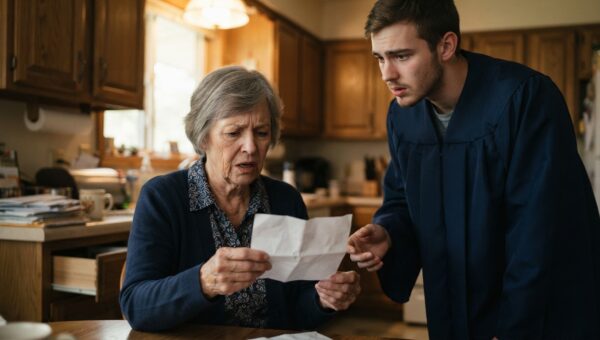
We sat there in that kitchen while the old wall clock by the pantry ticked off twenty seconds in heavy, deliberate chunks. I remember thinking how ridiculous it was that the refrigerator motor chose that exact minute to kick on, humming with a low, vibrating rattle that seemed to fill up the whole house. Justin reached into his coat pocket and pulled out a folded white paper, creased down the middle like a grocery list, and laid it flat on the wood between us. He didn’t push it toward me. He just left it there, weighted down by his thumb.
“You knew,” he whispered. It wasn’t an accusation. It was just a question looking for a place to land.
“I didn’t know,” I said, and my voice finally cracked right down the middle. “I didn’t know where she went. They told me she went to a family down near Omaha. That’s what the agency said in the room with the green carpet and the metal desk. They said her name was different.”
Justin pulled his hand back as if the paper had burned him. “Her name isn’t different now. The adoption was semi-open once she turned eighteen, but the birth records were sealed until she filed the state petition last month. The lawyer called her this morning.”
I walked over from the sink, my knees feeling stiff and hollow, and sat down in the chair opposite him. The paper on the table was a printout from the state registry office, headed with a seal I hadn’t laid eyes on since I was seventeen years old and sitting in a drafty room behind the Methodist parsonage with my mother holding my hand so hard my bones ached. There was my maiden name, Halloway, typed in those blocky, old-fashioned capitals. Below it was the entry number, the hospital code, and the signature of a social worker who had been dead for twenty years.
“She looks like you,” Justin said softly, staring out the window toward the old tractor shed where the evening shadows were stretching long and purple across the gravel. “That’s why you never could look her straight in the eye at Thanksgiving, isn’t it? You thought it was just regular friction, but it wasn’t. It was something else.”
“I thought she was too loud,” I said, and a sudden, sharp laugh bubbled up in my throat before dying out into nothing. “I spent seven years telling myself I just didn’t like the way she combed her hair. God help me, Justin. I looked at her at the rehearsal dinner and I felt like I was looking into a mirror I’d dropped and swept up in the dark.”
The quiet came back, heavier this time, settling over us like wet snow. Outside, a red-winged blackbird landed on the top rail of the cattle gate, dipped its head once, and flew off toward the creek. I thought of the twins, little Clara with her quick, nervous laugh and Toby with the way he squints at his drawing pad just like Arthur used to do. They were my grandchildren twice over now, bound to me by blood so thick it made my head throb behind my ears.
Justin didn’t move for a long time. Then he reached across the table, his big, rough hand, the hand of a man who spent ten hours a day handling rough-cut pine and steel bolts, and laid it over mine. His skin was warm. “She’s sitting in the car with the kids,” he said. “Down by the mailbox. She wouldn’t come up the drive until I talked to you first because she said she didn’t want to cause a fight.”
“Bring her in,” I said.
He blinked, surprised. “Mom, you don’t, “
“Bring her in, Justin,” I repeated, and this time my voice didn’t shake at all. “She’s standing out there in the cold with my grandchildren because she’s scared of what I might say. Go bring my daughter inside.”
He stood up so fast his chair scraped a harsh line across the linoleum, but he didn’t head for the door right away. He leaned down, put his arms around my shoulders, and held me tighter than he had since he was twelve years old and scraped his knee down to the white bone on the old cement cistern. I let my forehead rest against his chest, smelling the sawdust and wool on his jacket, and for the first time in thirty-eight years, the knot in the middle of my ribs loosened just enough to let the air back in.
He walked out through the screen door, the latch clicking behind him with a sharp, familiar sound that had marked the rhythm of our lives in this house for decades. I didn’t follow him to the porch. I stayed right there at the kitchen table, looking down at the white paper with its neat rows of black ink, and then up at the wedding portrait where Rachel was smiling into the camera with her chin tilted up just like mine.
The car door slammed down by the gate. I heard the crunch of tires on gravel again, coming slow this time, rolling up toward the house where the porch light had just flickered on against the gathering dusk.