I got a lot of things wrong during those six years, but the biggest mistake I made was believing that grief is a straight line. I thought you hit the bottom, you stayed there for a while, and eventually you climbed back up into the light. You accept the headstone. You accept the closed-casket funeral where the oak box felt too heavy for the thin boy inside it.
You learn how to say his name in the past tense without catching your breath on the middle syllable. Julian had been gone six years when the phone finally rang at 2:17 in the morning, and the screen flashed his name like he had just stepped out for a pack of cigarettes.
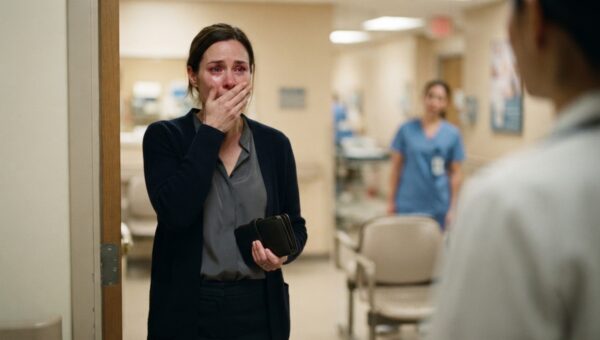
The house was dead quiet except for the hum of the refrigerator. My husband, Martin, was sleeping down the hall, breathing that heavy, rhythmic snore that usually drove me crazy but that night sounded like the only anchor in a storm. My phone sat face up on the nightstand. When the display lit up, the blue light cut sharp against the dark curtains. I reached for it because you always answer a phone at two in the morning; your brain automatically goes to the worst hospital room, the worst highway, the worst news.
I pressed accept before I even looked at the caller ID. But when the screen settled, it didn’t show a local hospital or an unknown number.
It showed Julian’s cell number. The exact ten digits I had deleted from my contacts three years after the accident because looking at them made my throat close up.
Nobody spoke on the other end. I said hello twice, my voice thick with sleep and irritation, thinking it was some kind of sick automated prank. Then came the three sharp taps. One, two, three. Knock, knock, knock. It wasn’t random tapping. It was the precise rhythm Julian and I used to use when we were kids sharing a bedroom wall, the signal we invented to tell each other that our father was coming up the stairs and we needed to pretend to be asleep.
A voice breathed against the receiver, low and raspy like it hadn’t used water in days. “Check Mom’s basement.”
The line clicked dead with a flat, electronic beep. I sat there in the dark for a long time, staring at the blank screen until it went black, my heart hammering against my ribs like a trapped bird.
My first instinct was to tell myself I was dreaming. Grief does strange things to your head at odd hours. People hear footsteps in empty hallways or smell pipe tobacco where nobody smokes. But the tapping stayed in my ears. Three knocks. Exactly three.
I didn’t sleep another wink. By six in the morning, I was dressed in jeans and an old fleece jacket, my car keys cold in my palm. Martin mumbled something from the bed about where I was going so early, and I told him I had to check on my mother. He rolled over, half-asleep, and told me to say hi. He didn’t see the way my hands were shaking as I locked the front door behind me.
Driving out to my mother’s place in the gray dawn felt like driving through a memory I had already finished reading. The county roads were empty, the cornfields sitting brown and stubbled under a heavy layer of November frost.
My mother lived alone in the old brick house where Julian and I grew up, a place that always smelled faintly of lemon wax and damp earth. She kept the place immaculate, refusing to change a single curtain or move a single piece of furniture since my father passed away ten years ago.
When I pulled into the gravel drive, her sedan was parked in its usual spot under the cottonwood tree. The house was dark. I didn’t knock; I just used my old key, the brass one with the notched edge that always stuck in the deadbolt if you didn’t jiggle it just right.
The front hall smelled the same as it always did. Old wool, peppermint candy, and coffee. I called out for her, but there was no answer. The quiet in that house was thick, almost heavy enough to lean against. I walked straight past the kitchen, past the framed photographs of Julian on the mantel, photos where he looked twenty-two forever, smiling with his gap-toothed grin beside his pickup truck, and headed straight for the basement door by the pantry.
The stairs down were steep and wooden, groaning under my boots with every step. My father had built those stairs himself back in nineteen-eighty, and they still had that raw cedar smell mixed with the dampness of the limestone foundation. The basement was dim, lit by a single pull-chain bulb hanging from a frayed cord near the laundry tubs.
I stood at the bottom of the steps, looking around at the rows of canned peaches, the old holiday boxes stacked near the fruit cellar, and the workbench where Julian used to solder old radio parts. The voice from the phone echoed in my head again. Check Mom’s basement.
I started moving boxes. Old tax returns from the nineties, boxes of Christmas ornaments, crates of glass jars. My arms got dusty and my knees began to ache against the cold concrete floor. I was halfway ready to laugh at myself, to admit that I had lost my mind over a ghost dial or a bad dream, when I noticed something odd near the main support beam directly beneath the basement stairs.
The cedar paneling on the side of the stairwell had a slight gap. Just a quarter-inch, but enough to catch the pale light coming off the floor. I crouched down, running my fingers along the rough wood. There was a small brass latch, painted over three times with white wall paint so it blended right into the grain. It took a firm tug with my fingernails to pop it loose.
The panel swung open with a dry creak. Inside was a dark, shallow cavity tucked between the floor joists, just big enough for a shoebox.
My fingers brushed against rough cardboard. I pulled the box out into the light of the hanging bulb. It was an old cigar box, the hinges rusted solid, tied around with a piece of faded yellow twine. I didn’t even use scissors; I just sawed the string back and forth across my thumbnail until it snapped.
Inside sat a photograph and a folded piece of lined notebook paper. I picked up the photograph first, my thumb smudging the corner. It showed Julian standing outside a red-brick building somewhere near a harbor. He looked older, his hair shorter and darker than I remembered, wearing a jacket I had never seen before. Standing right beside him was a woman with sharp dark hair and a serious mouth, her arm hooked through his. They weren’t smiling for the camera. They looked like people who had just finished running a very long race and were listening for footsteps behind them.
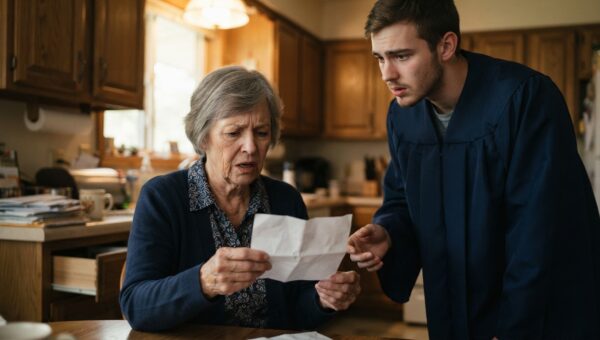
I unfolded the paper next. The handwriting was unmistakably Julian’s, tight and slanted to the left, written with a fine-point black pen that had bled slightly into the cheap paper. The date at the top was written two weeks after his funeral.
If you’re reading this, someone has been lying about my death.
The words sat there on the page, small and sharp, cutting through six years of mourning like a knife through old cloth. I read them once, and then I read them again, my brain refusing to line the letters up with the reality I had lived through. Two weeks after the funeral. Two weeks after we lowered an oak casket into the frozen clay behind the Methodist church. Two weeks after I held my mother’s shaking shoulders while she sobbed into a black veil.
“You were never supposed to find that.”
The voice came from the bottom of the basement stairs, soft and steady and completely devoid of surprise.
I jerked upright so fast my head nearly clipped the low ceiling joist. My mother was standing right there where the light ended, her hand resting lightly on the wooden handrail. She wasn’t wearing her slippers or her morning housecoat. She was dressed in her good gray skirt and her wool cardigan, looking down at me with eyes that looked terribly old and completely dry.
I opened my mouth, but the only sound that came out was a ragged breath that tasted like dust. I held up the letter like a shield. “Julian,” I managed to get out, the name feeling brittle on my tongue. “Julian is alive.”
My mother didn’t flinch. She didn’t drop her gaze to the floor or burst into tears. She just took one slow step down into the dim light, her shoes clicking softly against the concrete.
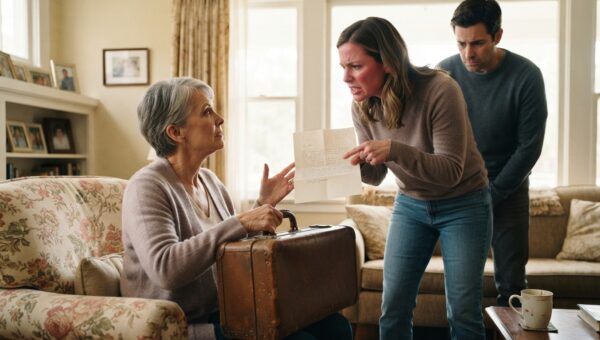
“He had to be,” she said, her voice dropping into that flat, rhythmic tone she always used when she was delivering news she knew you wouldn’t like. “If he wasn’t dead on paper, they would have found him. They would have finished it.”
“Who?” I asked, my voice rising until it bounced off the low rafters. “Who was going to finish what, Mom? He drove his truck off the ridge at Blackwood Point. There was an investigation. There was a body, “
“There was an engine block in a charred chassis and dental records bought from a corrupt clerk in another county,” she said quietly, cutting across my words with a terrifying matter-of-factness. “Julian made a lot of mistakes with his business partners, honey. Bad men. Men who didn’t care about courtrooms or bankruptcy filings. They wanted every penny he owed, and when he couldn’t pay, they told him they’d start with you and me.”
The basement seemed to tilt slightly on its axis. The smell of old dust and damp cedar suddenly became very sharp, pressing against my sinuses. I looked down at the photograph in my hand, at Julian standing by the harbor with that strange woman, breathing, walking, existing somewhere out there in the world while I spent six Thanksgivings crying into a turkey carcass and visiting a granite stone with his birth and death carved into the granite.
“You knew,” I whispered. The words felt small and heavy, sinking straight down into the concrete between us. “For six years, you let me sit by a grave that didn’t have anyone in it.”
“Every solstice,” she said, her voice finally cracking just a fraction, the first sign of the armor slipping. “Every six months, a burner phone rings in the pantry. A single ring. Just to tell me he’s still breathing. Do you have any idea what it’s like to carry that? To look at you in the kitchen and know you’re grieving a boy who is hiding in some damp room three states away? I didn’t want this lie. He made me swear it. If anyone knew the truth, even you, the circle would break. They would have smelled it on us.”
She took another step down, reaching out a hand that wasn’t quite steady. “Put it back, Clara. Please. He’s safe now. The men who chased him down there have been in federal prison for three years. But he’s built a life. He has a name that belongs to someone else. If you open that door all the way, you can’t close it again.”
I stood there on the cold floor, the photograph and the letter clutched in my fist so hard the paper began to crease at the edges. My whole body felt hollowed out, like an old barn standing empty after the harvest. Part of me wanted to scream at her, to tear the rest of the cedar paneling off the wall and throw the cigar box across the room. But another part, the tired, hollow part that had missed him every Sunday for six years, just felt a strange, cold clarity settling into my chest.
“I’m not putting it back,” I said. My voice didn’t shake anymore. It sounded steady, flat, and final.
I reached into my pocket and pulled out my phone. The screen was still unlocked. On the back of the photograph, scrawled in the same tight handwriting, was a string of numbers and letters, an encrypted VoIP address and a short access code.
My mother watched me with her hands folded over her cardigan, her lips pressed into a thin, bloodless line. She didn’t try to stop me. She just turned slowly and walked back up the stairs, leaving me alone in the dim light with the dust motes spinning lazily in the air.
I didn’t follow her right away. I walked over to the workbench, sat down on Julian’s old wooden stool, and began typing the address into my phone. It took three tries before the connection went through, the screen flashing a green indicator as it routed the signal through half a dozen proxy servers.
When the text box finally opened, I didn’t write a long paragraph. I didn’t ask how he could do this, or why he waited six years, or who the woman in the picture was. I just typed five words that felt heavier than anything I had ever carried.
I know where the box is.
I hit send.
The little status wheel spun for three agonizing seconds. Then the screen refreshed with a delivery receipt, followed immediately by a single incoming reply from a number with no name attached.
*I’m coming home.*
I sat there on the stool for a long time, watching the blue light of the screen fade against my palm while the sun finally cleared the tops of the cottonwood trees outside, catching the edge of the back porch in a pale, blinding glare.