My husband, Greg, thought he was being clever when he handed me the blue cardboard box across the kitchen island on my fifty-second birthday. It had a little cartoon tree on the front and a retail barcode still stuck to the cellophane. He told me it was time to find out what kind of stubborn ancestors gave us our high arches and our weird habit of putting vinegar on green beans.
I laughed, tore the plastic off, and swabbed the inside of my cheek while the morning coffee pot was still gurgling. We figured it would take three weeks, maybe four, and we would laugh about some great-grandfather from Dusseldorf who made barrels.
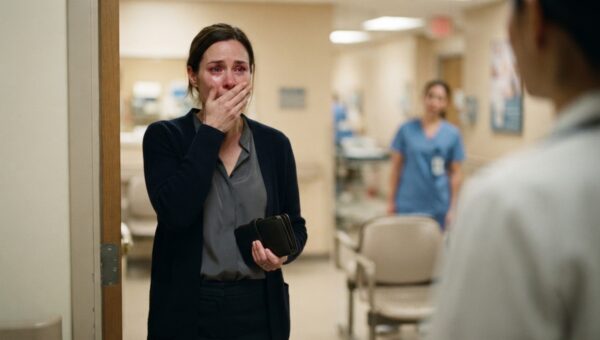
Almost two months went by. The little blue box completely slipped my mind while we dealt with Greg’s knee surgery and the endless pile of insurance paperwork that follows middle age. Then the notification popped up on my phone while I was standing in the grocery store aisle trying to decide between two brands of canned tomatoes. My fingers froze right over the cold metal shelf. The screen didn’t show a distant cousin in Ohio or a grandfather in Prussia. It showed a fifty percent match. A half-sister. Her name was Evelyn, and the birth date listed underneath her digital profile was exactly four months after mine.
My hands started shaking so badly I dropped a can of plum tomatoes right onto the linoleum floor with a heavy thud.
An employee looked over from the end of the aisle, but I didn’t care about the dented tin or the red juice leaking out across the white tiles. I walked straight out to my car, got behind the steering wheel, and sat there staring at the dashboard while the engine idled. I didn’t know an app could tear a fifty-year life apart in three seconds, but it did. I pulled my phone out of my coat pocket and dialed my father’s landline with a thumb that wouldn’t stop trembling.
My dad answered on the third ring, his voice raspy and familiar from eighty-one years of black coffee and early mornings in the machine shop. I didn’t even say happy birthday or ask about his arthritis. I just asked him one simple question. Who is Evelyn? The line went completely dead. Not a click, just that heavy, hollow silence that feels like someone pulled the oxygen right out of the receiver.
After a long, agonizing pause where I could hear the faint hum of his kitchen refrigerator in the background, he whispered seven words that made my stomach drop into my shoes. Where did you hear that name? I told him about the DNA results, about the fifty percent match, about the date of birth, and before I could get another syllable out, he hung up on me without another word.
Less than fifteen minutes later, while I was still sitting in the grocery store parking lot with the motor running, my cell phone buzzed again. This time it was my mother. Her voice wasn’t raspy; it was sharp and furious, carrying that edge of pure panic she only ever got when someone tracked mud across her newly scrubbed kitchen floor. She didn’t ask how I was or why I sounded like I had been running. She went straight to the point with a harshness that caught me entirely off guard.
You need to drop this right now, she snapped into the speaker. I couldn’t. The silence of fifty years was suddenly cracking right down the middle, and I wasn’t about to put my hands over my ears just because she told me to.
I didn’t go home. I put the car in drive, pulled out of the lot, and punched the address listed on Evelyn’s profile into my GPS. It was thirty-one miles away, over the county line and down into the older section of the river valley where the houses are small, brick bungalows with overgrown hedges and peeling white paint on the porch rails. My mind felt hollow, racing through every family album, every Sunday dinner at my parents’ house, and every birthday cake where my father had smiled and handed me a gift without a single shadow on his face. Forty-eight minutes later, I pulled my sedan up behind a faded blue station wagon in a gravel driveway that needed weeding.
I walked up the three wooden steps and pressed the doorbell. It let out a weak, buzzing chime that sounded like it was dying on the wall inside. A few seconds passed, and then the front door swung inward. The woman standing on the other side of the threshold was wearing an oversized gray sweatshirt and holding a dish towel in her hands. She stopped dead in her tracks, and so did I. It felt like I was looking directly into a mirror that had been left out in the weather for a few decades. She had the exact same stubborn jawline, the same hazel eyes that crinkled at the corners when she was surprised, and the same unruly wave of dark hair that neither of us had ever quite figured out how to tame with hairspray.
She stared at me for a long, frozen second, her knuckles turning white around the gray fabric of the dish towel. You look like my mother’s old photographs, she whispered, her voice cracking slightly in the damp afternoon air. I swallowed hard, my throat feeling like sandpaper. I think we have the same father. She didn’t slam the door in my face, and she didn’t call the police. Instead, she stepped back, pulled the door wide open, and told me to come inside out of the cold.
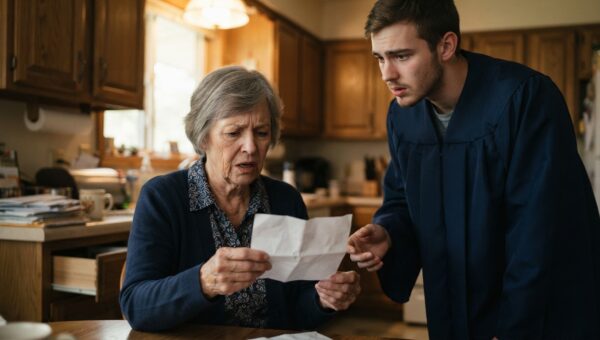
Her kitchen smelled like cinnamon tea and old paper. We sat across from each other at a small round table with a laminate top that had a cigarette burn near the edge. Evelyn didn’t waste any time beating around the bush. She slid a yellowed manila folder across the table toward me, its edges frayed from being opened and closed a thousand times over the decades. Inside were old black-and-white photographs of a young man with broad shoulders standing beside a 1970 Ford pickup truck, and a handwritten letter folded neatly into thirds on lined stationery with faded blue ink.
Our father was never a casual stranger, Evelyn told me softly, her eyes locked on mine as if she were trying to memorize every contour of my face to make sure I wasn’t a ghost. He was a young man torn between two obligations in the turbulent year of 1974. While he was already courting our mother and building a respectable future in the county seat, he had formed a deep, quiet bond with Evelyn’s mother, Clara, resulting in two pregnancies running parallel just months apart. When he finally chose to marry my mother and settle into the conventional life that everyone expected of him, he made a bitter, final pact with Clara to provide discreet financial support through a third party while erasing her from his daily existence entirely.
Neither woman knew the other was fully aware of the arrangement, Evelyn explained, tapping her index finger gently against the corner of the faded letter. My mother kept her distance because she had given her word and taken his money to keep the peace, but she never stopped loving him, and she never stopped telling me that my father was a good man who simply made an impossible choice. She left me this folder before she passed away last winter, she added, her voice dropping to a near whisper. She told me that one day the truth would find its way out of the dark, because secrets that heavy always demand to be carried into the light eventually.
I sat there at that laminate kitchen table for nearly two hours, reading the letters, looking at the dates, and watching the way Evelyn tucked her hair behind her left ear exactly the way I did whenever I was trying to solve a hard math problem. Every piece of the puzzle clicked into place with a sickening, undeniable weight. The reason my father was always so careful about who he talked to in town, the reason my mother guarded our family’s reputation like a fortress against an invading army, and the sudden, blind panic when a twenty-dollar DNA kit tore down a wall they had spent fifty years reinforcing with mortar and silence.
I didn’t stay at Evelyn’s house forever. When I finally stood up to leave, we didn’t hug, because we were still strangers in spite of the blood running through our veins, but we exchanged phone numbers with fingers that were a little steadier than they had been that morning. I drove back up north toward my parents’ house with the manila folder resting on the passenger seat like a live grenade. The sun was dipping low behind the telephone poles, casting long, bruised shadows across the asphalt as I pulled into my parents’ driveway right behind my father’s old gray sedan.
I walked through the front door without knocking, just like I had done every Sunday of my life. The house smelled like roast beef and floor wax, that familiar, unchanging scent of my childhood that suddenly didn’t feel safe anymore. My mother was standing by the kitchen counter with her arms crossed tight over her chest, and my father was sitting in his usual armchair by the radiator, his hands resting heavily on his knees, looking older and smaller than he ever had before. They both looked up the second the front door clicked shut behind me.
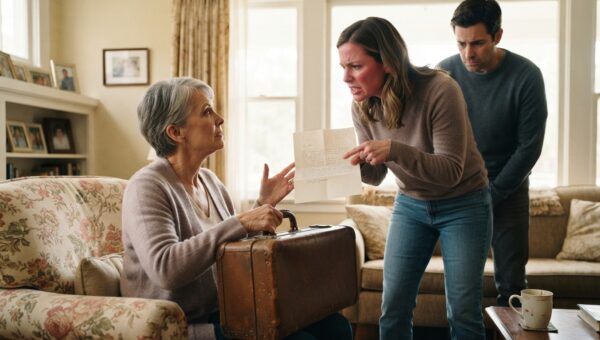
I didn’t yell, and I didn’t throw the folder at them. I walked into the living room, pulled the manila envelope out of my tote bag, and laid it right on the coffee table between my father’s worn leather slippers and the small stack of gardening magazines my mother kept neatly squared away. Evelyn knows everything, I said, my voice cutting through the quiet of the room like a knife. My mother opened her mouth as if she wanted to scream or deny it all over again, but the words caught in her throat when she looked at my face and saw the exact same stubborn expression she had been trying to suppress for half a century.
My father didn’t look at the folder. He slowly raised his head, his tired old eyes welling up with tears that he didn’t bother to wipe away with his sleeve. He looked back and forth between me and the empty space beside my chair, the heavy silence of a fifty-year secret finally collapsing under its own weight. He didn’t offer an excuse, and he didn’t try to lie. He just let out a long, shuddering breath that sounded like a sigh of profound, exhausted relief.
We didn’t fix everything that evening, and fifty years of carefully constructed lies don’t vanish just because someone finally speaks the truth out loud in a living room with floral wallpaper. But the wall is gone, and the silence has been broken for good. Two coffee mugs now rest side by side on the kitchen table of the family home, their identical silver spoons catching the afternoon light as my father sits quietly between his two daughters, finally speaking our names in the same breath.