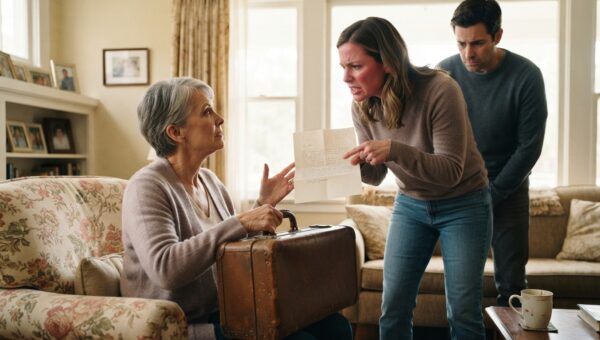
The sound of Arthur’s keys hitting the kitchen counter was never supposed to sound like a warning. It was just a heavy brass ring with three teeth on it and a faded red fob from the hardware store down on Elm, but when he dropped it that Tuesday evening around 5:15, the metal clinked against the granite tile with a sharp, ugly crack that made me stop wiping down the faucet.
He didn’t take off his coat. He stood right there in his work jacket, his shoulders squared up the way they got whenever he was carrying someone else’s trouble and needed to drop it on me to feel balanced.
“My mom has been crying all day,” he snapped, his voice tight enough to cut glass. “What did your mother say to her? I know she came over yesterday.”
I was standing by the sink with a gray dish rag in my hand, and for a second my brain just refused to match his words with anything real. I set the rag down on the edge of the basin.
“My mom?” I said, wiping my palms on my jeans. “I have no idea. What are you talking about?”
Arthur let out a short, rough breath through his nose, the way he always did when he thought I was dodging. He pulled his phone out of his pocket, his thumb swiping hard across the screen like he was trying to punch through the glass.
“She’s been sitting at her kitchen table since noon,” he said, staring me down. “Call her right now. Put her on speaker so I can hear what kind of mess she started.”
I didn’t yell. I didn’t cross my arms or get defensive the way I used to back when we were first married and every argument felt like a trial we both had to win. I just looked at him, at the little crease between his eyebrows that looked exactly like his father’s, and I reached for my phone on the charger next to the microwave.
My fingers felt cold against the plastic. I tapped my mother’s contact, saved as Mom with a small heart next to it that I hadn’t updated since 2018, and hit speaker before pressing it to my ear.
It rang twice before she picked up. Her voice was steady, too steady, coming through the little tinny speaker with that familiar background hum of her kitchen refrigerator.
“Hello?”
Arthur took two steps closer to the island, leaning over it until his face was six inches from the phone.
“Mom, what happened?” I asked, my voice dropping an octave because I already hated the feeling settling in my stomach. “Why is my mother-in-law so upset?”
There was a tiny pause on the other end, just long enough for me to hear her take a slow breath. Then she answered with a calm that chilled me right down to my toes.
“I only told her the truth.”
My stomach tightened into a hard, painful knot. “What truth?”
Arthur let out a harsh sound, half a laugh, half a scoff, waiting for me to catch him when he fell.
There was another brief silence on the line before my mother replied, her tone completely level. “I told her she has no right to be in my grandson’s life if she’s going to spend every visit trying to turn him against his own mother.”
The room fell dead silent.
The hum of our refrigerator seemed to stop, or maybe I just stopped hearing it.
Arthur stared at me, the anger draining right out of his face, leaving him looking gray and hollowed out in the fluorescent light of the kitchen. His mouth stayed slightly open, his lips parted as if he wanted to shout something else but couldn’t find the gears to make it turn.
Then my mother quietly added, “And that’s not even the part that made her cry.”
My heart started racing against my ribs like a trapped bird as she continued. “She cried because I showed her proof that someone else already knows exactly what she’s been doing.”
Arthur finally found his voice, but it came out thin and cracked, nothing like the roar he brought through the front door five minutes ago. “Mom? Who else knows?”
My mother didn’t raise her voice. She just gave us the name. And the entire kitchen floor seemed to drop three inches beneath my feet.
For the last eight months, Leo had been coming home from his Tuesday and Thursday afternoons with Helen with strange little bruises on his spirit that I couldn’t quite name. He was six, old enough to repeat things he heard, young enough to believe that whatever an adult told him in a soft voice must be a law of nature.
“Grandma says you have to sleep a lot because your head hurts,” he had told me out of nowhere while we were putting away groceries three weeks ago.
“Does she?” I had asked, trying to keep my voice light while my thumb rubbed the side of a soup can.
“Yeah. And she said when she was my age, moms didn’t leave their kids with babysitters while they went to sit in offices.”
At the time, I told myself Helen was just an old woman romanticizing the fifties, forgetting the three part-time jobs she worked when Arthur was small. I blamed myself for being tired after a fifty-hour week at the clinic. I let it slide because family peace was something Arthur cared about with a desperate, heavy-handed loyalty that left no room for friction.
Every time I tried to mention that Helen’s visits felt a little too calculated, Arthur would look at me with that tired, patient expression and tell me I was reading too much into things.
“She’s old, Clara,” he’d say. “She just loves the boy. She doesn’t mean anything by it.”
So I kept my mouth shut. I smiled when Helen brought over casseroles we didn’t eat. I let her take Leo to the park on Thursday afternoons even though my chest tightened every time she buckled him into the back seat of her Buick. I told myself I was being paranoid, that mothers-in-law and daughters-in-law were just wired to rub each other raw.
I didn’t know about the tablet.
Neither did Arthur, apparently, until my mother laid it out on Helen’s floral tablecloth yesterday afternoon.
My mother had gone over there not to start a fight, but to drop off a Tupperware container of stew after Arthur mentioned Helen wasn’t feeling well. She found Helen sitting at the kitchen table with an old iPad propped up against a sugar bowl, typing furiously into a Notes app that happened to sync with the family Apple ID Helen shared with her daughter, Arthur’s estranged sister, Sarah, who lives three states away and hasn’t spoken to Helen in four years.
Sarah is the one who set up the family cloud account years ago and never took her mother off it, mostly because she forgot or didn’t care enough to untangle the digital web. When Helen started drafting her long, rambling entries detailing every perceived failure of mine as a mother, cataloging my work hours, my tone of voice, the nights we ate frozen pizza, and the exact phrases she was teaching Leo to repeat, the sync feature dutifully pushed every single word straight to Sarah’s iPad in Boise.
Sarah didn’t call Helen. She didn’t have the energy for a screaming match with a woman who hadn’t apologized for anything since 1994. Instead, Sarah took screenshots of the entire document, forty-two pages of meticulous, passive-aggressive plotting, and sent them directly to the person she knew would actually do something about it.
My mother.
My mother didn’t wait for Arthur to finish pacing the length of our kitchen island. She reached out and grabbed the printed packet sitting on her own dining table, right there within arm’s reach of the phone.
“Arthur,” my mother said through the speaker, her voice dropping into that tone she used when I was twelve and caught lying about where I’d gone after school. “You might want to sit down. Because your mother didn’t just write notes. She hired someone.”
Arthur didn’t sit down. He leaned his hands flat against the cold granite, his knuckles turning white as the blood rushed out of them.
“Hired who?” he breathed.
“A family counselor,” my mother said plainly. “Dr. Vance down on Oak Street. Helen brought Leo into his office three times last month under the guise of ‘play therapy’ to help him adjust to his mother working full-time. She paid out of pocket so she wouldn’t have to put it on your insurance. And Dr. Vance has a thick file of notes stating that grandmother was actively coaching the child to view his mother as an unstable, intermittent presence in his life.”
The kitchen went so quiet I could hear the faint hum of the electric clock on the microwave.
Arthur looked at me then, really looked at me, for the first time since he walked through the door. The defensive anger was completely gone, replaced by a sort of stunned, deer-in-the-headlights confusion that made him look ten years older.
“She took him to a therapist?” he whispered. “Without telling us?”
“Without telling *you*,” my mother corrected. “She knew damn well she couldn’t tell Clara. So she ran a three-month campaign behind your back, Arthur, and she thought she was clever enough to get away with it because you were too busy defending her to look at what was right in front of your face.”
I didn’t say a word. I let the phone sit there on the counter between us, its little green speaker light blinking softly in the dimming kitchen.
Arthur reached out, his hand trembling slightly, and picked up his own phone. He didn’t look at me. He dialed his mother’s number with three stiff stabs of his thumb, his jaw working as he waited for her to pick up.
“Mom,” he said the second she answered. His voice wasn’t angry anymore. It sounded dead. “Pack a bag. Or I’m coming over right now with the printed copies Sarah sent me.”
There was a muffled, weeping sound on the other end of the line, thin and reedy, before Helen hung up without saying a single word.
The next forty-eight hours didn’t look like a movie. There were no dramatic confrontations on front lawns, no broken plates, no grand speeches about forgiveness.
Arthur spent most of Wednesday sitting at the kitchen table with the forty-two pages of printed notes spread out around his coffee mug, reading every single line with a look of mounting sickness on his face. He didn’t try to defend her. He didn’t mention family harmony. Every time he turned a page, his shoulders seemed to sink a little lower, as if he were finally feeling the actual weight of the loyalty he’d been carrying for a woman who used it as a weapon.
“I didn’t know,” he said to me late that night while we sat in the dark living room with only the porch light filtering through the blinds. “Clara, I swear to God, I didn’t know she was doing that.”
“I know you didn’t,” I told him, my voice flat because I was too tired to be angry anymore. “You just wanted to believe she was a good grandma.”
“She’s not allowed near him alone again,” he said, and the way he said it had a finality to it that told me the argument was over before it started. “Not at her house, not at the park, not anywhere without one of us right there watching every word she says.”
We established the rules on Thursday morning. No unsupervised visits. Ever. If Helen wanted to see her grandson, she could do it at our kitchen table while one of us sat twenty feet away with a book. No more whispered conversations in the hallway. No more secret trips to professional offices.
When Helen came over on Saturday for her first supervised visit under the new agreement, she looked smaller than she had a week ago. Her gray hair was slightly out of place, and she walked up our front steps with her shoulders hunched inside her beige cardigan, carrying a small paper bag of cookies she must have baked herself because she didn’t trust me to feed the boy right.
Arthur met her at the door. He didn’t hug her. He didn’t invite her into the kitchen right away.
“Mom,” he said, his voice level and cold as winter stone. “The rules are on the table inside. If you break one of them, you won’t see Leo again until he’s eighteen and can make his own choices.”
Helen looked past him into the hallway, her eyes meeting mine for half a second before she looked down at the floorboards. She didn’t argue. She didn’t try to spin a story or play the victim the way she usually did. She just nodded once, tight and stiff, and stepped past us into the house.
I watched her walk into the living room where Leo was sitting on the rug building a tower out of wooden blocks. She sat down slowly on the edge of the sofa, her hands folded in her lap, and didn’t say a single word for the first ten minutes.
Later that afternoon, after she had finished her two hours and left without looking back, I stood by the front window and listened to the heavy click of the deadbolt sliding home.
Arthur came up behind me, his hand resting quietly on the small of my back, warm and steady through my shirt. Through the kitchen archway, I could hear Leo laughing at something silly on the television, his voice bright and clear and entirely unburdened by anything that had happened outside these walls.
We stood there together in the quiet hallway, neither of us saying a word, just watching the dust motes settle in the pale afternoon light as the front door locked shut behind her.