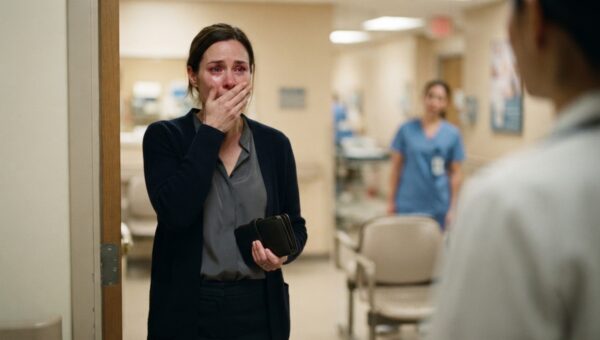
The plastic infusion bag hanging from the metal pole always looked entirely too small to hold the amount of cold liquid that was about to turn my veins to ice. I sat in the vinyl recliner at the outpatient clinic, staring at the little clear drop falling every two seconds. My left hand was wrapped in a heated blanket because the nurses said it kept the veins from collapsing, but the numbness always crept up past my wrist anyway.
When the nurse finished checking the drip rate and left me alone with the steady, mechanical hum of the machine, my mind went straight back to Buster.
Buster was a brindle terrier mix I had pulled out of a county shelter six months before the diagnosis hit. He had a notched ear and a ribcage you could play like a washboard when he first came home, but those physical things were easy to fix with a bag of grain-free kibble and a warm bed. The invisible parts were the ones that refused to mend. If a car backfired two blocks away, Buster would flatten himself against the hallway floorboards and shake until his teeth clicked. If I picked up my car keys too fast, he would retreat under the kitchen table and refuse to come out for hours.
The chemotherapy made it impossible to walk him. My legs felt like dry pine kindling after the first round, and the nausea sat behind my eyes like a lead weight that refused to shift.
I needed someone to take him out, even just around the block, so he wouldn’t go stir-crazy while I spent my afternoons throwing up into a plastic bucket.
I put a handwritten index card up on the bulletin board outside the student union at the community college down on Main Street, offering fifteen dollars an hour to anyone willing to handle a dog who was scared of his own shadow.
Julian showed up on a Tuesday morning at 9:00 sharp, wearing a faded canvas backpack and sneakers with duct tape across the toes. He wasn’t much older than nineteen, with sandy hair that fell into his eyes and a quiet way of standing that didn’t demand anything from you. I handed him the heavy nylon leash and a pouch of dried liver treats.
“He’s a bit high-strung,” I told him, leaning against the screen door for support. “If he balks at the driveway, just give the leash a firm tug and keep moving. He has to learn to get over it.”
Julian took the leash, looped it twice around his wrist with practiced ease, and gave me a small, polite nod. “Yes, ma’am. I’ll get him moving.”
They made it about twenty feet down the sidewalk before Buster planted his paws. I watched from the living room window, pressing my forehead against the cool glass. Buster dropped his belly right down onto the hot concrete, his tail tucked tight between his hind legs, ears pinned flat against his skull.
In the old days, that was when I would lose my temper or start coaxing him with high-pitched baby talk that only made him more suspicious. I waited for Julian to yank the leash. I waited for him to get frustrated with a stubborn animal who wouldn’t cooperate on his very first day on the payroll.
Instead, Julian just stopped. He stood there for a second, looking down at the shaking dog.
Then he unslung the heavy canvas backpack from his shoulders, let it drop to the grass, and sat right down beside Buster on the sun-baked sidewalk. He didn’t pull. He didn’t scold. He reached into the bag, pulled out a thick paperback book with a cracked spine, and opened it to a dog-eared page.
I couldn’t hear the words through the double-paned glass, but I saw the rhythmic movement of his jaw. He sat there in the middle of a Tuesday morning, reading out loud to a terrified terrier who was staring up at him with wide, white-rimmed eyes.
Three weeks later. The routine had settled into something I almost looked forward to, even on the mornings when the chemo made my teeth ache. Julian would arrive, clip the leash to Buster’s harness, and head out the front door. I would usually be sitting on the porch swing with a glass of lukewarm water and a lemon drop to keep the metallic taste in my mouth at bay.
Most days, they didn’t even make it past the big oak tree at the edge of the yard before Buster would hit the brakes. And every single time, Julian would drop his bag in the grass, sit down cross-legged, and pull out his book. Sometimes it was history. Sometimes it was old-fashioned fiction with yellowed pages. But his voice always had the same low, steady cadence that seemed to pull the panic right out of the air.
I watched Buster’s breathing slow down after about ten minutes of reading. The rigid bow in the dog’s back would soften, and he would let out a long, shuddering sigh that I could hear from the porch. Then he would inch closer to Julian’s knee, pressing his wet black nose against the boy’s jeans until Julian reached down to scratch behind his ears without ever looking up from the page.
One afternoon, the sun was sitting heavy and hot right on top of the porch railing. My stomach was doing flip-flops from the morning dose, and I felt hollowed out, like an old barn left out in the weather too long. Julian and Buster were stationed about ten feet from the front steps, deep in chapter four of whatever paperback he was hauling around that week.
I pushed myself up from the swing, my joints popping like dry twigs, and walked down the steps. I didn’t want him wasting his whole hour sitting in the dirt if my dog was going to be a stubborn mess every single day.
“You don’t have to sit out here the whole time if he refuses to walk, Julian,” I said, my voice raspy from lack of use. “I’m paying you to move him, not to read him bedtime stories in the middle of traffic.”
Julian closed the book with a soft thump, marking his place with a folded receipt from the hardware store. He looked up at me, squinting against the bright glare off the white siding. He didn’t look defensive or embarrassed. His eyes had that flat, old look that usually belongs to people who have lived through things they shouldn’t have had to talk about.
He smiled gently and reached out one long, tanned finger to scratch behind Buster’s ears. The dog leaned right into the palm of his hand, his eyes half-closed in total trust.
“When I was in foster care, the only time I felt safe was when someone sat with me and read to me,” he said, his voice dropping so low I had to strain to catch it over the sound of a distant lawnmower. “He’s not being difficult, ma’am. He’s just scared of being left behind again.”
The words hit me right in the chest, knocking the wind out of me just as surely as the oncologist’s report had six months ago. I stood there on the hot concrete, my fingers digging into the wooden railing because my knees suddenly forgot how to support my weight. I thought about the three different group homes Julian had bounced through before he aged out at eighteen, according to the brief chat we had when I first hired him. I thought about Buster sitting in a concrete cage at the shelter, waiting for a family that kept walking past his run.
I didn’t say anything back to him for a long, quiet minute. There wasn’t anything that fit. The silence between us didn’t feel awkward; it felt heavy and true, like the space inside an old church after the service has let out.
“What book is that?” I asked finally, pointing a shaky finger at the paperback in his lap.
Julian looked down at the cover, his thumb tracing the worn cardboard edge. “Just some old Steinbeck. My social worker gave it to me back in junior high. I’ve read it about four times.”
I let out a breath that sounded half like a laugh and half like a sob. “Well. My living room is air-conditioned, and I’ve got a fresh pitcher of iced tea in the fridge if you’re not in a rush to get back to campus.”
Julian looked down at Buster, then back up at me, and a slow, easy grin spread across his face. “I think we can take a little break for chapter five.”
That afternoon marked a turning point in the house, though nothing dramatic changed on the surface. The chemo treatments kept coming every Tuesday, and I kept losing clumps of hair in the shower every morning, but the dread lost its sharpest edge. Julian started coming an hour early, before the walks, just to sit on the front porch with me and read out loud while Buster dozed between our chairs.
By the time my final round of blood work came back clear enough for the doctor to use the word remission, Buster was walking a full mile down to the creek and back without stopping once. He still checked over his shoulder every few minutes to make sure we were right behind him, but the panic was gone, replaced by a steady, quiet rhythm that carried us all through the worst of it.
Julian stayed on as our regular walker even after my strength came back and I could handle the leash myself. We never talked much about his past after that one afternoon by the steps, and he never asked me about the gray circles under my eyes or the scarves I wore to cover my bald head. We didn’t need to.
An afternoon sunlight filtered through the maple tree onto the front lawn, where Buster rests his chin on Julian’s knee while the soft murmur of a turned book page drifts up to the porch.