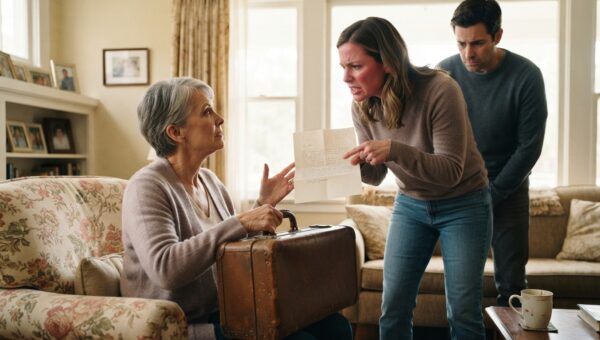
4,380 days. That was the exact count of how long I had kept my heart bolted shut against my sister Clara. Twelve years, three months, and four days since I walked through the front door of my Marietta house and found her standing in the hallway with my husband, both of them looking like ghosts who had been caught trespassing.
I cut them out of my life like a rotting limb that same afternoon. I packed his bags in Hefty garbage sacks and threw them onto the damp asphalt of the driveway, and as for Clara, I simply erased her. I never said her name again. When our mother brought her up during Sunday dinner three years later, I picked up my plate and walked out to my car without a word, and nobody ever brought her up to me a second time. I skipped her birthdays, her drifting through town, whatever small jobs she took at the local diners or dry cleaners, keeping my blinders firmly in place so I could survive the humiliation of it all.
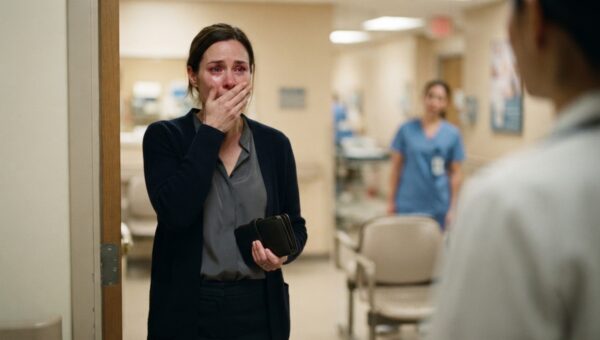
Last month Clara died in a charity ward giving birth to a little girl she had no business having alone. My cousin Sarah called me from the hospital parking lot, her voice shaking so hard she could barely form the words, begging me to drive down to the county seat for the service.
I didn’t even take my coat off when I heard her out. I told her flat, right through the receiver: ‘She’s been dead to me for twelve years, Sarah. I’m not going to start grieving her now.’ And I meant every word of it. I meant it with every fiber of my stubborn, bruised soul. I sat in my armchair that evening watching the local news with my tea, feeling nothing at all except the mild, familiar friction of an old scab staying right where it belonged.
I meant it right up until 8:15 the next morning when the desk phone rang and a woman with a flat, clinical hospital-register voice asked for my date of birth. They had a question about the baby. A simple question, the kind you answer without thinking when you are half-awake and stirring sugar into your chicory. Except the answer they needed from me, a thing Clara had put in writing on a witnessed legal form three days before her heart gave out, didn’t line up with a single thing I had believed for twelve years.
When the woman on the other end of the line finished the sentence about who had legal custody of the infant, the heavy ceramic coffee cup slid right out of my hand and shattered against the linoleum, because she didn’t call me Clara’s estranged sister. She called me the designated guardian of record.
I stood there in the spreading puddle of brown liquid, my socks soaking through, staring down at the broken handle of the mug I had bought at the Covington county fair back in ninety-eight. My brain didn’t want to receive the signal. The nurse on the phone kept talking, her voice tinny and distant through the speakerphone function, asking if I could drive down to regional intake before noon to sign the release paperwork. I told her I couldn’t. I told her she had the wrong person, that Clara had an ex-husband somewhere out in Texas, or at least a boyfriend she had been running with for the last five years. ‘No, ma’am,’ the nurse said, her patience wearing thin around the edges like old flannel. ‘The patient left a sealed envelope marked solely for your legal name, along with a notarized declaration dated last Tuesday.
She named you specifically. Said you were the only person she trusted not to lie to a child.’
I drove down Highway 41 with both hands clamped so hard on the steering wheel of my pickup truck my knuckles looked like peeled turnips. The sky over Cobb County had that flat, bruised gray look it gets right before a November storm drops freezing rain on the windshield, and every mile marker felt like a nail being driven into a coffin I thought I had buried a decade ago. I kept seeing Clara as she looked when we were girls sharing that narrow upstairs bedroom on Elm Street, her hair braided into two crooked tails while she stole pieces of saltine cracker from my box. I kept trying to lay that picture over the woman who had broken my marriage wide open on a Tuesday afternoon in 2012, but the two images wouldn’t stitch together no matter how hard I forced them.
The intake office at the county medical center smelled of floor wax and old radiator heat. A young social worker named Mr. Henderson met me by the double doors with a manila folder tucked under his arm like a Bible. He didn’t look at me with pity, which I suppose I was bracing for; he just looked tired, the way people look when they have spent thirty years cleaning up other people’s wrecked lives. He led me back to a small consultation room with yellow walls and a single plastic chair facing a scarred oak table. He laid the manila envelope down between us without a word. The handwriting across the front was unmistakably Clara’s, though the letters were cramped and shaky, written with a pen that looked like it was running out of ink.
‘She didn’t want us to contact the father,’ Mr. Henderson said softly, keeping his hands flat on the table. ‘According to the birth registry and her advance directives, there is no legal father listed. She had a lawyer draw up the permanent guardianship transfer three days before the delivery because her blood pressure was spiking and she knew she wasn’t coming home.’
I didn’t touch the envelope right away. I just stared at the return flap where she had written my married name, the one I kept even after the divorce because changing it back felt like too much trouble. ‘She had a choice,’ I muttered, my voice sounding harsh and thin in the small room. ‘She made her bed twelve years ago when she walked out of my house with my husband.’
Mr. Henderson tilted his head, his glasses slipping slightly down his nose. ‘Did she?’ he asked. It wasn’t an accusation; it was just a question hanging in the air between us like dust motes in a beam of greasy sunlight. He stood up, muttered something about checking on the paperwork at the front desk, and left me alone with the envelope.
The silence in that room was heavier than the silence I had lived with in my empty house for twelve years. My fingers were shaking so badly I had to use the corner of my driver’s license to slice open the paper flap. Inside wasn’t just a legal form. It was three folded sheets of yellow legal pad paper, covered front and back in that familiar, spidery handwriting that used to help me with my algebra homework when Daddy was working late at the lumber mill.
I unfolded the top sheet and started reading under the harsh hum of the fluorescent tube overhead.
* * *
*Dear Sarah,* it began, though she had crossed out Sarah and written *Mary* instead, her pen digging so hard into the pulp it tore a small hole in the margin. *If you are reading this, the doctors were right and I didn’t bounce back this time. I know you never wanted to lay eyes on me again, and God knows you had every right to feel that way after what you walked into that afternoon in Marietta. I let you believe the worst because telling you the truth back then would have broken something worse than your heart. Greg didn’t just come on to me, Mary. He had gotten hold of those old promissory notes Daddy signed for the tractor repair shop before he passed away. He bought the debt from the bank in Atlanta, and he told me that if I didn’t let you catch us, if I didn’t play the part of the willing home-wrecker and drive you out of that house so he could force a quick sale on the equity, he was going to turn the notes over to a collection agency and put Mama and Daddy’s name in the public ledger for bankruptcy.*
My eyes stalled on the words, refusing to track across the lines. *That’s a lie,* I whispered to the empty yellow walls. *That’s just a lie she made up to make herself feel better.* But my hands wouldn’t stop trembling. I forced my eyes back down to the paper, my breath catching in my throat like a dry bone.
*He swore to me he would take care of you after the split, that you’d get the house clear and free once the quick-claim went through, but he lied about that too as soon as you were gone. He packed up and headed west six months later with some woman from the credit union. I stayed away because I was poison to you, Mary. I lived in that little room over the hardware store in Cedartown for nine years because every time I looked in the mirror, I saw the sister who wrecked your life to save a piece of scrap paper with Daddy’s signature on it. I never wanted him. I hated the smell of his tobacco and the way he looked at you when you weren’t looking. When I found out about the baby last spring, I knew I couldn’t leave her to the state, and I knew I couldn’t raise her right on what I make folding sheets at the motel.
You were always the strong one. You were always the one who knew how to keep a roof from leaking when the rain came down sideways. Please take care of her. Her name is Clara Jr., but I called her Lily. Don’t let her grow up thinking she was an accident of a bad season. Tell her her auntie has a good heart, even if it took twelve years to thaw out.*
The paper slipped from my fingers and drifted down onto the scuffed vinyl floor like a dead leaf. My chest felt hollowed out, scooped clean with a dull spoon. All those years I had spent nursing my hatred like a prize heifer, keeping it fed on bitterness and old grievances, thinking I was the righteous victim in a tragic play. And all the while Clara had been living in a small, damp room over a hardware store thirty miles down the road, eating her own shame in the dark so my dead parents’ name wouldn’t be dragged through the mud in the county gazette. She didn’t betray me out of spite or cheap desire; she had fallen on the sword so I could keep my clean dignity intact while she took the blade alone.
Mr. Henderson opened the door softly, poking his head into the room. ‘You alright in here, Mrs. Vance?’ he asked, his eyes dropping to the yellow pages scattered at my feet.
I didn’t answer right away. I reached down, my joints popping in the quiet room, and gathered the sheets together, smoothing them against my knee with a palm that wouldn’t steady itself. ‘Where is she?’ I asked, my voice cracking on the third word until it sounded like gravel sliding down a chute.
‘Nursery bay three,’ he said gently. ‘She’s sleeping. Formula-fed, strong lungs, about six pounds four ounces. The pediatrician cleared her for discharge an hour ago.’
He walked over to the desk and laid a clipboard with a thick stack of blue carbon-copy forms in front of me, placing a ballpoint pen right beside the signature line. I didn’t look at the small print about liability or state oversight. I didn’t care about the mortgage or the Marietta house or what the neighbors down the road would say when they saw a crib being carried up my front steps for the first time in twelve years. I just picked up the pen, wrote my name across the bottom line with the same steady, stubborn hand our father had taught me to use when I was ten years old, and walked down the linoleum-floored hallway toward the back of the ward where the nursery lights were burning low against the gray November afternoon.
They brought her out to me wrapped in a coarse flannel blanket that smelled of hospital bleach and mild baby soap. She didn’t look like Clara, and she didn’t look like Greg; she just looked small, her little red face scrunched up against the light as she yawned and curled her tiny fingers into a fist no bigger than a peach pit. I tucked her inside my heavy wool coat, buttoning the top button right up under my chin to keep the draft out, and carried her out through the sliding glass doors of the county hospital without looking back once.
The sun was already dipping below the tree line when I pulled my truck back into the gravel drive of my Marietta house. The porch light was off, casting long, dark shadows across the boards where I had stood twelve years ago and thrown my husband’s bags into the dirt. I carried the baby up the steps, her warm weight resting against my ribs like a live coal against the cold. When I unlocked the front door and stepped inside, the house smelled of old cedar and the faint, sweet scent of talcum powder rising from my coat.
I stood in the center of the living room where the coffee cup had shattered that very morning, the brown stain still dark and wet near the base of the radiator, and I pulled the blanket back just enough to see her breathing. The twelve-year silence didn’t vanish all at once; it hung around the edges of the room like fog settling over the pasture after a hard freeze. But as I settled into the old armchair by the front window and pulled the afghan over my knees, the house felt less empty than it had in a very long time.